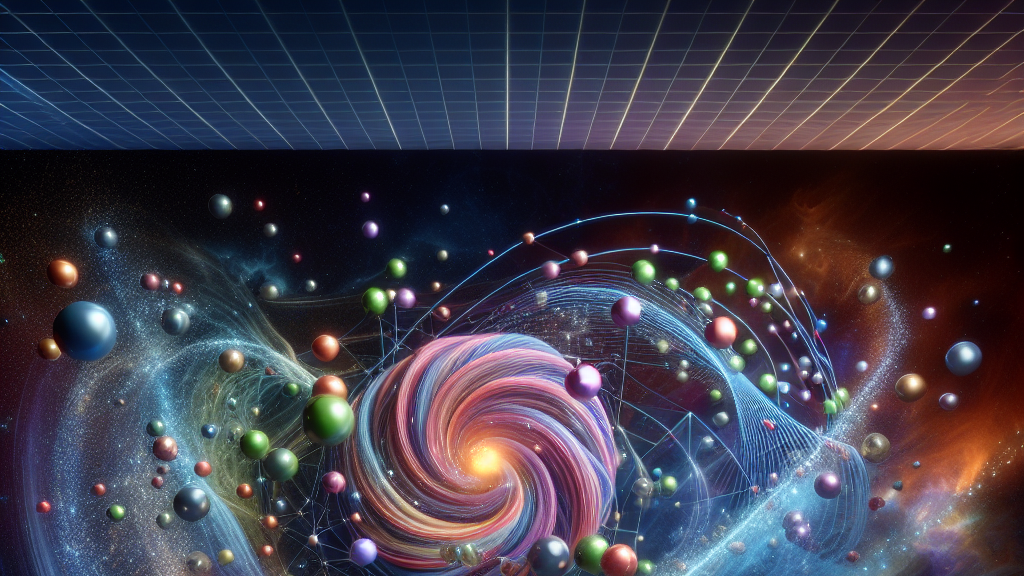
Imagine flipping a switch and revealing a hidden light. That’s the kind of mystery and wonder that scientists are exploring by studying light’s hidden potential in microwaves. This type of light transition, from dark to shining brightly without any external push, could reshape our understanding of how light interacts at a quantum level.
In a microwave chamber teeming with special polar molecules, researchers found that light could switch from being almost invisible to incredibly bright on its own. This occurs because of a delicate dance between attraction and repulsion forces among the molecules. When these forces compete just right, they can create a variety of weird and wonderful quantum patterns, like tiny whirlpools of light or a stunning glow.
In the future, this newfound ability to control light might lead to revolutionary tech that uses less energy or even creates new visual experiences. Think of virtual reality worlds with lights that move and change in real-time, or energy-efficient displays that are clearer and more vibrant than anything we’ve seen before. The possibilities are as endless as the light itself.
Did you know that some types of light can self-organize into vortex-like patterns without any external assistance?
FAQs
What is superradiance, and how does it relate to light phenomena?
Superradiance refers to a bright burst of light emissions when particles, like molecules, align and emit light in unison. In this study, it reveals new behaviors of light in microwaves.
How do polar molecules affect light in a microwave setting?
Polar molecules in a microwave setting can change the way light behaves, creating variable quantum states that shift light from invisible to radiant, depending on the forces at play.
What are the potential applications of understanding light phase transitions?
By mastering light phase transitions, we could develop more energy-efficient lighting, enhance visual displays, and even improve technologies involving light manipulation in quantum computing.
Background
In the world of physics, superradiance is when a group of particles, like atoms or molecules, emit light together in a synchronized and enhanced manner, creating a very bright flash. This study explores how superradiance can change based on unique interactions in a microwave environment, particularly when using polar molecules that possess different charge distributions. These interactions can create a range of unexpected and exciting light behaviors.
History
Superradiance has been studied since the mid-20th century, primarily in the context of understanding how particles emit light collectively. Recent research has delved into how different environmental conditions, such as the presence of polar molecules and specialized cavities, can drastically alter these light emissions. This study pushes the boundaries of traditional superradiance theories by showing how other forces, like dipole interactions, bring unique quantum phenomena to life.
Based on “Dark Superradiance in Cavity-Coupled Polar Molecular Bose-Einstein Condensates” by Yuqi Wang, Su Yi, Yuangang Deng, available on arXiv (arxiv.org/abs/2504.18125), used under CC BY 4.0 (creativecommons.org/licenses/by/4.0/).