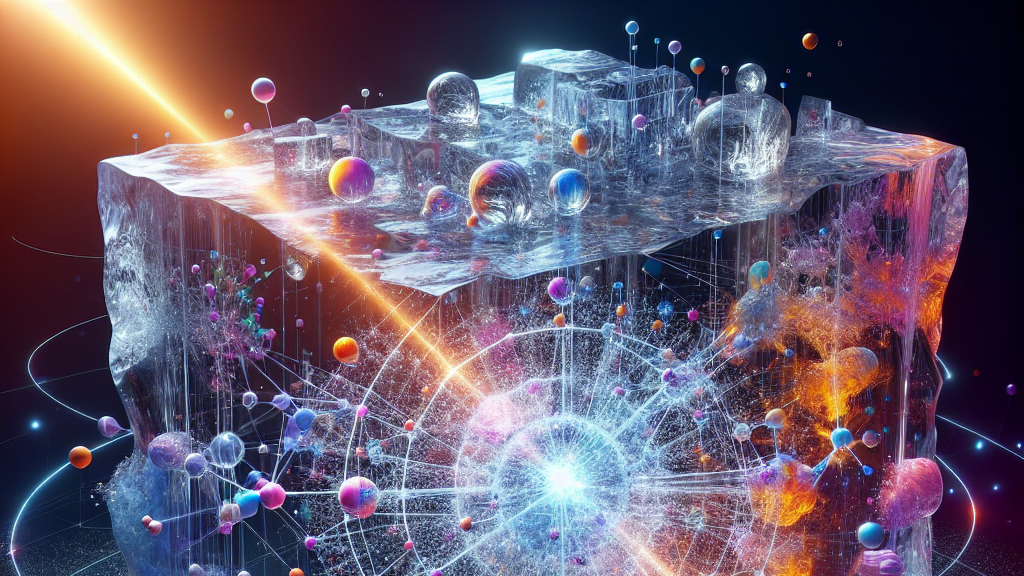
Imagine a world where ice is not just a frozen block but a dynamic playground for molecules when exposed to light. That’s exactly what researchers have uncovered as they explored how UV light sparks chemical reactions inside ice, creating molecules that could shape everything from our planet’s climate to the makeup of distant moons.
By using advanced computer models, scientists dug deep into the behavior of ice when it absorbs UV light. They found that these light-driven reactions lead to the creation of new molecules like hydronium ions and hydroxyl radicals. Intriguingly, the presence of imperfections or ‘defects’ in the ice plays a crucial role in how these reactions unfold, making the behavior of ice far more complex and fascinating than we ever imagined.
This research has huge implications for our understanding of natural processes. For example, in the future, scientists might be able to harness this knowledge to better predict climate changes by studying ice in polar regions, or even unlock secrets about how life might exist on icy planets and moons. Who knew ice could reveal such cosmic and earthly secrets just by catching some rays?
Light can transform ice into tiny chemical factories, producing new molecules previously unseen in such frozen environments.
FAQs
How does UV light affect molecules in ice?
UV light absorption in ice can trigger chemical reactions, forming new molecules like hydronium ions and hydroxyl radicals, which are key to many environmental and astrophysical processes.
Why are defects in ice important for UV reactions?
Defects in ice, like vacancies and existing molecules, influence how light-driven reactions occur, affecting the formation of molecules and their stability.
What role could this ice research play in understanding climate change?
This study helps us understand how ice interacts with light, which could provide insights into natural phenomena like ice melting patterns and atmospheric reactions, essential for climate predictions.
Are there implications of this research beyond Earth?
Yes, the findings could explain processes on icy bodies in space, shedding light on how similar cosmic environments might support chemical reactions essential for life.
What makes this discovery about ice different from previous studies?
This research provides a detailed look at the molecular level of ice reactions with light, highlighting the significant role of defects, which was not fully understood before.
Background
Understanding how light interacts with matter is crucial in various scientific fields. When light hits a substance, it can excite molecules, causing them to react and form new compounds. This process is especially intriguing in ice, which is abundant in nature and space. Defects in the crystalline structure of ice, like vacancies or previously formed molecules, can alter how these reactions happen, making it a complex and exciting topic of study.
History
The study of how light affects ice dates back to early investigations of polar regions and space environments. Scientists have long known that light can alter ice, but this research builds on those foundational studies by applying advanced computational techniques to explore the detailed mechanisms behind these transformations. This deeper understanding challenges previous assumptions and opens new avenues for research in environmental science and astrophysics.
Based on “Defects at Play: Shaping the Photophysics and Photochemistry of Ice” by Marta Monti, Yu Jin, Gonzalo Díaz Mirón, Arpan Kundu, Marco Govoni, Giulia Galli, Ali Hassanali, available on arXiv (arxiv.org/abs/2506.16568), used under CC BY 4.0 (creativecommons.org/licenses/by/4.0/).