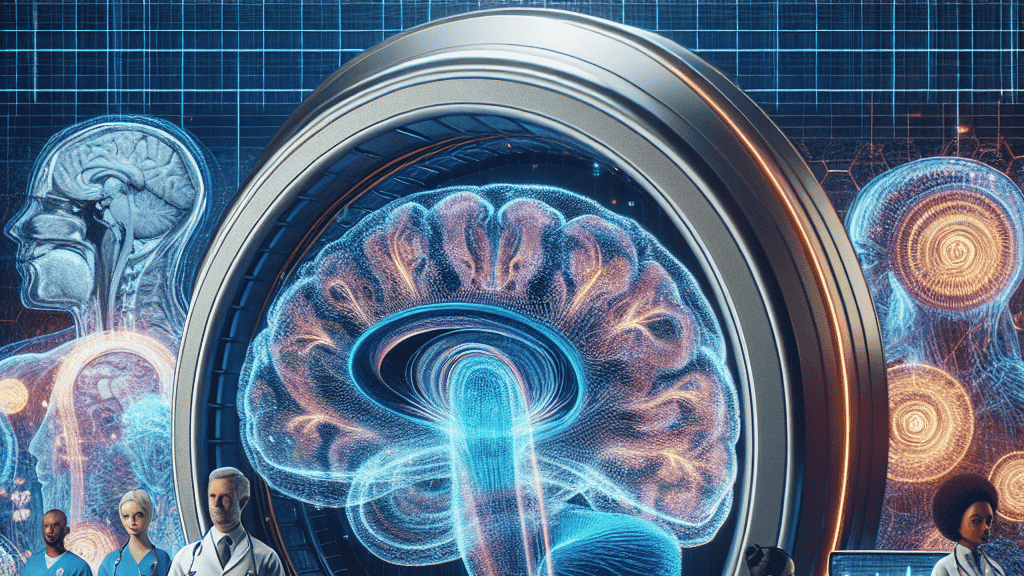
Imagine a world where doctors no longer have to rely solely on traditional scans to diagnose a stroke. In this future, a device uses electrical signals to non-invasively peek inside your brain and help doctors make life-saving decisions in an instant. This isn’t just a sci-fi fantasy; researchers are pioneering a way to use Electrical Impedance Tomography (EIT) combined with machine learning to achieve just that.
This new approach focuses on using Virtual Hybrid Edge Detection (VHED) functions, which are specifically designed to handle real-world noise and complexities instead of just relying on raw voltage data from EIT. By creating virtual patients with realistic models and simulating strokes, scientists have shown that VHED functions, when used as inputs for machine learning algorithms, can significantly enhance the accuracy of stroke detection. This is a game-changer because it means more reliable and swift diagnostics, even in imperfect conditions.
In the future, such technology could revolutionize emergency medical care. Imagine a portable device that paramedics could use right in the ambulance, providing doctors with instant insights into a patient’s brain health before they even arrive at the hospital. This could lead to faster treatments and better outcomes for stroke patients, potentially reducing the brain damage caused by delayed treatment.
Did you know? This new EIT tech isn’t just for labs—one day, it could fit in an ambulance!
FAQs
How does Electrical Impedance Tomography improve stroke detection?
Electrical Impedance Tomography (EIT) enhances stroke detection by using electrical signals to create images of the brain, allowing for non-invasive, detailed insights that can swiftly identify different types of strokes.
What makes Virtual Hybrid Edge Detection functions special?
Virtual Hybrid Edge Detection (VHED) functions are special because they process EIT data in a way that’s more resilient to noise and real-world complexities, offering more reliable inputs for machine learning algorithms in stroke classification.
Why is using VHED functions better than raw data?
Using VHED functions is superior to raw data because they maintain high accuracy in noisy conditions, ensuring that critical stroke classification information is not lost or distorted during analysis.
What are virtual patients in medical research?
In medical research, virtual patients are simulated models that mimic real human features and conditions, allowing researchers to test diagnostic methods and treatments in a controlled, repeatable manner.
How could this research impact emergency medical treatments?
This research could drastically improve emergency medical response by equipping paramedics with portable EIT devices, enabling rapid diagnosis and treatment of stroke patients, potentially saving lives and reducing long-term brain damage.
Background
Electrical Impedance Tomography (EIT) is an imaging technique that utilizes electrical currents to map the conductivity of a body. It’s like seeing inside someone without a single cut. Typically, researchers capture voltage data and interpret it to spot different body conditions. In stroke diagnostics, identifying conductivity differences can signal the presence of either hemorrhagic (bleeding) or ischemic (blockage) strokes. However, noise and data complexity can obscure these readings. Enter Virtual Hybrid Edge Detection (VHED) functions—a methodology focusing on clear, noise-resistant data interpretation, boosting accuracy even in less-than-perfect settings.
History
EIT has been around for a few decades, initially explored for applications like breast cancer detection and lung monitoring. It involves the challenge of interpreting electrical signals through complex tissue structures. With evolving machine learning techniques, the effectiveness of EIT in medical diagnostics has improved significantly. This study builds on recent advances, like the use of VHED, to mitigate noise issues and enhance interpretive clarity, particularly in the nuanced arena of stroke detection.
Based on “Stroke classification using Virtual Hybrid Edge Detection from in silico electrical impedance tomography data” by Juan Pablo Agnelli, Fernando S. Moura, Siiri Rautio, Melody Alsaker, Rashmi Murthy, Matti Lassas, Samuli Siltanen, available on arXiv (arxiv.org/abs/2501.14704), used under CC BY 4.0 (creativecommons.org/licenses/by/4.0/).