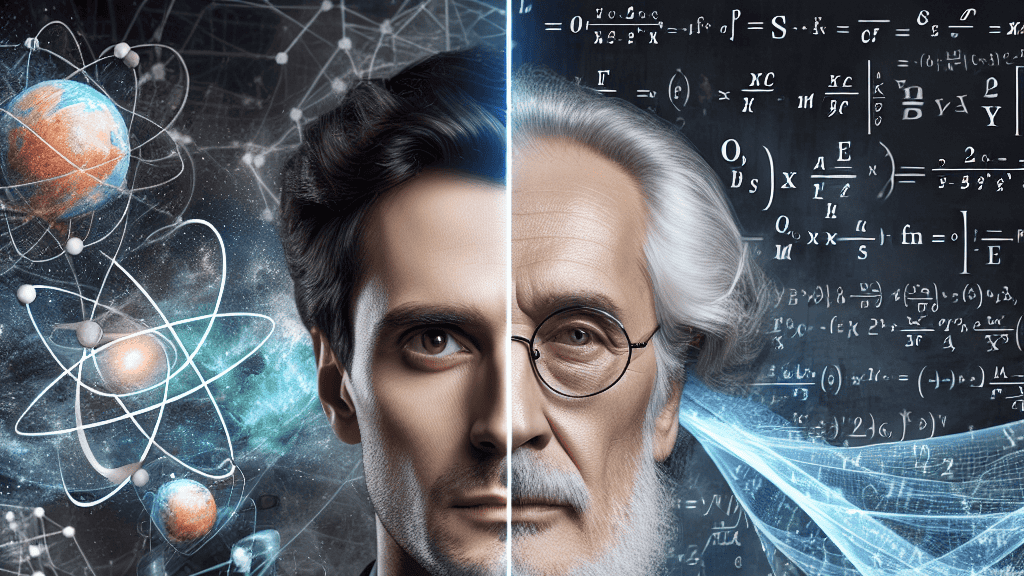
Did you know that the brilliant ideas of two award-winning scientists could be quietly making your life easier every day? Nobel Prize winner Giorgio Parisi and Abel Prize winner Michel Talagrand have tackled some of the most complex issues in algorithms and computation. Even if you haven’t heard their names before, their work is behind the scenes in many tech features you enjoy today. Their research is all about optimizing randomness to make algorithms faster—fancy talk for making computers do things quicker and smarter.
Parisi’s discoveries about disorder and fluctuations in physical systems have changed how scientists think about solving problems involving randomness. His work, built on pure physics intuition, was later confirmed by Talagrand using advanced mathematics. These insights are now key to knowing which optimization problems can benefit from fast algorithms, helping in areas like sorting data or scheduling tasks. Imagine trying to find the quickest route for a delivery truck among hundreds of destinations—that’s the kind of problem their research helps solve efficiently.
Why does this matter? Faster algorithms mean quicker search results, smoother streaming, and more efficient apps. Imagine waiting less time for your favorite show to load or having more accurate directions from your navigation app. As technology evolves, Parisi and Talagrand’s work ensures that behind-the-scenes processes keep up, making everyday digital interactions seamless and hassle-free. Their breakthroughs might not be front-page news, but they certainly make a difference in our tech-driven lives.
The insights from Parisi and Talagrand help in designing algorithms that can make decision-making processes up to 10 times faster!
FAQs
How have Parisi and Talagrand’s contributions impacted optimization problems?
Their groundbreaking ideas have helped in understanding which optimization problems can be solved quickly versus those that remain challenging, potentially speeding up tasks from internet searches to large-scale data processes.
What is the significance of connecting physics with algorithms?
By using physics principles to look at randomness, Parisi’s work paired with Talagrand’s mathematical proof has revolutionized the way we can efficiently solve complex computational problems, blending two fields for greater insights.
How does their research affect everyday technology use?
Improvements in optimization algorithms contribute to faster and more efficient technology operations—think quicker load times for apps and more responsive GPS systems, all benefiting from these mathematical advancements.
Why was the research of Parisi and Talagrand deserving of prestigious awards?
Their contributions have provided profound insights across multiple disciplines, leading to practical advancements in technology, math, and physics, earning the recognition of their respective fields.
What are some real-world applications of their research?
From enhancing logistics and data management to improving algorithmic processes in digital applications, their work helps optimize solutions for complex problems across various industries.
Background
The core of Parisi and Talagrand’s work lies in the interplay of randomness and structure in mathematical and physical systems. Parisi originally explored how disorder affects physical systems, using intuition from physics to suggest new theories. Talagrand confirmed these ideas mathematically, providing rigorous proofs and extending their implications in the realm of algorithms and computational theory. This intersection of disciplines has illuminated why some problems can be solved quickly, while others remain computationally expensive.
History
Historically, the challenge of solving optimization problems involving randomness has puzzled scientists for decades. Parisi’s work, initially rooted in the physics of disordered systems, bridged the gap to mathematical optimization. Talagrand’s subsequent contributions solidified this foundation, offering a mathematical perspective that validated and extended Parisi’s theories. Together, their work has built a bridge between physics, mathematics, and computer science, influencing modern algorithm design.
Based on “Turing in the shadows of Nobel and Abel: an algorithmic story behind two recent prizes” by David Gamarnik, available on arXiv (arxiv.org/abs/2501.15312), used under CC BY 4.0 (creativecommons.org/licenses/by/4.0/).