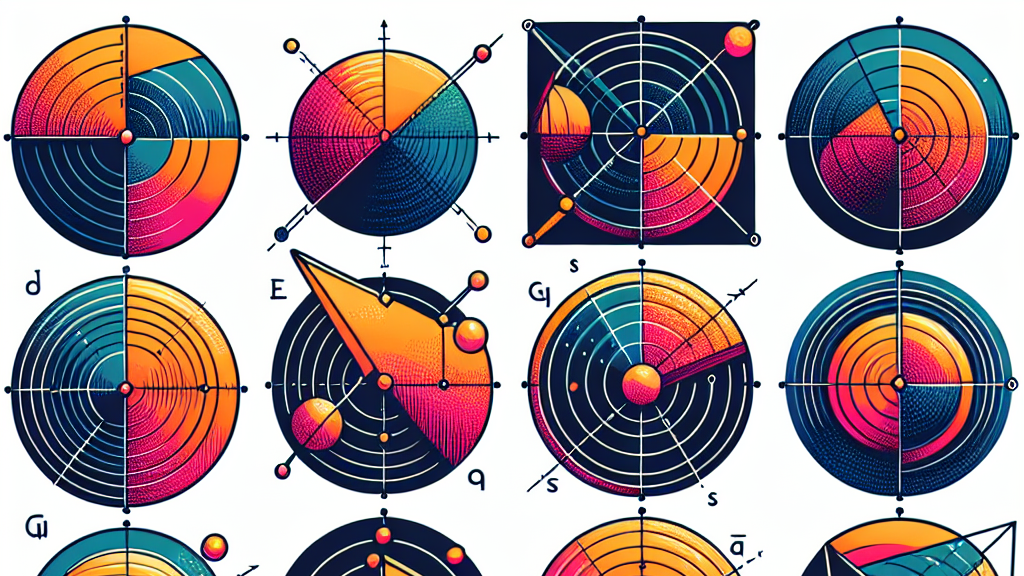
Imagine shapes that have a secret dance with a circle, where their every move is influenced by a specific angle. Intriguing, right? This study uncovers how such unique interactions occur with shapes in the Euclidean plane, revealing that when two tangents from any point of a circle to a shape meet, they do so at a constant angle. This constant angle, alpha, is key to understanding the mysterious relationship between these shapes and the circle.
In more detail, the researchers dive deep into the world of geometry, focusing on convex shapes—like smoother-sided polygons—and their intriguing properties. They used something called a ‘dynamical formulation’ to figure out how these shapes and the circle work together. Fascinatingly, the existence of these non-circular shapes with this special property isn’t straightforward; it hinges on what angle alpha is! This means that the angle significantly determines whether such shapes can exist or not.
Now, let’s picture this in everyday life: imagine designing a park with a circular fountain. You want the surrounding walkways to have specific architectural harmony, following a constant angle as they approach the fountain. This study helps in understanding how to create those unique walkways that naturally flow around circular elements, offering new ways to think about design and space planning.
Did you know? The angle of tangents can completely change whether unique shapes can exist in geometry!
FAQs
What are convex shapes in the Euclidean plane?
Convex shapes in the Euclidean plane are closed curves where any line segment connecting two points within the shape lies entirely inside the shape. Examples include shapes like circles, ellipses, and certain polygons.
What is the significance of the angle alpha in geometry?
The angle alpha greatly influences the interaction between shapes and a circle in this study. It determines whether specific convex shapes can exist, hosting unique tangent properties to a circle at a constant angle.
How does this research connect to real-world applications?
This exploration can help in urban design or architecture where specific spatial dynamics around circular structures, such as fountains or rotundas, need to be planned with aesthetic and functional harmony.
Why is a dynamical formulation used in the study?
The dynamical formulation allows researchers to analyze and explore shape properties mathematically, helping them understand conditions under which unique convex shapes can exist in relation to a circle.
Are there any surprising findings in this study?
Yes, one surprising finding is that the presence of non-circular shapes with the tangent property depends non-trivially on the angle alpha, showing that even subtle angle changes can influence geometric existence.
Background
The study revolves around convex shapes and how they interact with circles in a Euclidean plane. A convex shape is one where any two points can be connected with a line segment that doesn’t leave the shape’s boundaries. Tangents are lines that just touch a curve at a point, and in this study, they explore how these tangents form constant angles with a circle. By using a method called dynamical formulation, researchers can explore these geometric relationships more deeply, checking how feasible such shapes are based on the tangent angle alpha.
History
Geometry, the study of shapes, has a long history dating back to ancient civilizations where it was used for land measurement and architecture. Convex shapes and tangents have been explored in various forms, but understanding them in relation to a circle with a constant tangent angle is a modern twist. This builds on the foundational work of mathematicians who studied relationships within shapes to uncover deeper structural insights, setting the stage for this advanced exploration of geometric dynamics.
Based on “Circular Isoptics in Flatland” by Alexander Thomas, available on arXiv (arxiv.org/abs/2504.02907), used under CC BY 4.0 (creativecommons.org/licenses/by/4.0/).