Connect with us

Search by keyword

Math

How to Perfectly Slice a Pizza: Math Has the Answer

This study shows us how to perfectly slice a pizza-like shape to make sure the biggest piece is as small as possible, using math magic that’s way faster and smarter than before!

How to Perfectly Slice a Pizza Math Has the Answer
✨Researched by humans. Explained by robots. Learn more.

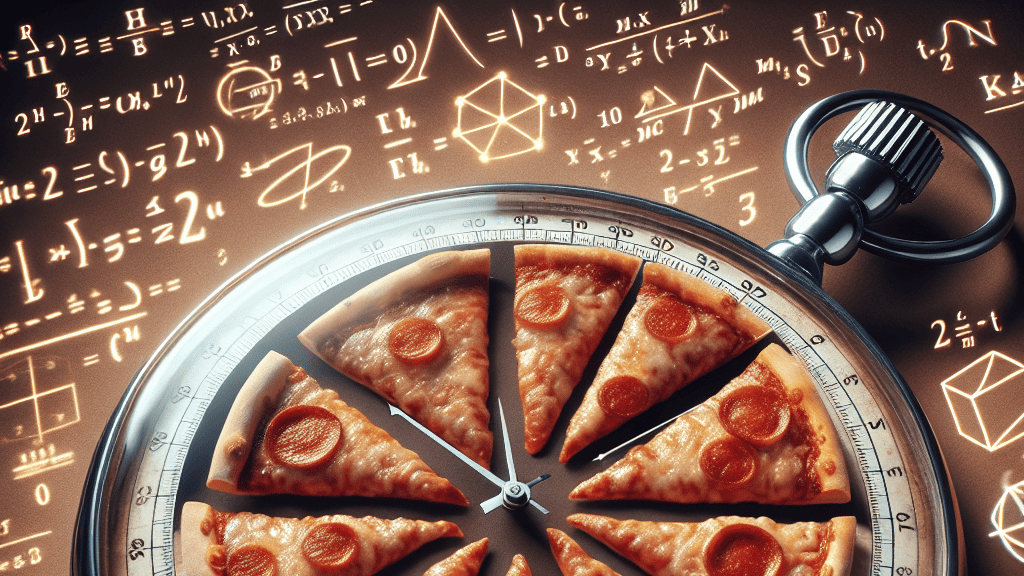
Imagine you’re trying to slice a pizza perfectly so no one fights over who gets the biggest piece. Mathematicians have turned this ordinary problem into a fascinating challenge! It’s like a puzzle: can you find the best way to slice a shape into smaller pieces so that their sizes are as equal as possible, using fewer cuts?

Enter the world of ‘Conway’s Fried Potato Problem’—it’s not just about potatoes! The research dives deep into how you can slice a round, flat shape (think of it like a pizza) using math to make sure no slice is too large compared to the others. Previously, people thought the best way was to make several parallel cuts, but the tricky part was figuring out exactly where those cuts should go. The new technique they’ve discovered is super fast and clever, cutting the time it takes to figure this out down to a fraction.

Why does this matter? Well, picture this method being applied in designing better manufacturing processes where precise cuts are crucial, or even in optimizing layouts in various spaces! Whether we’re talking about materials in a factory or slices at your local pizzeria, this research can make operations smoother and more efficient, saving time, reducing waste, and even making our lives just a bit more delicious.

Did you know? This math problem is inspired by a simple question: How can we slice a potato perfectly?

FAQs

What is Conway’s Fried Potato Problem?

Conway’s Fried Potato Problem is a mathematical challenge that seeks to slice a convex shape into equal parts using the fewest number of cuts, ensuring that the largest piece is as small as possible.

How does this research improve slicing techniques?

This research introduces a new algorithm that allows for finding the direction of cuts in a convex shape much faster, cutting down the time required significantly compared to older methods.

Why is optimizing slice sizes important?

Optimizing slice sizes ensures fair distribution and can improve efficiency in industries ranging from food distribution to manufacturing, as well as help in reducing waste.

Can this method be applied to real-world problems?

Yes, the method can be used in various fields where precise cutting is needed, such as manufacturing or material science, to ensure even distribution and minimize waste.

Is this research only applicable to shapes like pizza or potatoes?

No, while it’s inspired by such shapes, the mathematical techniques can be applied to any convex shapes in problems where slicing or division is required.

Background

Conway’s Fried Potato Problem is an intriguing mathematical problem that originated from the idea of slicing convex shapes with minimal waste. The goal is to divide a shape such as a circle or polygon into equal parts with the smallest maximum piece. The mathematical approach involves using hyperplanes—essentially straight-line cuts in the shape—to achieve this division efficiently.

History

The Fried Potato Problem was initially conceptualized by mathematicians intrigued by optimization in geometry. Earlier work by Bezdek and Bezdek proposed that parallel cuts provide the optimal solution. However, the challenge remained to determine the best direction for these cuts quickly, motivating recent advancements in algorithm design, such as the work outlined in this study, which significantly expedites the process using advanced computational techniques.

Based on “The algorithmic Fried Potato Problem in two dimensions” by Francisco Criado, Francisco Santos, available on arXiv (arxiv.org/abs/2501.13873), used under CC BY 4.0 (creativecommons.org/licenses/by/4.0/).


Trending

Latest

Can AI Save Water Discover How

Computers

AI is transforming the tech world, but it uses lots of water! A new tool, SCARF, helps us measure and reduce AI's water footprint,...

Whats a Forbush Decrease and Why Should We Care Whats a Forbush Decrease and Why Should We Care

Space

Scientists just observed the biggest solar storm event in years, revealing unexpected cosmic ray patterns. Understanding these changes could help us protect our technology...

Can Cars Spot Danger Faster Than Humans Can Cars Spot Danger Faster Than Humans

Computers

Think about how quickly you react when something unexpected happens on the road. This research brings us closer to creating self-driving cars that can...

Can Fear of the Other Stop Social Harmony Can Fear of the Other Stop Social Harmony

Physics

Fear of the unknown might make it harder for people to agree and get along. This study shows that when people have strong xenophobic...

Can AI Revolutionize Breast Cancer Diagnosis Can AI Revolutionize Breast Cancer Diagnosis

Electricity

This research introduces a groundbreaking AI model that can accurately assess HER2-positive breast cancer using widely accessible staining methods, potentially revolutionizing how we diagnose...

Can AI Transform Your Singing into a Choir Can AI Transform Your Singing into a Choir

Computers

Imagine singing solo and having AI turn you into a choir. This research unveils a groundbreaking AI tool that transforms your voice into rich...

You May Also Like

Math

This research shows how mathematical proofs can change and adapt to create stronger conclusions through a logical analysis called 'ordinal analysis.' This matters because...

Math

Discover how tiny math maps, known as log Gromov-Witten invariants, help us understand the geometry of complex shapes, which can impact fields from robotics...

Computers

Discover why figuring out if two simple shapes can cover your floor perfectly is as mysterious as a puzzle with no solution. This research...

Math

Imagine a future where your energy bills are lower because your energy storage system knows the best times to store and use energy. This...

Computers

This research shows how AI Transformers can decode complex math secrets like never before, potentially transforming how we understand geometry using minimal data.

Computers

Discover how studying the arrangement of pages and queues in graph layouts might lead to more efficient data organization and processing tricks that could...

Electricity

Ever wondered if your car could drive perfectly on its own, handling turns and bumps like a pro? This research is taking us a...

Computers

What if we could use machine learning to decode how the parts of a complex system interact? This research opens the door to understanding...

Computers

This research explores how noise impacts the efficiency of machine learning algorithms, revealing that algorithms may learn faster or get stuck depending on the...

Copyright © 2024 8ig8rain.

Disclaimer: The content on 8ig8rain.com consists of AI-generated summaries of scientific abstracts from arXiv. Please note that most arXiv abstracts are preprints and may not have undergone formal peer review. While these summaries aim to convey key ideas and potential applications, they are provided for informational purposes only and should not be interpreted as validated scientific findings or professional advice. The summaries are intended to educate, spark curiosity, and inspire further exploration of science.