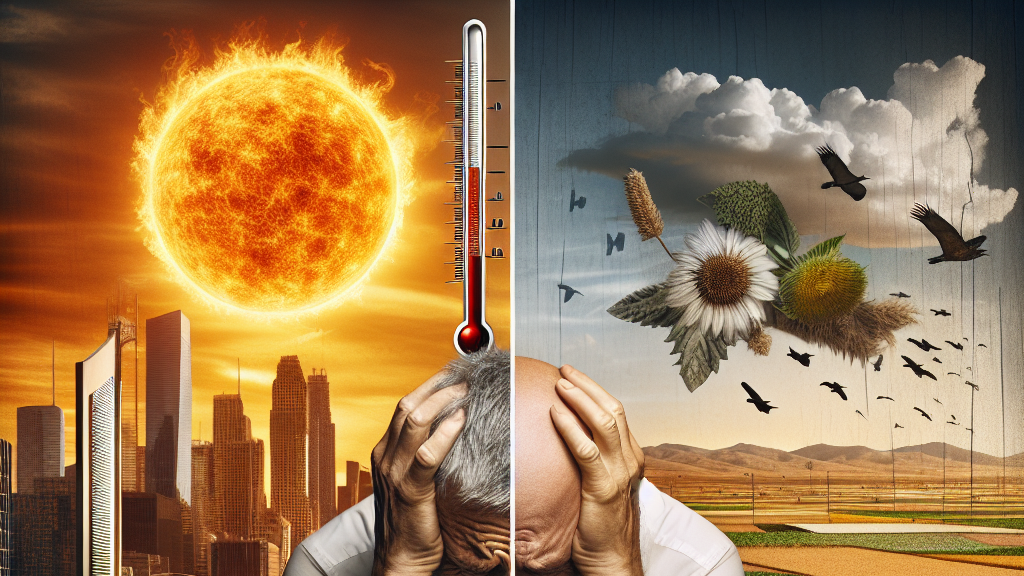
Ever noticed how a hot and humid day can leave you feeling moody or on edge? It turns out, there’s more to it than just discomfort. Recent research reveals that the combination of heat and humidity might be increasing your risk of depression, and this is not just a passing feeling—it could have real implications for your mental well-being.
Scientists have discovered that previous studies may have overlooked the role humidity plays in mental health, focusing only on temperature. By using a measure known as ‘wet bulb temperature,’ which combines heat and humidity, researchers were able to assess its effects on mental health across different socioeconomic groups in India. They found that extreme heat, especially when humid, increases the risk of depression. Interestingly, this effect was not seen with anxiety, pointing to a specific link between wet heat and depressive symptoms.
Imagine living in a place where climate change means frequent heatwaves, and these not only make you sweat but also start affecting your mood. This research suggests that understanding how heat interacts with humidity is crucial for crafting policies to safeguard mental health. Programs like the District Mental Health Program in India show promise in protecting vulnerable communities from heat-related mental health risks. As climate change continues, addressing its hidden costs, like the impact on mental health, becomes even more essential.
Did you know? The body feels much hotter on humid days because sweat doesn’t evaporate as quickly, making it harder to cool down.
FAQs
How do heat and humidity together influence mental health?
The combination of heat and humidity, measured as the ‘wet bulb temperature,’ has been shown to increase the risk of depression. While heat alone can be challenging, the added discomfort of humidity can exacerbate feelings of sadness or lethargy.
Why is humidity important in assessing mental health risks?
Humidity affects how we physically perceive heat. When it’s humid, our bodies struggle to cool down through sweating, which can lead to increased stress and potential mental health issues, such as depression.
What role does the District Mental Health Program play in this context?
The District Mental Health Program in India supports vulnerable communities by providing resources and support to mitigate the adverse mental health effects of extreme weather, like heatwaves.
Why are the findings about depression but not anxiety significant?
The research suggests specific effects of heat and humidity on depression, highlighting the need to tailor mental health interventions to these unique environmental stressors rather than a one-size-fits-all approach.
How could these findings affect future climate policies?
The study emphasizes the importance of considering mental health impacts as a cost of climate change, urging policymakers to incorporate mental health strategies into climate adaptation plans.
Background
Extreme heat can impact our mood and mental state, but it’s not just the temperature that matters—humidity can amplify this effect. The ‘wet bulb temperature’ is a metric that combines heat and humidity to give a more accurate picture of how weather conditions impact our body and mind. When it’s humid, sweat evaporates more slowly, making us feel even hotter and potentially impacting mental health.
History
Research on heat and mental health has been growing as climate change intensifies weather extremes. Earlier studies often focused just on temperature, but recent insights show that humidity plays a critical role too. This study builds on previous work by integrating humidity into assessments, highlighting the underestimated complexity of the heat-mental health connection.
Based on “Beyond the heat: The mental health toll of temperature and humidity in India” by Manuela Fritz, available on arXiv (arxiv.org/abs/2503.08761), used under CC BY 4.0 (creativecommons.org/licenses/by/4.0/).