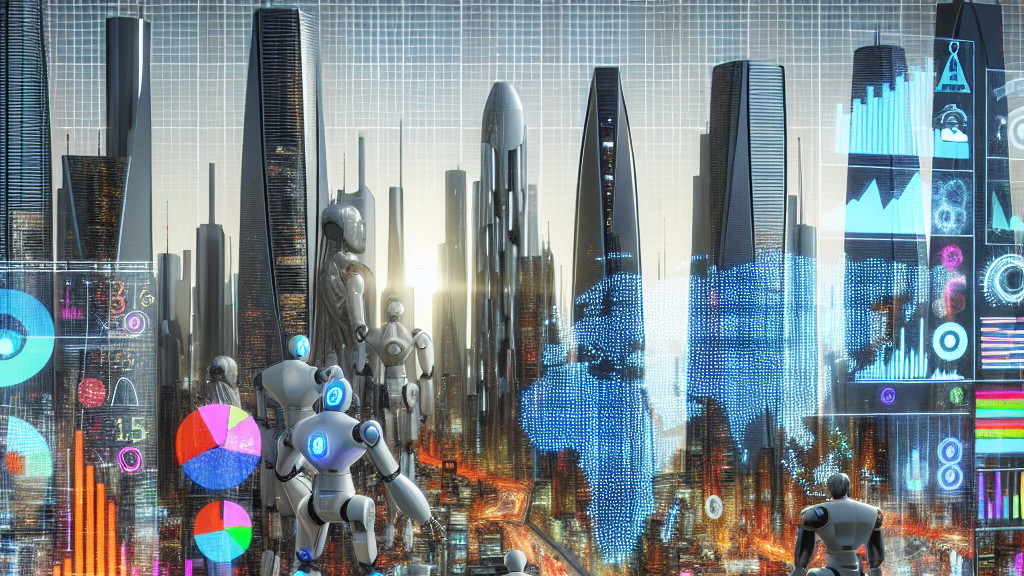
What if the rise of Artificial Intelligence (AI) meant humans no longer had jobs? It sounds like something from a science fiction movie, but it might be closer to reality than we think. AI technology is advancing so fast that in the not-so-distant future, machines might take over most tasks, making human labor less needed and pushing our wages down, possibly even to zero. This shift could completely change how our economy and lives function.
Researchers are worried that as AI takes over, the gap between the rich and the poor might widen drastically. Owners of AI systems and capital could become extremely wealthy, while the rest of us struggle to find work and make a living. This shift could lead to fewer people being able to afford the goods produced by AI, creating a strange situation where we have plenty of products but no one to buy them. To prevent such chaos, new ideas like Universal Basic Income (UBI) are being proposed to ensure everyone benefits from AI’s advances.
A Universal Basic Income would mean everyone receives a set amount of money regularly, regardless of employment status, to cover basic needs. This approach could help redistribute wealth, ensuring that the benefits of AI’s productivity boost are shared more evenly. Imagine a future where, instead of worrying about job loss, people could pursue passions and interests while AI handles the heavy lifting. It’s a big change that requires society to rethink its values and systems, but it might be necessary to keep our economy stable and ensure everyone can thrive in a world dominated by AI.
Did you know that the idea of robots replacing human jobs was first popularized in the 1920s? Science fiction writer Karel Čapek coined the term ‘robot’ in his play R.U.R., predicting that machines could one day do all human work.
FAQs
How might Artificial Intelligence affect human jobs in the future?
Artificial Intelligence could perform many tasks that humans do today, potentially reducing the need for human labor and pushing wages lower. This might lead to increased unemployment and economic inequality if not addressed with new economic measures.
What solutions are proposed to address job loss due to AI?
Solutions such as Universal Basic Income, public or cooperative AI ownership, and progressive taxation of AI earnings are being considered to redistribute the wealth AI generates and maintain economic stability.
Could Universal Basic Income solve the problems caused by AI job replacement?
Universal Basic Income could provide financial support to people affected by job losses due to AI, helping to redistribute wealth and stabilize the economy by ensuring everyone has money to spend on basic needs.
What is the potential impact of AI on wealth distribution?
AI could further concentrate wealth among those who own AI systems, leading to a wider wealth gap if current economic systems remain unchanged. New policies and economic structures may be necessary to ensure fair distribution of AI-generated wealth.
Why is it urgent to rethink economic structures due to AI advancements?
As AI continues to evolve rapidly, it poses challenges to traditional labor markets and economic systems. Rethinking these structures is crucial to prevent economic and social instability and to ensure that all individuals can benefit from AI’s progress.
Background
Artificial General Intelligence (AGI) refers to AI systems that have the ability to understand, learn, and apply intelligence across a wide range of tasks, similar to a human. As AGI technology advances, it could replace human labor in many industries, leading to economic shifts. Currently, much of the world’s economy is based on human labor as a key component of productivity and growth. If machines take over, the value of human labor could diminish, significantly altering the distribution of wealth and economic power.
History
The concept of machines replacing human labor isn’t new; it dates back to the Industrial Revolution when machines first started to perform tasks that humans did manually. In the 20th century, automation in factories and the introduction of computers led to significant economic and social shifts. In more recent years, the rise of AI and machine learning has accelerated these changes, prompting predictions about the potential for AI-driven economic disruption.
Based on “Artificial General Intelligence and the End of Human Employment: The Need to Renegotiate the Social Contract” by Pascal Stiefenhofer, available on arXiv (arxiv.org/abs/2502.07050), used under CC BY 4.0 (creativecommons.org/licenses/by/4.0/).