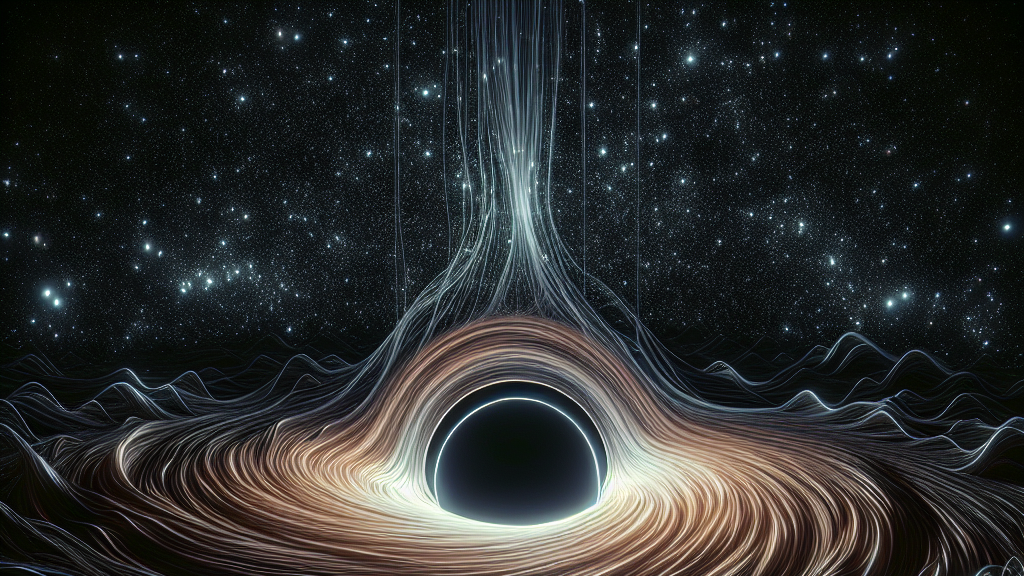
Did you know that black holes might have ‘hair’? No, not the kind you brush, but cosmic features that could change how we see the universe! Scientists are diving deep into the mysteries of black holes, and it turns out they might have something called ‘scalar hair.’ This could be what causes those stunning light shows when stars get too close—where light bends and swirls, creating gorgeous patterns around the black hole.
In this fascinating study, researchers are using data from the Event Horizon Telescope, which captured the first-ever image of a black hole, to understand the effects of this ‘hair.’ By analyzing how light bends and creates shadows around black holes, they can pinpoint how these cosmic giants might behave differently from what we previously thought. They focused on ‘strong lensing,’ a gravitational effect that makes black holes a bit like funhouse mirrors, warping light in strange and beautiful ways.
Imagine looking through a gigantic, swirling lens—a cosmic kaleidoscope—where everything you see is twisted and bent. That’s what happens with black holes and their ‘hair,’ helping scientists learn more about the universe. Understanding these effects could one day lead to new technologies or insights into our world. Who knows, maybe the next big tech breakthrough will start with a black hole’s hair!
Black holes are so powerful that they can bend light around them, like a cosmic funhouse mirror!
FAQs
What is scalar hair on black holes?
Scalar hair refers to hypothetical features on black holes that could affect how they interact with surrounding space and matter. Unlike the traditional view of black holes as simple, smooth objects, scalar hair suggests additional complex properties that influence gravitational lensing and shadow formation.
Why do scientists study gravitational lensing around black holes?
Gravitational lensing helps scientists understand the massive forces at play around black holes. By studying how light bends around these cosmic objects, researchers can gain insight into their structure, behavior, and possibly uncover new physics.
How does this research change our understanding of the universe?
This research challenges existing theories about black holes and could lead to new discoveries about their nature. By exploring the concept of scalar hair, scientists are probing the boundaries of current astrophysical models and possibly paving the way for revolutionary discoveries in cosmology.
What role does the Event Horizon Telescope play in this research?
The Event Horizon Telescope provides crucial observational data that allows researchers to study black holes up close, analyze their shadows, and test theories about their properties, such as the existence of scalar hair.
Could the findings about scalar hair lead to new technologies?
While it’s too early to say for sure, understanding black holes better could inspire new technological advancements. Knowledge of gravitational forces and light manipulation might translate into innovative applications in fields like optics or space exploration.
Background
Gravitational lensing is an effect predicted by Einstein’s general relativity, where massive objects like black holes warp space-time and bend the path of light. This study investigates whether black holes can have additional properties, termed ‘scalar hair,’ that impact these lensing effects. Such properties could provide insights into black holes’ behavior beyond classical physics.
History
The idea of black holes having ‘hair’ emerged to challenge the ‘no-hair’ theorem in classical physics, which suggests black holes are defined only by mass, charge, and spin. Recent advances in telescopic technology, like the Event Horizon Telescope, have allowed scientists to directly observe these objects, sparking new discussions and investigations about their true nature.
Based on “Effect of primary scalar hair on black hole’s strong lensing in Beyond Horndeski Gravity” by Mohsen Fathi, available on arXiv (arxiv.org/abs/2502.19155), used under CC BY 4.0 (creativecommons.org/licenses/by/4.0/).