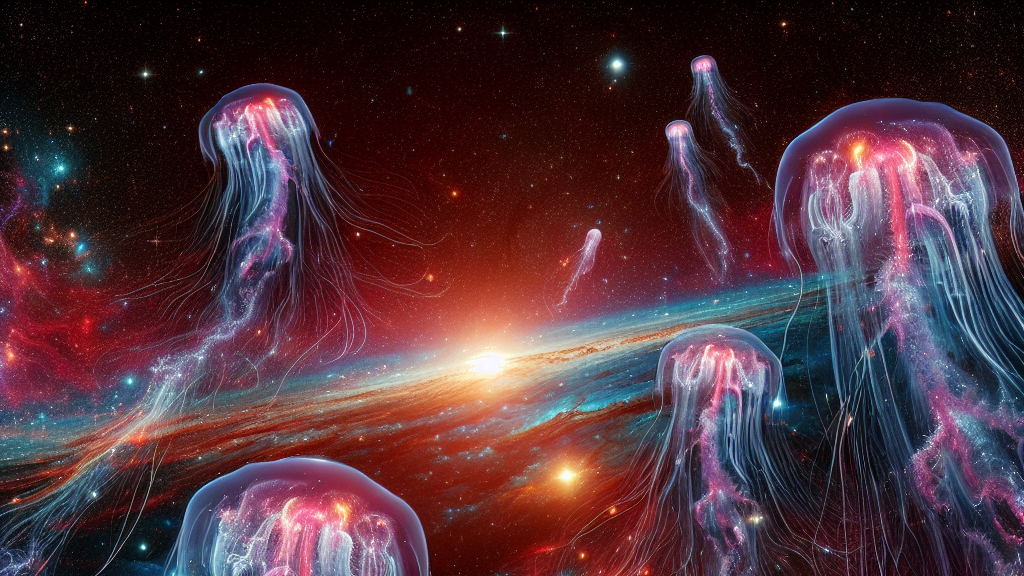
Imagine galaxies that look like jellyfish, floating through the ocean of space with long, trailing tails. These aren’t just pretty sights; they’re cosmic mysteries that tell us about the wild transformations happening in the universe. Such galaxies are ripped and shaped by the fierce forces in space, leading them to form stunning tails made of gas.
This research dives into the intriguing world of these jellyfish galaxies and their hotshot centers, known as active galactic nuclei, or AGN. Scientists used super-smart simulations called IllustrisTNG to bring these galaxies to life. They found that jellyfish galaxies are much more likely to host these supermassive black holes at their cores compared to their calmer counterparts. What’s causing this? The intense pressure from their surroundings strips away their gas, fueling the black holes and kick-starting wild activity within the galaxies.
Why should we care about these space oddities? Well, discovering why jellyfish galaxies are so active could unlock new secrets about how galaxies form and evolve over time. This knowledge could even help us understand what’s happening in our own galaxy. Imagine, one day, using what we’ve learned to fuel new technologies inspired by the universe’s hidden mechanics. It’s like having a sneak peek into the thrilling drama of the cosmos!
Jellyfish galaxies can glow bright with activity, thanks to their central black holes devouring gas like a cosmic buffet.
FAQs
What makes jellyfish galaxies unique in space?
Jellyfish galaxies are fascinating because they have long, trailing gas tails caused by intense pressure exerted by their environment. This makes them look like cosmic jellyfish floating through space!
How do jellyfish galaxies help us understand black holes?
These galaxies often have active supermassive black holes at their centers, which scientists think are fed by gases stripped from the galaxy. Studying them helps us learn more about how black holes grow and influence their surroundings.
Why do scientists use simulations to study jellyfish galaxies?
Simulations allow scientists to recreate the complex environment where jellyfish galaxies exist, helping them analyze how different factors contribute to galaxy transformations and black hole activity.
Are jellyfish galaxies more common than other galaxies?
No, they are not as common as other types of galaxies. Their unique and dramatic changes happen primarily because of the extreme environments they inhabit.
Could studying jellyfish galaxies lead to new technological advancements?
Understanding the processes within jellyfish galaxies could inspire new technologies by revealing the principles of energy transfer and transformation in extreme environments.
Background
When galaxies wander into dense galactic clusters, the pressure from the surrounding gas can strip them of their own gas. This phenomenon, called ram-pressure stripping, is what gives jellyfish galaxies their unique gas tails. The pressure pushes gas out, but it can also compress it at the galaxy’s core, potentially triggering activity in the central black hole, known as an active galactic nucleus.
History
The concept of ram-pressure stripping has been around for decades, explaining how galaxies can lose gas when they move through dense clusters. Over time, this understanding has evolved, linking these transformations to the presence and activity level of black holes at the centers of galaxies. This study builds upon this knowledge by using advanced simulations to explore these phenomena in even greater detail.
Based on “Jellyfish galaxies with the IllustrisTNG simulations — Supermassive black hole activity in dense environments with ram-pressure stripped satellites” by Shalini Kurinchi-Vendhan, Eric Rohr, Annalisa Pillepich, Elad Zinger, Mohammadreza Ayromlou, Gandhali D. Joshi, available on arXiv (arxiv.org/abs/2506.05474), used under CC BY 4.0 (creativecommons.org/licenses/by/4.0/).