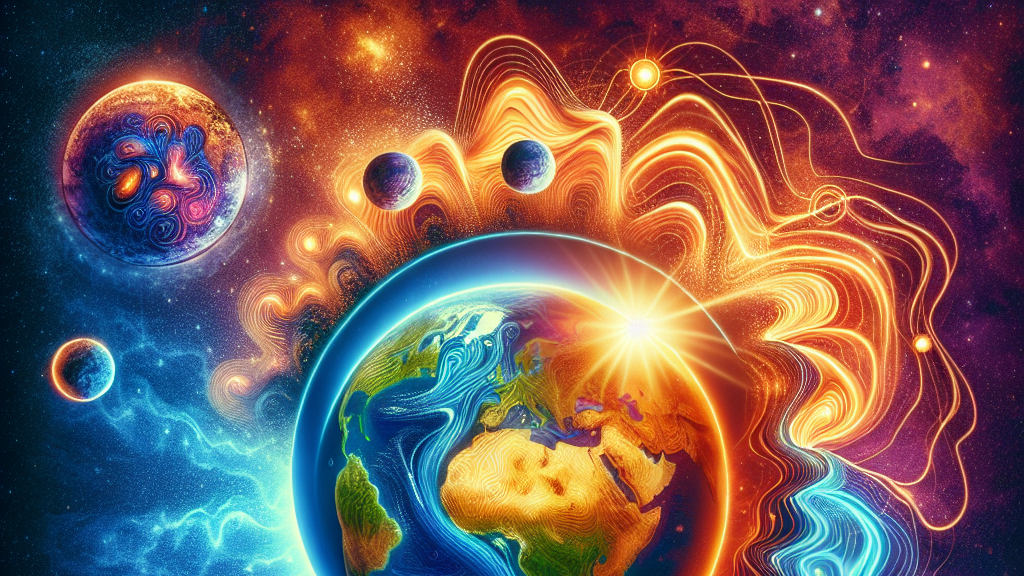
Ever thought gravity could have a hand in human smarts? This isn’t just about apples falling from trees – we’re talking about gravitational waves, which are ripples in spacetime that influence everything from Earth’s interior to the very evolution of our brains. They may be the unsung heroes in the epic drama of human cognition. But how so, you ask? It turns out that these waves helped power the radioactive decay that keeps our planet’s plates moving and its core molten. Why does that matter? Well, without plate tectonics, Earth’s climate wouldn’t have had the dramatic shifts that spurred animals, including our distant ancestors, to adapt. And a molten core means a magnetic field that shields us from solar radiation, crucial for life to thrive and evolve.
Dig a little deeper, and we see that our brain growth spurt – from ape-like to human-sized brains – aligns suspiciously well with these tectonic and climatic upheavals. The merging of North and South America is one such event believed to have stirred unprecedented climate shifts, forcing early humans to adapt quickly. Essentially, the waves of gravity that most of us never think about could be the gentle nudge towards the cognitive prowess we boast today.
Imagine a future where understanding these forces allows us to tap into their power for energy, climate stability, or even interstellar travel. While we might not use gravitational waves to power our homes just yet, unraveling their past impacts sets the stage for future innovations. Who knows, the key to our survival and growth might still lie in the mysteries of gravity.
Gravitational waves, invisible ripples in spacetime, are believed to have influenced the conditions needed for human brain evolution.
FAQs
How do gravitational waves influence Earth’s tectonic activity?
Gravitational waves are thought to have been instrumental in the formation of elements through neutron star collisions. These elements contribute to radioactive decay within Earth, releasing heat that drives plate tectonics.
In what ways have tectonic activities impacted human brain evolution?
Tectonic shifts have historically caused major climate changes. These challenging environments prompted evolutionary adaptations, including increased brain size, first in mammals and later in humans.
Why is Earth’s magnetic field essential for life?
Earth’s magnetic field, maintained by its molten core, protects life from harmful solar winds. Without it, life as we know it, including human evolution, might not have been possible.
Could gravitational waves have a future application?
While direct applications of gravitational waves are still speculative, understanding their influence on Earth’s history could lead to innovative technologies in energy, climate management, or space travel.
Did human cognitive abilities evolve only because of gravitational waves?
Gravitational waves played a part by influencing tectonic activity, which in turn contributed to environmental changes that spurred cognitive evolution. However, other factors, like social interactions and tool use, also played significant roles.
Background
Gravitational waves are ripples in the fabric of space-time caused by massive celestial events like merging neutron stars. These waves are believed to have facilitated the synthesis of radioactive isotopes deep within the Earth. This radioactive decay releases heat that sustains geological processes like plate tectonics, vital for maintaining a livable climate and Earth’s magnetic field.
History
The study of gravity dates back to Newton’s apple, and later to Einstein’s theories of relativity, which predicted gravitational waves. Only recently confirmed through astronomical observation, these waves help explain cosmic phenomena and have opened a new window into understanding the universe. This research builds on these discoveries, linking them to the conditions that supported the evolution of intelligent life on Earth.
Based on “Evolution of human cognition required Einstein’s gravitational waves” by Bernard F. Schutz, Tsvi Piran, Patrick J. Sutton, available on arXiv (arxiv.org/abs/2503.03604), used under CC BY 4.0 (creativecommons.org/licenses/by/4.0/).