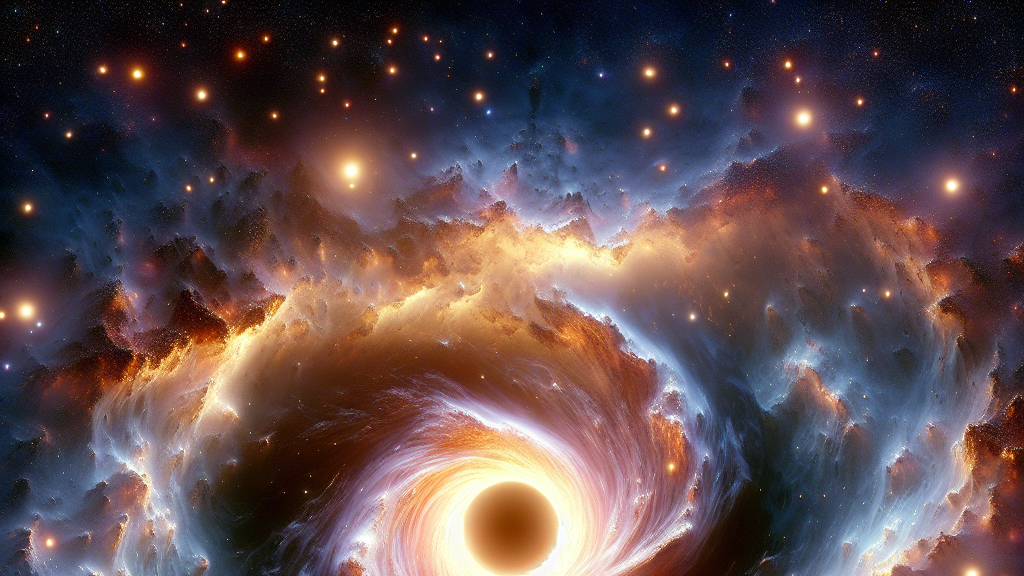
**Picture this: giant black holes, a billion times heavier than the sun, quietly wandering through space! It’s not science fiction; it’s what scientists are currently investigating. These powerful cosmic wanderers can be knocked off their centers by massive gravitational waves created when two galaxies merge. This study explores the idea of spotting these giants as they venture away from their usual galactic homes.**
The researchers used advanced simulations to see what happens when these black holes, after being kicked by gravitational waves, leave their original spots in a galaxy. As they move, they drag clusters of stars with them, creating a unique stamp in the sky—a cosmic signature that tells us a massive black hole has passed by. These signatures, known as black hole recoil clusters, could be visible with powerful telescopes, offering a new way to spot these elusive giants. In fact, if these clusters have a certain speed and size, they could be seen even if the black hole is millions of light years away!
Imagine looking up with a future telescope like the Euclid or the Extremely Large Telescope and finding these black hole clusters. Up to 8000 such clusters might be detectable, showing us what happens after some of the universe’s most massive black holes merge. This could change how we understand galaxies and the powerful forces within them, revealing secrets of the cosmic dance that has occurred billions of times across the universe. This is not just about scientific curiosity—it could redefine how we see our cosmic neighborhood and the mysteries it holds.
Did you know these massive black holes can weigh more than a billion suns?
FAQs
How do scientists detect these wandering black holes in galaxies?
Scientists use simulations to predict that black holes, displaced by galaxy mergers, leave behind clusters of stars, creating unique signatures that can be detected with telescopes.
Why are these black holes wandering in the first place?
When two galaxies merge, the gravitational forces can kick supermassive black holes out of their usual spot, causing them to wander through space.
How can future telescopes help in finding these wandering black holes?
Telescopes like Euclid and the Extremely Large Telescope will have the capability to detect the unique signatures of these black hole clusters in the vastness of space.
What is the significance of these findings in space exploration?
Detecting wandering black holes can reveal insights into galaxy formation, the impact of black holes on their surroundings, and the powerful forces within the universe.
Could we potentially observe these black holes in our lifetime?
Yes, with the planned advancements in telescope technology, observing these cosmic events is becoming increasingly feasible.
Background
The study of supermassive black holes and their interactions within galaxies is crucial for understanding cosmic events, especially when galaxies merge. These mergers can create gravitational waves that are powerful enough to displace these black holes. When they are knocked out of their usual places, these black holes drag clusters of stars along with them, forming what’s known as black hole recoil clusters.
History
Research on black holes began with the theory of general relativity, which predicted their existence. Over the years, studies have focused on the gravitational waves produced by cosmic events like galaxy mergers. This study builds on previous work by considering the aftermath of galaxy mergers and how displaced black holes can be observed indirectly through their trailing stellar clusters.
Based on “Caught in the act: detections of recoiling supermassive black holes from simulations” by Alexander Rawlings, Peter H. Johansson, Thorsten Naab, Antti Rantala, Jens Thomas, Bianca Neureiter, available on arXiv (arxiv.org/abs/2505.17183), used under CC BY 4.0 (creativecommons.org/licenses/by/4.0/).