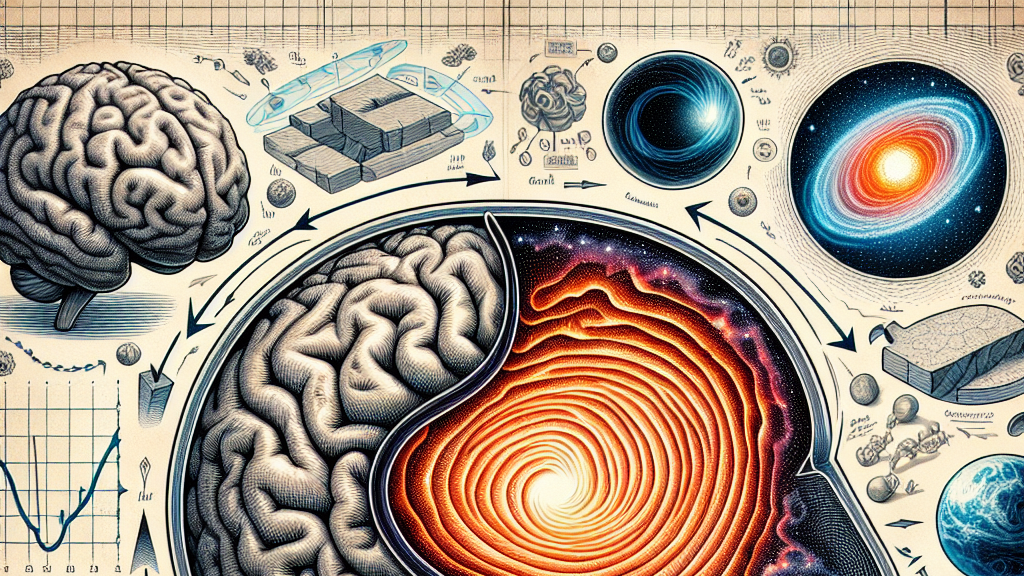
What if gravitational waves, those ripples in space-time caused by massive space events, are the reason humans can think? Imagine: the very laws of physics that shape our universe, like gravity, have a hidden hand in shaping our brains. But how? It involves the insides of our planet and the dance of tectonic plates that have, over time, influenced the climate and, in turn, our ancestors’ brain sizes.
The research suggests something astonishing. When massive stars collide, they send gravitational waves through space. These waves somehow keep Earth’s core molten. The core’s heat allows tectonic plates to shift, which might have been crucial for life as we know it. These tectonic shifts have led to major climate changes. Imagine continents crashing together or pulling apart – these dramatic moves change weather patterns, forcing species to adapt, evolve, or perish. For our ancestors, adapting meant bigger brains.
So, what does this mean for us today? If it weren’t for those cosmic events billions of light years away, Earth might not have the dynamic inner and climatic systems that drove brain evolution. That means everything from your thoughts to your dreams, even your smartphone, might owe a thank you to gravitational waves. It’s a mind-bending thought: distant stars colliding in space led to the development of human intelligence through a cosmic chain of events here on Earth.
If gravitational waves didn’t exist, our planet might be too cold for the tectonic activity that helped jump-start human brain evolution.
FAQs
How do gravitational waves keep Earth’s core hot?
Gravitational waves help in the process of binary neutron stars merging, which leads to radioactive isotope decay deep within Earth’s interior. This decay generates heat, maintaining the molten state of Earth’s core.
Why is Earth’s molten core important for human evolution?
The heat from Earth’s core facilitates plate tectonics. These movements have influenced climate changes that, over time, likely spurred significant increases in relative brain size among mammals and humans.
Could humans have evolved without tectonic activity driven by gravitational waves?
Without tectonic activity, Earth’s climate might not have experienced the shifts that prompted crucial evolutionary leaps in brain size, suggesting our cognitive development could have been drastically different or delayed.
What role did tectonic shifts play in brain evolution?
Major climatic changes caused by tectonic shifts likely drove evolutionary biologists to find links to increases in mammalian and human brain size, as species had to adapt to new environments.
How are neutron stars connected to human cognition?
The rare explosive mergers of neutron stars lead to radioactive decay processes on Earth, which play a surprising role in maintaining the dynamic systems essential for life and cognitive evolution.
Background
Gravitational waves are ripples in space-time caused by massive cosmic events like the collision of neutron stars. Earth’s core remains molten partly because of heat generated by the decay of radioactive isotopes, which were formed due to gravitational wave-induced stellar events. This heat powers plate tectonics, which contributes to Earth’s changing climate, influencing the evolutionary trajectory of life’s brain development.
History
Gravity has fascinated scientists since Isaac Newton, but only recently have we detected gravitational waves, predicted by Einstein in his theory of General Relativity. These waves, proven by observing cosmic collisions, connect to Earth’s tectonic activity in surprising ways. This study unveils a novel link, suggesting life’s complexity here is connected to celestial phenomena far beyond our planet.
Based on “Evolution of human cognition required Einstein’s gravitational waves” by Bernard F. Schutz, Tsvi Piran, Patrick J. Sutton, available on arXiv (arxiv.org/abs/2503.03604), used under CC BY 4.0 (creativecommons.org/licenses/by/4.0/).