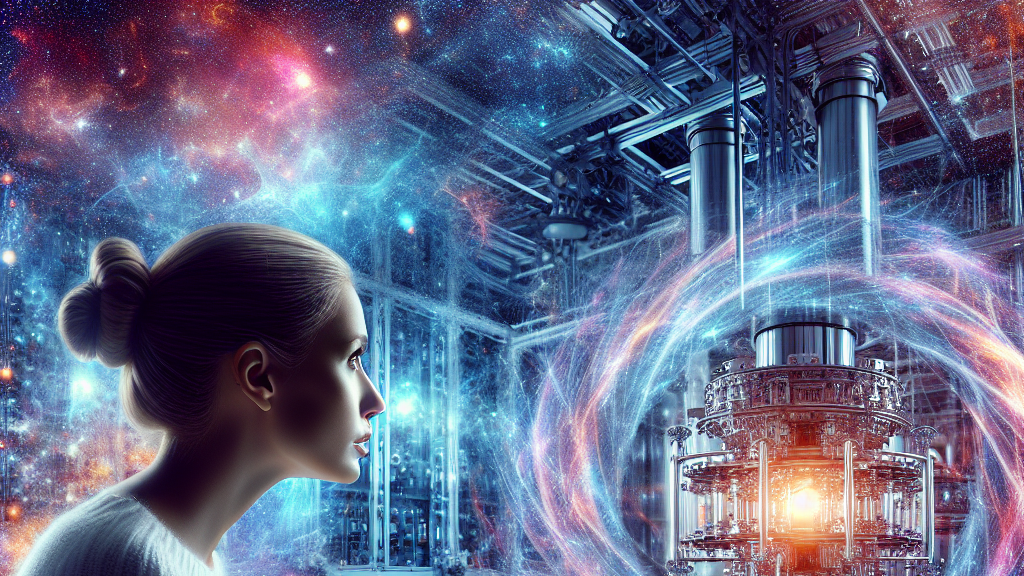
Ever imagined what happens when particles crash into each other at nearly the speed of light? Welcome to the world of heavy-ion collisions, where scientists explore the universe’s most thrilling mysteries. By using gigantic machines called accelerators, they discover new states of matter, like the quark-gluon plasma, which might just hold the keys to understanding the very makeup of our universe.
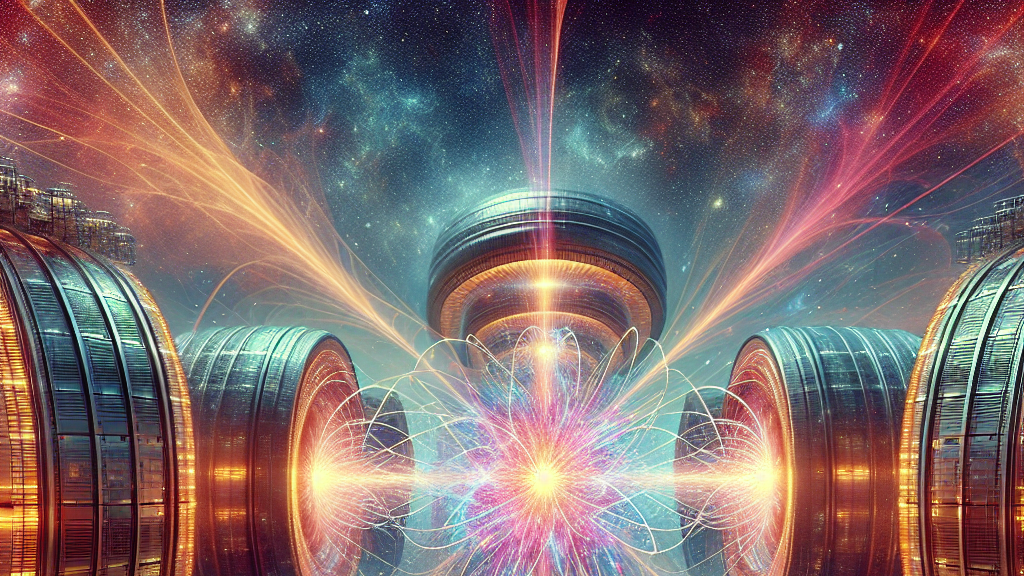
Heavy-ion collisions are like cosmic car crashes in particle labs. Scientists accelerate ions—tiny charged particles—to mind-boggling speeds and then make them collide. These high-energy collisions create an intense environment similar to the conditions just after the Big Bang. Out of this chaos emerges the quark-gluon plasma, a form of matter where particles called quarks and gluons are no longer confined inside protons and neutrons.
Imagine being able to recreate a slice of the early universe to understand how the world around us came to be. As we delve deeper into the properties of quark-gluon plasma, it opens doors to numerous possibilities, such as advancements in energy production or even the development of new materials. The insights from these high-energy particle smashes could one day revolutionize technology, offering us cleaner energy sources and more stable materials.
Did you know that quark-gluon plasma is believed to have existed just microseconds after the Big Bang?
FAQs
What are heavy-ion collisions?
Heavy-ion collisions involve accelerating and crashing ions, which are charged atoms, at high speeds to study new states of matter and the fundamental forces of nature.
Why are scientists interested in quark-gluon plasma?
Quark-gluon plasma is believed to provide insights into the early universe and the fundamental building blocks of matter, helping us understand how the universe evolved.
How do particle accelerators work in the study of heavy-ion collisions?
Particle accelerators are massive machines that use electromagnetic fields to propel charged ions to high speeds, allowing them to collide and create high-energy environments similar to those just after the Big Bang.
Could this research affect future technology?
Yes, understanding quark-gluon plasma could lead to advancements in energy production and new material technologies, offering cleaner energy sources and more durable materials.
Is quark-gluon plasma found naturally?
No, quark-gluon plasma occurs under extreme conditions, such as those created in heavy-ion collisions, and is not naturally found on Earth.
Background
Heavy-ion collisions are experiments where ions, usually of heavy elements like gold or lead, are accelerated to near the speed of light and made to collide. This process creates conditions of extreme energy and temperature, similar to those just after the universe began with the Big Bang. In these collisions, researchers hope to study the quark-gluon plasma, a state of matter where quarks and gluons, the fundamental particles inside protons and neutrons, are free from confinement.
History
The study of heavy-ion collisions began around the 1980s with the advent of large particle accelerators. Over the decades, facilities like CERN’s Large Hadron Collider have allowed physicists to observe and study the properties of quark-gluon plasma. This research builds on the foundational work in quantum chromodynamics, a theory describing how quarks and gluons interact, which has been pivotal in understanding strong nuclear forces that hold atomic nuclei together.
Based on “The quest for the quark-gluon plasma from the perspective of dynamical models of relativistic heavy-ion collisions” by Marcus Bleicher, Elena Bratkovskaya, available on arXiv (arxiv.org/abs/2504.14740), used under CC BY 4.0 (creativecommons.org/licenses/by/4.0/).