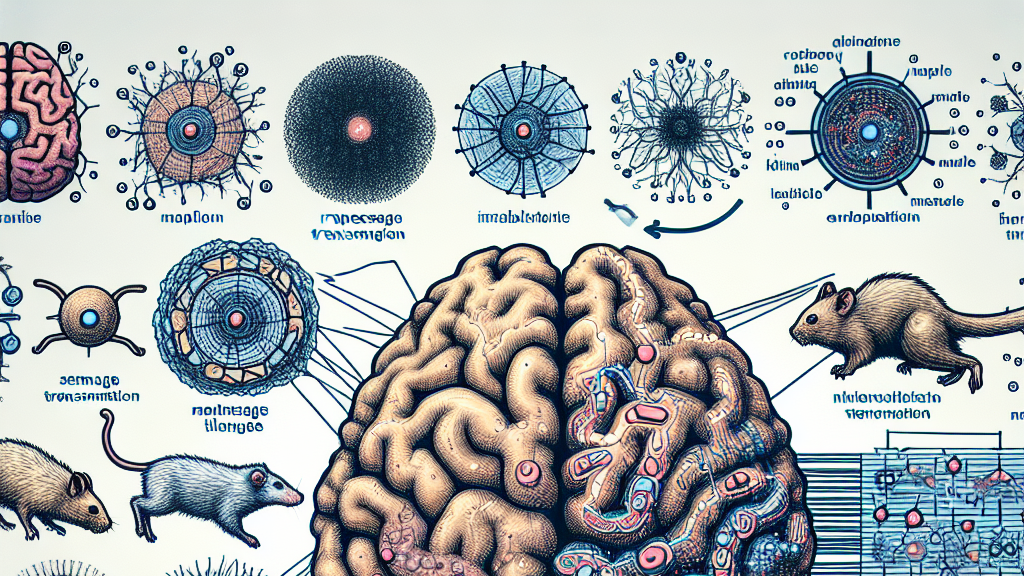
Did you know that the size of a mammal’s brain can affect how well it keeps communication flowing within the brain itself? Scientists have looked into this fascinating world of brain networks and found that smaller brains might be better at keeping their internal messages alive compared to larger ones. Imagine your brain network as a busy highway—sometimes more jam-packed than others!
In a study of various mammal brains, researchers explored how messages in these brain highways can sometimes collide and get lost. They used a fascinating model where messages bumping into each other at the same spot get erased, while those that make it past the intersection keep traveling to neighboring areas. Through simulations resembling real-life brain maps, they found that message survival patterns fit a certain type of distribution known to science but didn’t require specifics like distance or strength between brain areas. Surprisingly, it all boiled down to how big the brain is, with smaller brains allowing messages to thrive longer.
Now, why does this matter? Well, for one thing, it hints at why some animals might have evolved bigger brains with distinct sections or modules. For example, larger brains could mean more specialized areas, but at a cost to how long messages last as they travel. This could have real implications for understanding animal behavior and evolution itself. It might even shed light on why certain species, like chimpanzees, are unique in how they process information.
Chimpanzees have the lowest message survival rate among the animals tested in the study.
FAQs
How does brain size affect message survival in mammal brains?
Brain size significantly impacts message survival; smaller brains generally allow messages to survive longer compared to larger brains. This could be due to the more modular structure of larger brains, which affects internal communication efficiency.
What is the colliding-spreading model used in this research?
The colliding-spreading model is a theoretical approach simulating how messages travel and sometimes collide within a brain network. When two messages arrive at the same node simultaneously, they are deleted, simulating traffic congestion. The surviving messages continue to spread to nearby nodes.
Why are the findings about message distribution patterns important?
The findings show that message distribution patterns do not rely on specific distances or weights between brain areas; they emerge from the brain’s structure and dynamics alone. This insight helps understand brain function and could inform evolutionary biology studies.
How might this research influence our understanding of brain evolution?
These findings offer insights into how brain size and structure have evolved across different species, potentially revealing why certain brains have become more modular over time to optimize communication and survival.
Why do chimpanzees have the lowest message survival?
Chimpanzees’ large brain size and unique modular structure might lead to lower message survival due to how their brain networks manage internal communication, offering clues about their distinct evolutionary pathways.
Background
In the world of neuroscience, white matter is like the dense network of highways that connect various regions of a mammal’s brain, allowing them to communicate. These networks face ‘congestion,’ similar to traffic jams, which can affect the messages traveling through them. Researchers use a colliding-spreading model to understand how messages move and possibly fail when they collide at busy network intersections. This study looks precisely at how messages in these brain highways behave across different species and how brain size plays a critical role in message survival.
History
Brain network studies have long aimed to understand how different structures and sizes affect information flow. Early work focused on how information is processed within these vast networks, while recent studies have moved into understanding dynamics and survival of neural messages. This research builds upon previous knowledge and introduces the idea that brain size imposes functional constraints, leading to possibly evolved structures in larger animals to manage this effectively.
Based on “Brain volume predicts survival of colliding-spreading messages on mammal brain networks” by Yan Hao, Tate Tower, Hannah Lax, Marc-Thorsten Hütt, Daniel J. Graham, available on arXiv (arxiv.org/abs/2505.15477), used under CC BY 4.0 (creativecommons.org/licenses/by/4.0/).