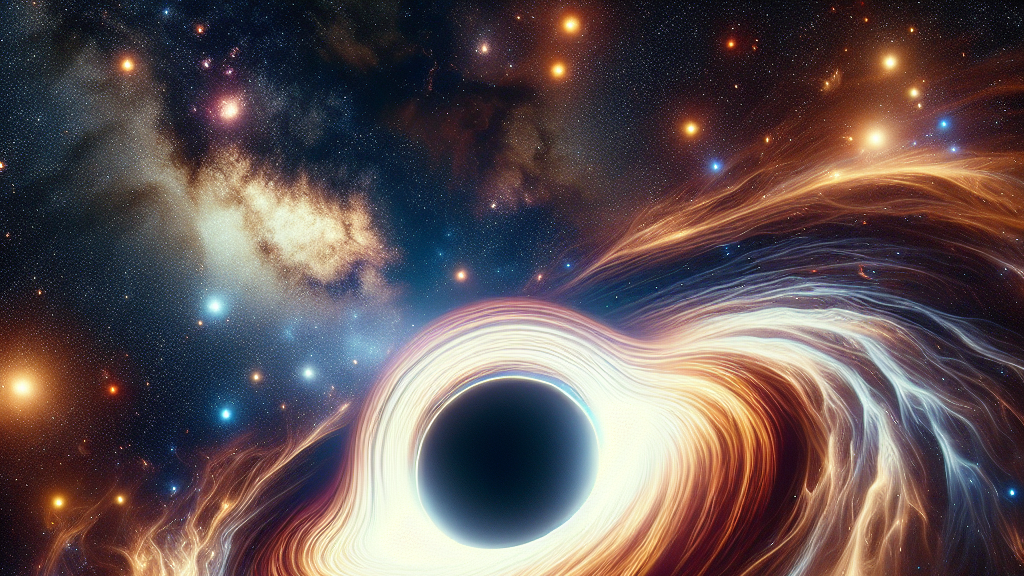
Black holes are already some of the most intriguing and mysterious objects in our universe. But what if they have an invisible partner in crime that’s messing with our cosmic observations? It turns out that the brightest source of high-energy neutrinos, NGC 1068, doesn’t emit the gamma rays we expect. Some scientists think this cosmic mischief might be due to dark matter playing hide-and-seek with gamma rays!
Researchers have long struggled with explaining why we see so many neutrinos but so few gamma rays from NGC 1068. Gamma rays usually accompany high-energy neutrinos, so their absence is puzzling. The answer might lie in an interesting idea: dark matter, that elusive yet abundant stuff that makes up much of our universe, could be absorbing the gamma rays before they reach us. This notion suggests that dark matter might have properties we haven’t fully appreciated, like the ability to scatter photons.
If dark matter is indeed blocking gamma rays, it opens up a whole new way to study it and understand its mysterious properties better. Imagine a future where we can ‘see’ dark matter through its interactions with particles like neutrinos and gamma rays. This could revolutionize space exploration and our understanding of the cosmic dance happening around black holes. Understanding these interactions might one day help us harness cosmic rays for technology or unlock hidden secrets of the universe.
Did you know that dark matter, though invisible, makes up about 27% of the universe?
FAQs
What is NGC 1068, and why is it significant in this research?
NGC 1068 is a galaxy with a supermassive black hole at its center, known for being the brightest source of high-energy neutrinos detected by IceCube, yet it emits surprisingly few gamma rays. This discrepancy is what the study aims to explain.
How does dark matter affect gamma rays near supermassive black holes?
Researchers suggest that dark matter might absorb gamma rays around supermassive black holes. This interaction could be why we see fewer gamma rays even though high-energy neutrinos are abundant.
Why are neutrinos more detectable than gamma rays around NGC 1068?
The area near the supermassive black hole is opaque to gamma rays, meaning they get blocked or absorbed, possibly by dark matter. However, this region is transparent to neutrinos, allowing them to pass through and reach our detectors like IceCube.
What is the IceCube instrument mentioned in the research?
IceCube is a neutrino observatory located at the South Pole. It detects high-energy neutrinos coming from cosmic sources, like NGC 1068, helping scientists understand the universe’s most energetic events.
How could this research change our understanding of dark matter?
If dark matter is indeed interacting with gamma rays as suggested, it would provide new insights into its properties, potentially allowing us to study it through its cosmic interactions and improve our understanding of the universe.
Background
NGC 1068 is an active galaxy known for emitting high-energy neutrinos, detected by the IceCube observatory. In astrophysics, high-energy neutrinos often accompany gamma rays when cosmic rays are accelerated. However, NGC 1068 shows an unusual pattern: while it’s bright in neutrinos, its gamma-ray output is weak, which isn’t typical. The study suggests dark matter might absorb gamma rays, explaining the discrepancy.
History
This research connects to longstanding mysteries about dark matter’s properties and its potential interactions with other cosmic phenomena. Previous models attempted to explain the neutrino-gamma ray mismatch using cosmic ray acceleration near supermassive black holes. However, they often overestimated gamma-ray levels or relied on fine-tuning parameters. This study introduces a different perspective by considering dark matter’s impact on gamma rays.
Based on “Plausible Indication of Gamma-Ray Absorption by Dark Matter in NGC 1068” by Gonzalo Herrera, available on arXiv (arxiv.org/abs/2504.21560), used under CC BY 4.0 (creativecommons.org/licenses/by/4.0/).