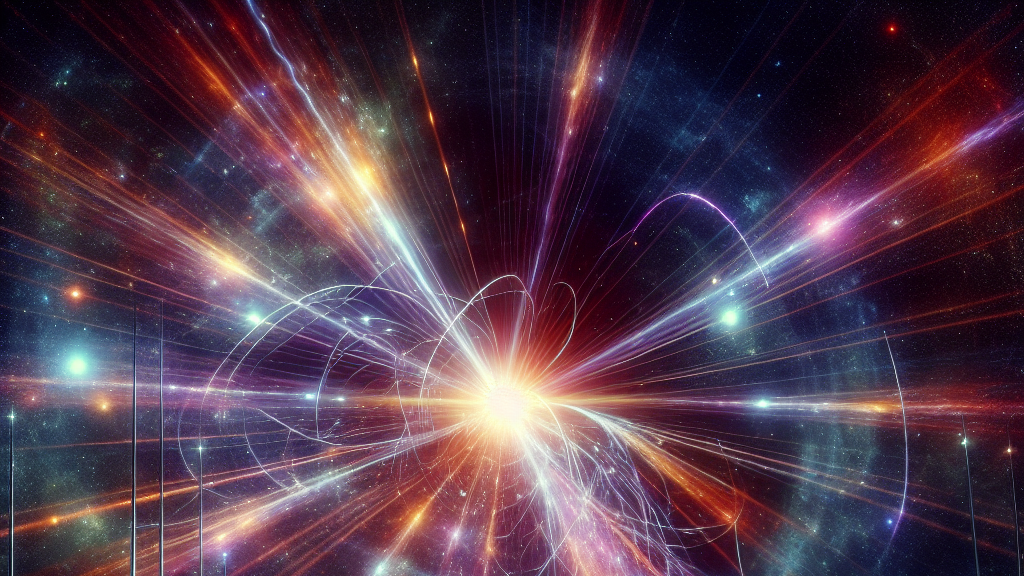
Have you ever wondered what happens when the universe’s most energetic particles collide with invisible forces in space? It’s like the ultimate fireworks show, but instead of bright lights, you get a wave of mysterious particles called cosmogenic neutrinos. These particles could hold the key to understanding some of the biggest cosmic puzzles, like where the universe’s most powerful cosmic rays come from and what exactly is out there in the dark parts of space that we can’t see.
Enter the GRAND project – a massive plan to use radio antennas to catch these neutrinos in action. When cosmic rays smash into things like cosmic microwaves or light from faraway galaxies, they create these high-energy neutrinos. Detecting them isn’t easy, but that’s precisely what GRAND aims to do. By detecting specific types of these neutrinos, scientists can peek into phenomena that challenge what we think we know about physics, like super-light particles that might be dark matter or new types of neutrino interactions.
So why should you care? Imagine scientists using this information to discover new particles that could change how we understand everything from gravity to the very fabric of the universe. It’s the stuff of science fiction coming to life, unlocking new chapters of cosmic knowledge. Someday, this could lead to technology that harnesses the same power, revolutionizing energy, communication, or even travel. It’s all about taking the invisible and making it visible, and the GRAND project could be the telescope that makes that happen.
Did you know that these neutrinos, traveling at nearly the speed of light, can pass through entire planets without stopping?
FAQs
What are cosmogenic neutrinos, and why are they important?
Cosmogenic neutrinos are high-energy particles created when cosmic rays interact with cosmic microwaves or light from distant galaxies. They are crucial because they help us understand the origins and properties of the universe’s most energetic cosmic rays.
How does the GRAND project aim to detect cosmogenic neutrinos?
The GRAND project plans to set up a vast array of radio antennas to detect the tau neutrinos and their antiparticles from the cosmogenic neutrinos, helping scientists study beyond the Standard Model physics.
What new physics could be discovered through studying cosmogenic neutrinos?
Studying cosmogenic neutrinos could reveal new interactions like neutrino self-interactions or interactions with dark matter, potentially unveiling unknown parts of particle physics and the universe.
How do cosmogenic neutrinos interact with dark matter?
One theory suggests that neutrinos might scatter with ultra-light dark matter, which could help scientists understand the existence and behavior of dark matter in the universe.
What makes the detection of cosmogenic neutrinos challenging?
These neutrinos are incredibly elusive, traveling through matter without interacting much, which makes them hard to detect without highly sensitive and specific instruments like the ones used in the GRAND project.
Background
Cosmic rays are high-energy particles from space that constantly bombard Earth. When they collide with the cosmic microwave background or light from distant galaxies, they can produce neutrinos – tiny, nearly massless particles that are difficult to detect. Understanding these interactions can reveal information about the origins and makeup of the universe. Recent advances, such as the GRAND project, aim to precisely detect these elusive neutrinos using sophisticated radio antennas.
History
Cosmic rays were first observed in the early 20th century, but their origins remained mysterious for decades. As technology advanced, scientists proposed that neutrinos could be byproducts of cosmic ray collisions. The first successful neutrino detection in the 1950s opened up new avenues in astrophysics. The GRAND project builds on the groundwork laid by previous experiments, such as IceCube and other neutrino observatories, aiming to provide more detailed insights into cosmic phenomena and beyond the Standard Model physics.
Based on “Cosmogenic neutrinos as probes of new physics” by Luighi P. S. Leal, Daniel Naredo-Tuero, Renata Zukanovich Funchal, available on arXiv (arxiv.org/abs/2504.10576), used under CC BY 4.0 (creativecommons.org/licenses/by/4.0/).