Imagine if computers could look deep into the tiniest bits of the universe and tell us what they find. That’s the exciting prospect of using machine learning in particle physics, an area that studies the fundamental particles at the heart of everything. This research is like giving these computers super-smart glasses to see and understand the chaos of particle collisions better than ever before.
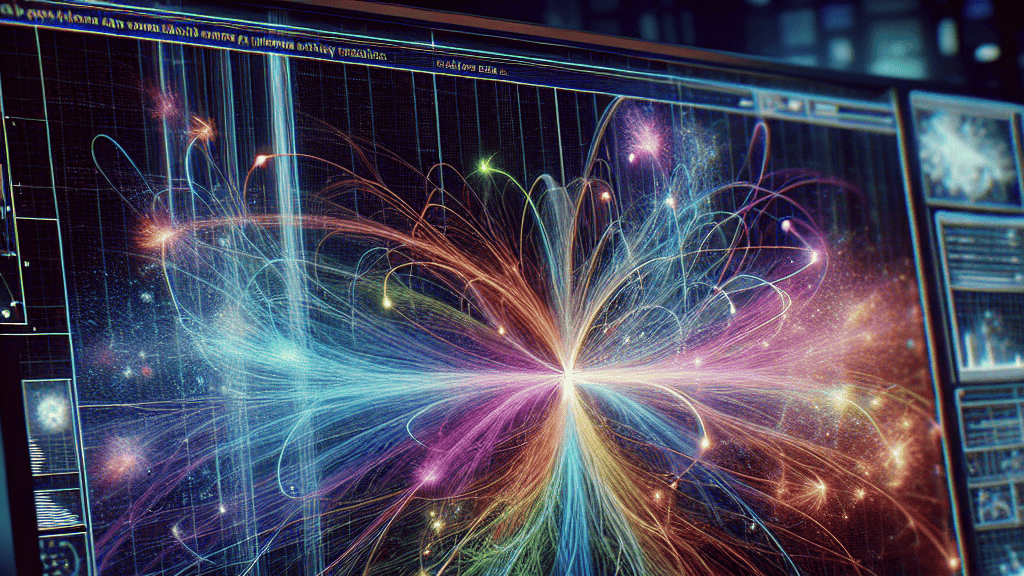
Scientists have studied how machine learning can help recognize and categorize jet patterns in high-energy physics experiments. Jets are collections of particles that emerge when atoms collide at high speeds. Traditionally, finding the origins of these jets has been a complex task using what’s called a ‘cut-based’ method. However, using advanced machine learning models on simulated data, researchers are exploring a better way of detecting and tagging these particle patterns.
The potential impact is massive. Imagine if we could quickly and accurately understand these particle collisions; it could unlock new insights into the universe’s mysteries, from the Big Bang to black holes. This research lays the groundwork for smarter, faster analyses that could change everything from science to technology, potentially influencing fields like medical imaging, climate modeling, and beyond.
Jets are not just fast; they’re one of the speediest phenomena in the universe, moving at nearly the speed of light.
FAQs
What unexpected discovery did scientists make?
Scientists found that machine learning techniques can recognize jet patterns more accurately than traditional methods, which might dramatically improve how we understand particle collisions.
How do jets relate to everyday technology?
Understanding jets better could lead to advancements in technologies like medical imaging or climate modeling by adapting the same complex data analysis techniques.
Why does machine learning matter in this context?
Machine learning offers a way to process vast amounts of complex data from particle experiments more efficiently, helping scientists make quicker discoveries.
Background
In particle physics, jets are sprays of particles resulting from the collision of high-energy protons or other particles. Identifying the origins of these jets is crucial to understanding fundamental forces and particles, which is traditionally done using cut-based methods that involve strict criteria on data patterns.
History
Since the early days of particle physics, scientists have used various techniques to identify particles from collisions, with newer methods evolving with better technology. Recently, machine learning has emerged as a powerful tool to sift through large datasets, offering more flexibility and accuracy compared to older, rule-based approaches.
Based on “Machine Learning Based Top Quark and W Jet Tagging to Hadronic Four-Top Final States Induced by SM as well as BSM Processes” by Jiří Kvita, Petr Baroň, Monika Machalová, Radek Přivara, Rostislav Vodák, Jan Tomeček, available on arXiv (arxiv.org/abs/2501.07589), used under CC BY 4.0 (creativecommons.org/licenses/by/4.0/).