Imagine if the universe had a hidden layer, a secret code that holds the key to everything from gravity to the tiniest particles. That’s what this research explores: how the universe’s symmetry, like a dance of nature’s particles and forces, might have roots in a deeper, more complex space.
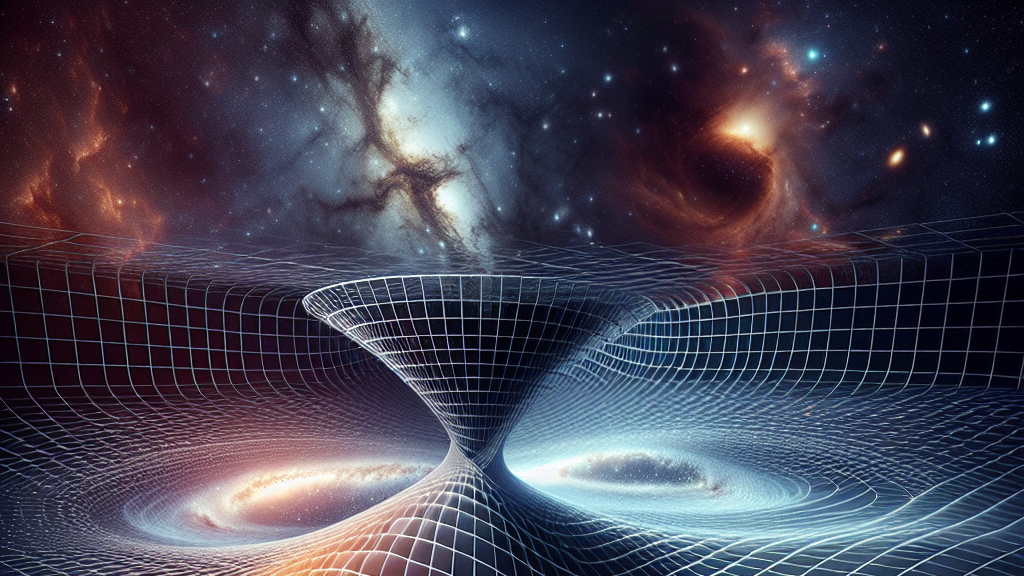
The study looks at spacetime as part of a larger, complex fabric. When viewed in this way, the usual rules of symmetry that apply to the universe’s structure don’t perfectly align. However, by introducing a unique mathematical structure called spin, a familiar picture emerges, resembling the standard model of particle physics, hinting at new ways these fundamental rules might connect to a larger, unseen whole.
In simple terms, this could one day change how we understand basic forces like gravity or electromagnetism, leading to breakthroughs in quantum technology or even new ways to think about the universe’s building blocks. Just like discovering a hidden bridge between two lands, this research might guide us to new shores in the realm of physics.
Did you know? The symmetries of spacetime might actually be hiding a deeper structure that’s key to understanding the universe!
FAQs
How does this research redefine our understanding of spacetime?
This research suggests that spacetime might be part of a larger, more complex structure, which could change how we understand fundamental forces and particles in the universe.
What are spinors and why are they important?
Spinors are mathematical objects used to describe particles like electrons. In this research, they help connect complex spaces to familiar physical concepts, potentially revealing new physics.
How could this research impact future technology?
By offering new insights into quantum mechanics and fundamental forces, this research could pave the way for breakthroughs in quantum technology and a deeper understanding of the universe’s fabric.
Background
The study of symmetries in physics often involves complex mathematical structures. In this context, spacetime symmetries, which dictate the laws governing our universe, are considered within a framework known as the Poincaré group. When seen through the lens of a complex manifold, a mathematical concept referring to higher-dimensional spaces, the usual representation of these symmetries doesn’t fit perfectly. However, by using a concept called spin structure, which is crucial in describing particles like electrons, researchers can find a more comprehensive description that aligns with known physics.
History
The search for a unified understanding of the universe’s fundamental forces has a rich history, stretching back to Einstein’s work on relativity and further refined by the development of quantum mechanics. The standard model of particle physics emerged as a framework to describe these forces and particles. This research builds on that legacy by suggesting that the underlying symmetries of the universe might be part of a larger, more complex structure, potentially offering new insights into the universe’s fundamental nature.
Based on “Complex hidden symmetries in real spacetime and their algebraic structures” by R. Vilela Mendes, available on arXiv (arxiv.org/abs/2501.12960), used under CC BY 4.0 (creativecommons.org/licenses/by/4.0/).