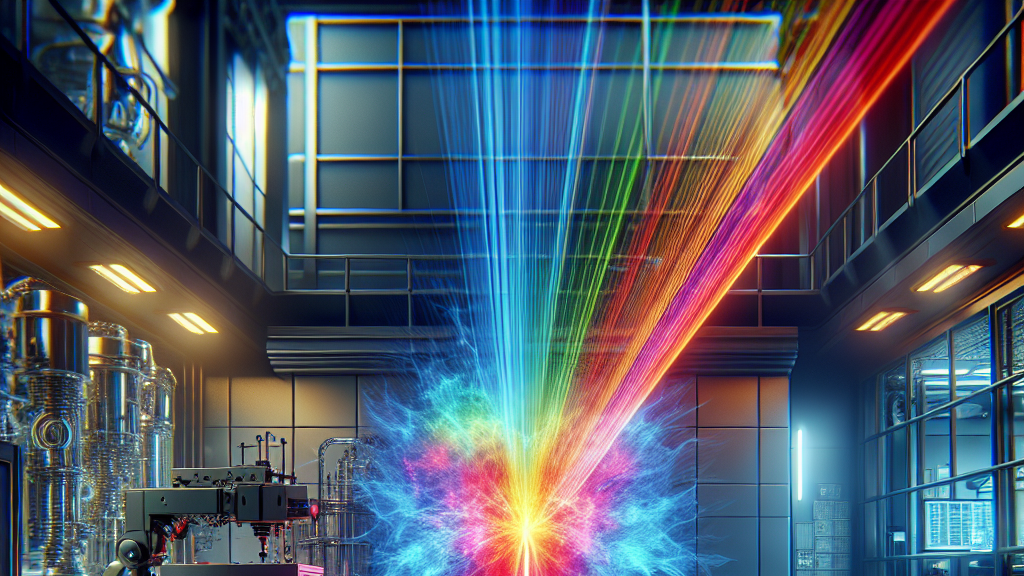
Think about how cool it would be if we could steer light like a magic wand to see through walls or even around corners! That’s essentially what this new research is aiming to do with pulsed terahertz (THz) radiation. Scientists have found a way to control these invisible waves, which are produced by super-quick laser pulses, and direct them in almost any direction they choose—even backward!
The secret lies in a technique called ‘flying focus.’ This involves changing the speed and direction of the ionization front—the area where the laser electrons are knocked out of their atoms—as the laser pulse moves. By carefully managing this, researchers can guide the THz radiation, bending it away from the laser itself. This achievement opens the door to exciting new applications, particularly in remote THz spectroscopy, where you can analyze materials without being right next to them.
Imagine using this technology in the real world. It could become a crucial tool for security checks, allowing us to scan through materials to see what’s hidden inside, or for scientists trying to understand atmospheric conditions remotely—no need to be on site! With the ability to control light like this, the possibilities seem almost endless.
Terahertz radiation can penetrate through clothing and walls, making it a potential game-changer for security and surveillance.
FAQs
How can pulsed THz radiation be directed in different directions?
Scientists use a technique called ‘flying focus,’ which adjusts the speed and direction of the ionization front created by the laser pulse, allowing control over the emission angle of the THz radiation.
Why is THz radiation important in remote sensing?
THz radiation can penetrate various materials and detect hidden objects, making it ideal for non-invasive checks in security, material analysis, and environmental monitoring.
Can this technology really see through walls?
Yes, THz radiation can penetrate walls and other materials, providing the potential for non-invasive scans, similar to how we utilize X-rays, but with different properties and applications.
What might be the future applications of this technology?
Potential applications include remote material analysis, improved security screening, and environmental monitoring from a distance, all enabled by the capability to steer THz radiation.
What makes the flying focus technique unique?
Unlike traditional methods, the flying focus technique provides precise control over the direction and speed of the radiation, allowing more versatility and remote application possibilities.
Background
Terahertz (THz) radiation is part of the electromagnetic spectrum, positioned between microwaves and infrared light. Known for its ability to penetrate through materials that block visible light, THz radiation is valuable in imaging and spectroscopy. The flying focus technique involves manipulating the laser beam’s focal point, influencing where and how the radiation moves, giving scientists precise control over the direction and speed of the emission.
History
In the past, controlling light and other forms of radiation has been limited by the technology available. Researchers have long sought ways to better manipulate these waves for practical applications. The development of ultrashort laser pulses allowed more precise interaction with materials, and the discovery of the flying focus technique represents a significant step in directing THz radiation, diverging from traditional methods.
Based on “Steering laser-produced THz radiation in air with superluminal ionization fronts” by Silin Fu, Baptiste Groussin, Yi Liu, Andre Mysyrowicz, Vladimir Tikhonchuk, Aurelien Houard, available on arXiv (arxiv.org/abs/2407.18579), used under CC BY 4.0 (creativecommons.org/licenses/by/4.0/).