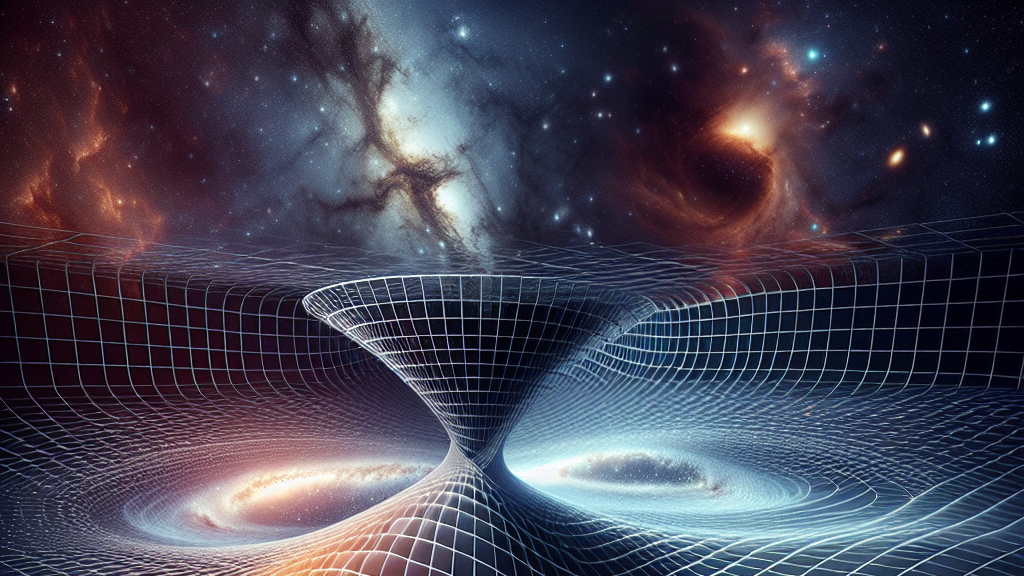
Imagine being able to travel faster than light—yes, like something straight out of a science fiction movie! While this concept excites our imagination, it creates some mind-bending puzzles. One big question is: how do we deal with particles that seem to break the rules of time by going backward? Enter this fascinating new research, which offers an innovative way to tackle these tricky paradoxes.
The study introduces a bold approach that uses a special mathematical tool to ‘regularize’ or smooth out the bizarre idea of tachyons—those hypothetical particles that can exceed light speed. Picture this like bringing order to chaos. By treating these tachyons as an infinite sum of normal particles that always move forward in time, this method ensures everything stays paradox-free. It does so without needing previous theories that were a bit like forcing a square peg into a round hole. Even more intriguing, this method hints at ways we might avoid certain cosmic dramas, like naked singularities, and perhaps even unlock super-speed communication.
In practical terms, if we can truly wrap our heads around this concept, it might one day lead to technologies that allow communication across vast cosmic distances instantly. Imagine sending a message to another galaxy without waiting light-years for a reply! As we continue to explore the mysteries of the universe, these ideas could pave the way for groundbreaking tech that defies our current understanding of speed and time.
Did you know? Tachyons are theoretical particles that move faster than light, which means they could, in theory, travel backward in time!
FAQs
What are tachyons and why are they significant in physics?
Tachyons are theoretical particles that potentially move faster than the speed of light. They are significant because their existence could challenge the foundations of relativity and open new possibilities for understanding time and communication.
How does the proposed regularization principle affect tachyons?
The regularization principle uses mathematical tools to ensure that tachyons, which typically create paradoxes by traveling backward in time, are instead seen as moving forward in time. This approach avoids the usual paradoxes associated with faster-than-light travel.
Could this research impact future technology?
Yes, if the principles are fully understood and applied, it could lead to groundbreaking technologies, such as faster-than-light communication, potentially revolutionizing how we interact across vast cosmic distances.
What is the significance of avoiding naked singularities?
Avoiding naked singularities is important because they represent points where the known laws of physics break down. Keeping our universe logical and predictable is crucial for our understanding of the cosmos.
Are tachyons considered purely theoretical or could they exist?
Currently, tachyons remain theoretical constructs. There is no empirical evidence for their existence, but they are a useful concept in exploring the limits and potential extensions of modern physics.
Background
In physics, tachyons are hypothetical particles that can travel faster than light, challenging the very nature of time and space. They have been a topic of theoretical exploration to understand potential faster-than-light communication or cosmic phenomena like black holes. The study uses specialized mathematical functions, specifically the zeta-function, to reframe tachyons in a manner that avoids paradoxes by ensuring they only go forward in time.
History
The fascination with faster-than-light travel dates back to Albert Einstein’s theory of relativity, which set the speed of light as the ultimate cosmic speed limit. Subsequently, theorists have speculated on particles like tachyons. Previous approaches like the Reinterpretation Principle attempted to explain these oddities, but the new study offers a fresh approach, using mathematical tools to ensure a logical consistency that previous theories struggled to achieve.
Based on “Breaching the light barrier without paradoxes” by Abhishek Kumar Mehta, available on arXiv (arxiv.org/abs/2503.22704), used under CC BY 4.0 (creativecommons.org/licenses/by/4.0/).