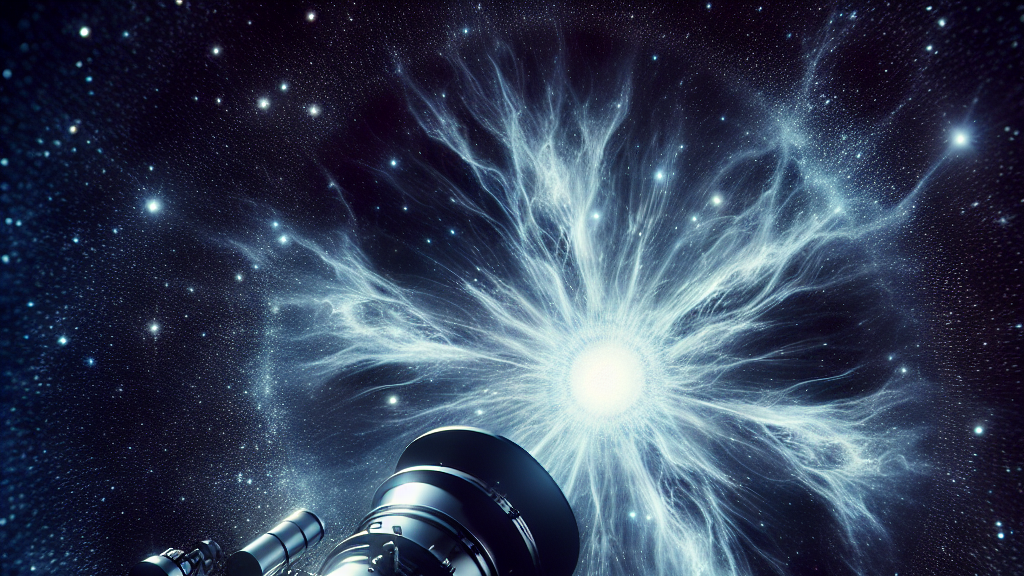
Imagine a telescope so powerful it might help us catch glimpses of mysterious ‘ghost’ particles coming from stars that have exploded, called supernovas. These secretive particles, known as axions, have puzzled scientists for decades. But now, thanks to advanced projects like IAXO and BabyIAXO, there’s a real chance we could finally spot them and unlock some of the universe’s most baffling mysteries. Not only would this be a major breakthrough in understanding axions themselves, but it would also give us a window into the intense and violent processes happening in the hearts of dying stars.
Typically, axions have been challenging to detect, especially those produced by our sun. However, the IAXO project has the sensitivity to catch axions born from supernovas, which are much more intense events. By setting their sights on these powerful cosmic explosions, scientists hope to discover new aspects of supernovas, such as how particles like pions behave and the conditions inside these stellar cauldrons. This research might even lead us to rethink fundamental aspects of nuclear matter and the extreme physics at play.
In the future, if a supernova were to occur relatively close to our cosmic neighborhood, these telescopes could gather crucial data about star explosions and the elusive axions. Such findings could transform our understanding of the universe, affecting everything from the composition of stars to the basics of how energy and matter exist on a nuclear level. So next time you look at the night sky, remember that telescopes might soon uncover the hidden stories of stars that have long disappeared, leaving behind only their mysterious and invisible echoes.
Axions are so elusive, they’ve been called ‘ghost particles’ because they barely interact with anything around them!
FAQs
What are axions and why are they important in understanding supernovas?
Axions are hypothetical particles that could help explain certain mysteries in physics, including the strange phenomena occurring during supernova explosions. Detecting them could provide crucial insights into supernova dynamics and the physics of dense nuclear matter.
How can IAXO and BabyIAXO telescopes detect axions?
IAXO and BabyIAXO are designed with advanced technology and sensitivity to detect axions specifically from high-energy events like supernovas. By aiming these telescopes at such cosmic explosions, scientists hope to capture signals of axions that are otherwise undetectable.
Could this research really change our understanding of space?
Absolutely! If axions can be detected, it will revolutionize our understanding of particle physics and the processes occurring in supernovas, potentially reshaping theories about how stars live and die.
Why haven’t axions been detected before?
Axions are extremely difficult to detect because they rarely interact with other matter, which is why they are known as ghost particles. Earlier experiments lacked the sensitivity needed to see them, but new telescopes like IAXO offer hope.
What real-world applications could arise from axion detection?
Uncovering the secrets of axions might lead to advancements in technology and energy, as well as a deeper understanding of fundamental physics and the universe’s most powerful events like supernovas.
Background
Axions are theoretical particles predicted to solve certain problems in particle physics. They are part of the effort to understand why the sun and other stars act the way they do. A supernova is a massive star explosion that releases a vast amount of energy, providing a perfect environment to study rare particles like axions. These particles are thought to be produced in huge quantities during such energetic events but are hard to detect because they interact very weakly with regular matter.
History
Axions were first proposed in the 1970s as a solution to the strong CP problem in quantum physics. Over time, researchers have suggested that these particles could play a role in dark matter and the mysteries of stellar physics. While previous attempts to detect axions in solar contexts have been made, advances in telescope technologies like IAXO represent a significant leap in exploring axions from supernova sources, thereby opening new avenues in particle astrophysics.
Based on “Detecting Supernova Axions with IAXO” by P. Carenza, J. A. García Pascual, M. Giannotti, I. G. Irastorza, M. Kaltschmidt, A. Lella, A. Lindner, G. Lucente, A. Mirizzi, M. J. Puyuelo, available on arXiv (arxiv.org/abs/2502.19476), used under CC BY 4.0 (creativecommons.org/licenses/by/4.0/).