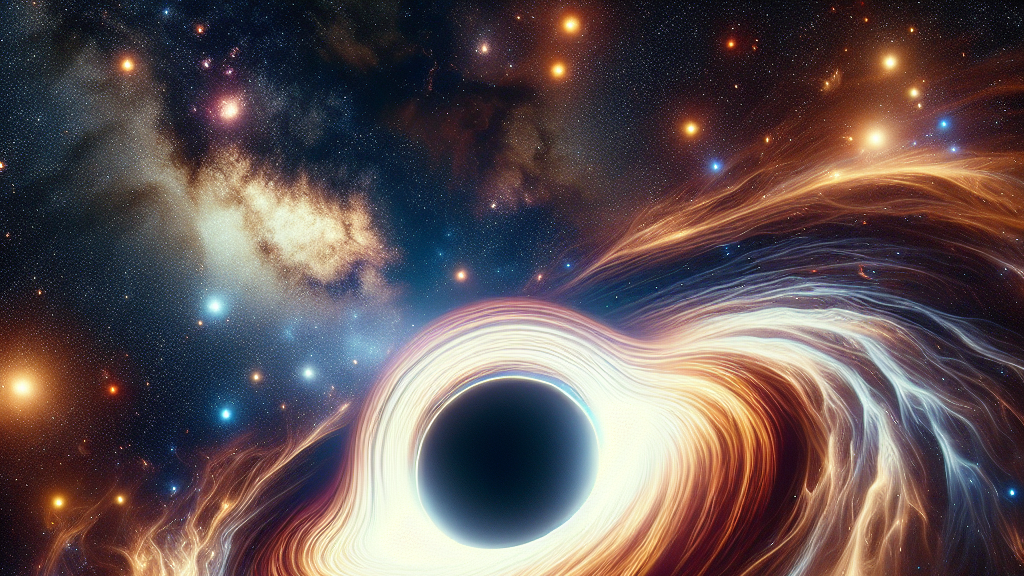
Imagine a world where black holes are not just cosmic vacuum cleaners but creators of dark matter, the mysterious ‘stuff’ that makes up about 85% of the universe. A new study explores this exciting possibility, suggesting that tiny particles known as pseudo-Nambu-Goldstone bosons could be born from black holes under certain conditions. These particles are intriguing candidates for dark matter because they don’t behave like ordinary matter, don’t emit light, and are nearly impossible to detect directly.
The researchers propose an innovative way that these particles might be created. In the early universe, black holes could have emitted these dark matter particles through processes like Hawking radiation or superradiance. These aren’t just random sci-fi terms; they describe real processes where a black hole emits energy. The study examined how particles of different masses can be produced from both rotating and non-rotating black holes, providing new insights into the elusive nature of dark matter.
This research could have profound implications for our understanding of the universe. For instance, it might help explain sudden bursts of neutrinos detected in space, which were previously unaccounted for. If black holes are indeed spawning dark matter in this way, it could offer a new perspective on cosmic phenomena and open up new avenues for studying the early universe and unlocking the secrets of dark matter.
Did you know? Hawking radiation suggests that black holes can slowly ‘evaporate’ over time by emitting particles.
FAQs
What is pseudo-Nambu-Goldstone boson dark matter?
Pseudo-Nambu-Goldstone bosons are tiny particles hypothesized in physics models to be potential candidates for dark matter, which is an unobservable form of matter.
How do black holes create pseud-Nambu-Goldstone boson dark matter?
Black holes might create these particles through processes like Hawking radiation, where energy is emitted, possibly transforming into these dark matter particles.
Why is this research on dark matter important?
This research is crucial because understanding dark matter could unlock many mysteries about the universe’s composition and explain cosmic phenomena we currently can’t account for.
Could this research explain cosmic neutrino bursts?
Yes, this model can potentially explain sudden neutrino events detected by space observatories, linking them to dark matter produced by black holes.
What role do gravitational waves play in this research?
Gravitational waves might carry the signature of these processes, providing indirect evidence of dark matter production through black holes.
Background
Dark matter, which doesn’t interact with light, forms most of the universe’s mass. Pseudo-Nambu-Goldstone bosons are hypothesized particles that could make up dark matter, emerging from the breaking of U(1) symmetry, a concept in physics that deals with fundamental forces. Black holes, known for their gravitational pull, can emit radiation through a process known as Hawking radiation, discovered by Stephen Hawking, suggesting that black holes might lose mass and energy over time.
History
The concept of dark matter originated from the work of Fritz Zwicky in the 1930s, who observed that some galaxies were heavier than they appeared. Since then, physicists have been searching for candidates for dark matter, leading to various models over the decades. The idea of pseudo-Nambu-Goldstone bosons as dark matter candidates has roots in symmetry breaking theories from the 1970s. This study builds on recent advances by integrating these concepts with contemporary theories on black hole physics, significantly influenced by Hawking’s work in the late 20th century.
Based on “Pseudo-Goldstone Dark Matter from Primordial Black Holes: Gravitational Wave Signatures and Implications for KM3-230213A Event at KM3NeT” by Siyu Jiang, Fa Peng Huang, available on arXiv (arxiv.org/abs/2503.14332), used under CC BY 4.0 (creativecommons.org/licenses/by/4.0/).