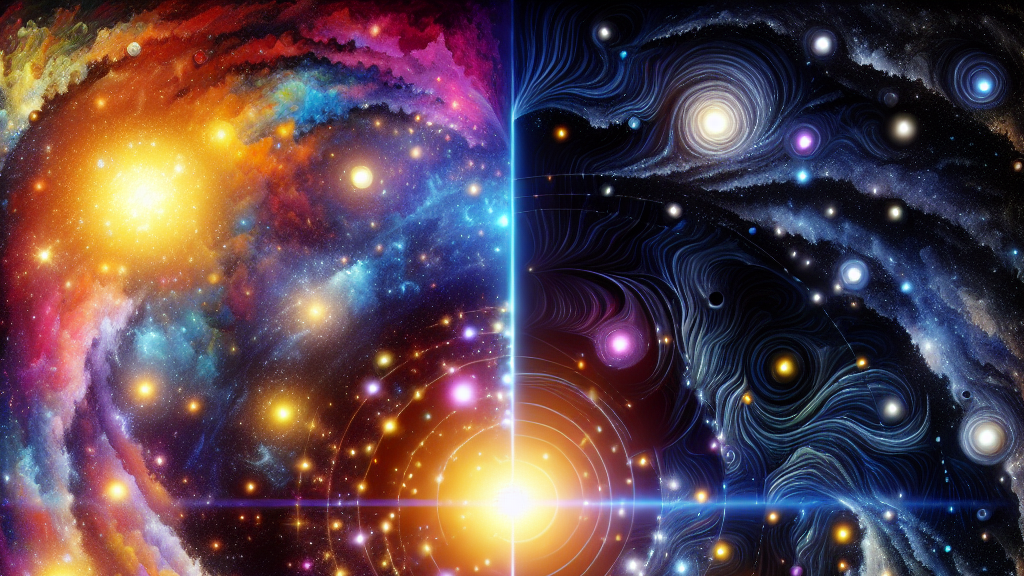
Imagine if the universe as we know it wasn’t the whole story. What if there were hidden realms where the rules were different, and things were way hotter than we ever thought possible? That’s exactly what this fascinating study is exploring! Scientists are diving deep into the possibility that, early on, our universe’s expansion was driven by a mysterious, super-hot realm populated by dark matter. This hidden world was potentially much hotter than the universe we see today, filled with galaxies and stars.
The research looks at a specific scenario where dark matter, along with a dark photon that interacts weakly with our world, dominated this hidden sector. They’re trying to figure out how the universe’s visible side — the part with everything we know and love — eventually warmed up through something called ‘reheating.’ This complex dance between hidden and visible worlds might hold the key to understanding why our universe looks and behaves the way it does today.
Practically speaking, this research could lead to new ways of searching for dark matter, exploring deeper into its mysterious properties. Imagine future experiments designed to look for the telltale signs of this hidden realm! By unveiling this secret side of the universe, scientists hope to piece together not just the past but potentially the future of cosmic discoveries and technologies. The stakes are high — this could reshape what we know about everything!
Dark matter might have kept a secret hotter universe hidden for eons!
FAQs
What does hidden sector mean in dark matter research?
In dark matter research, a hidden sector refers to a part of the universe composed of particles that don’t interact with regular matter in usual ways, making them nearly invisible. This study suggests such a sector could have been much hotter in the early universe.
How does this affect our understanding of the universe’s expansion?
If the early universe’s expansion was driven by a hot hidden sector, it challenges current theories about how galaxies and other cosmic structures formed, potentially offering new insights into the big bang and beyond.
What is meant by reheating of the visible sector?
Reheating of the visible sector refers to the process by which the universe’s standard model particles, like those in stars and galaxies, gained energy and heat from the hidden sector, shaping the universe as we know it today.
Could this research change how we search for dark matter?
Yes, this research could lead to new experimental approaches, using particle physics and cosmic observations to detect the potential interaction between hidden and visible sectors, increasing our chances of discovering dark matter.
What are the potential implications for future technology?
Understanding the interplay between hidden and visible sectors of the universe might lead to new technologies in particle detection, space exploration, and potentially even new physics models that could revolutionize science.
Background
In the early universe, things were much hotter and denser. Scientists theorize that dark matter, a mysterious form of matter that doesn’t emit light, might have played a role in shaping how the universe expanded. In this context, the idea of a ‘hidden sector’ arises, which is a parallel realm consisting of particles such as dark matter and a dark photon. Unlike the visible part of the universe that consists of stars and galaxies, the hidden sector doesn’t interact strongly with light, making it largely invisible to us.
History
The study of dark matter has evolved significantly over the decades. Initially proposed to explain why galaxies don’t fly apart, dark matter has been a puzzle in cosmology. In recent years, theories have proposed more complex interactions and properties of dark matter, including the existence of hidden sectors. Earlier models focused on visible matter, but research like this builds on those by suggesting unseen forces and particles have had major roles in cosmic evolution, influencing theories on big bang and the future of universe.
Based on “Light from darkness: history of a hot dark sector” by Rupert Coy, Jean Kimus, Michel H. G. Tytgat, available on arXiv (arxiv.org/abs/2405.10792), used under CC BY 4.0 (creativecommons.org/licenses/by/4.0/).