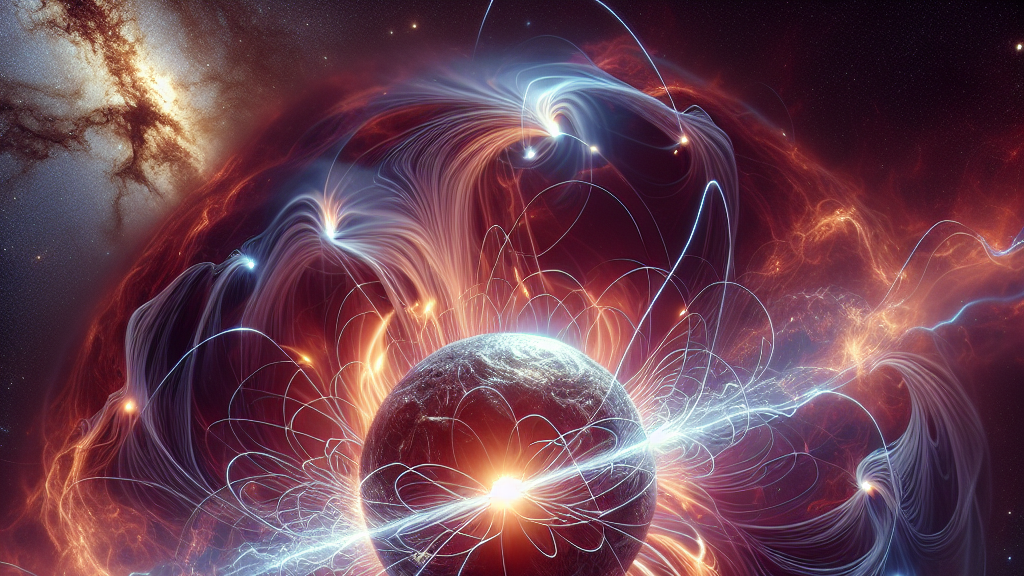
Imagine a world where the tiniest of particles could dramatically change the properties of some of the universe’s most fascinating objects—neutron stars. These stars are the end-stage of massive star explosions, and they pack a jaw-dropping amount of mass into a relatively tiny space, creating incredibly dense environments. Scientists believe that ultra-light versions of mysterious particles, called axions, could exist inside these stars, altering their behavior in surprising ways.
Axions are fascinating because they help solve a big problem in physics known as the strong-charge-parity (CP) problem—basically a conundrum about why matter behaves the way it does. The study delves into how these lightweight axions could condense inside neutron stars, influencing the nuclei and affecting the stars’ internal structure. This could lead to different thermal behaviors and even change how neutron stars emit energy. With these findings, researchers hope to unlock secrets about the complex nature of both axions and neutron stars.
The implications of this research are profound. If axions can indeed alter the mass and energy characteristics of neutron stars, this knowledge could refine our understanding of phenomena like pulsar glitches and neutron star cooling. It might even lead to the discovery of new, exotic types of stars or cosmic structures that challenge our current theories about space and the nature of matter itself. Imagine what would happen if, someday, these findings paved the way for new technologies or modes of energy generation based on cosmic principles!
Did you know that neutron stars can pack the mass of several suns into a sphere only about 12 miles across? It’s like stuffing a mountain into a suitcase!
FAQs
What are axions, and why are they important in neutron stars?
Axions are theoretical particles that solve a major issue in physics known as the strong-charge-parity (CP) problem. When they condense inside neutron stars, they could alter the stars’ structure and behavior, shedding light on mysterious cosmic phenomena.
How does the presence of axions change the behavior of neutron stars?
Axions can modify the interactions of nuclear particles within neutron stars, potentially changing the stars’ energy emission and cooling processes. This could impact observable features like pulsar glitches.
Why is the study of neutron stars important for our understanding of the universe?
Neutron stars are incredibly dense remnants of dead stars. Studying them can reveal much about the fundamental laws of physics, the nature of matter, and cosmic evolution. Insights from neutron star research can lead to breakthroughs in physics and cosmology.
Can understanding axion-neutron star interaction lead to new discoveries?
Yes! By studying these interactions, scientists may uncover new cosmic structures or refine current theories about space. It could even inspire new technologies based on cosmic principles.
What are the potential implications for axion presence in other cosmic phenomena?
If axions influence neutron stars, they might affect other cosmic phenomena too, leading to a deeper understanding of the universe, possibly revealing unknown aspects of physics and matter.
Background
Neutron stars are fascinating cosmic objects that result from the collapse of massive stars after they explode as supernovae. They are incredibly dense, with gravitational fields so strong that they warp space-time. The study centers on axions, hypothetical particles introduced to solve the strong-charge-parity (CP) problem in quantum chromodynamics (QCD), the theory governing strong interactions. Axions, believed to be ultra-light, can condense in high-density environments like neutron stars, potentially altering their structure.
History
The concept of axions was first proposed in the late 1970s to address why CP symmetry—related to the behavior of particles—is not violated in strong nuclear interactions. Since then, axions have been a topic of theoretical interest, particularly in cosmology and particle physics. Recent advancements in detecting changes in neutron stars’ behavior have sparked interest in how axions might be influencing these dense cosmic objects. This study builds on past theories, offering evidence that the presence of axions can modify fundamental aspects of neutron stars.
Based on “Pi in the Sky: Neutron Stars with Exceptionally Light QCD Axions” by Mia Kumamoto, Junwu Huang, Christian Drischler, Masha Baryakhtar, Sanjay Reddy, available on arXiv (arxiv.org/abs/2410.21590), used under CC BY 4.0 (creativecommons.org/licenses/by/4.0/).