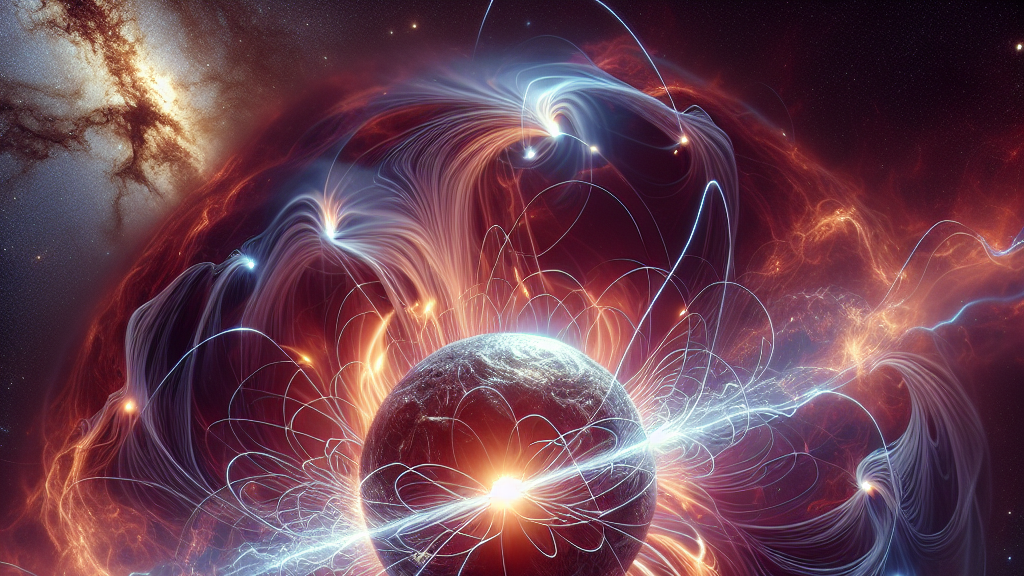
Imagine if tiny particles we can’t even see are hiding the answers to some of the universe’s biggest mysteries. That’s what scientists are exploring with axion stars—neutron stars that may have these mysterious particles inside them. These axions could solve a major cosmic puzzle known as the strong CP problem, which has baffled scientists for decades.
The research looks at how these axion particles affect the matter inside neutron stars. Neutron stars are incredibly dense, and the presence of axions could change the mass, structure, and behavior of the atoms within them. Using advanced theories, scientists are starting to map out how axions might alter the way these stars work, including their energy states and stability.
If axion stars become a reality, they could change everything we know about space and gravity. These stars might not be held together by gravity as we understand it but by the axions’ own forces. Imagine a universe with new kinds of celestial bodies, guiding everything from the galaxy formations around us to gravitational waves that ripple through space. This could redefine our understanding of the cosmos and bring us closer to solving the mysteries of the universe.
Neutron stars are so dense that just a teaspoon of their material would weigh about six billion tons on Earth!
FAQs
What is an axion star?
An axion star is a theoretical type of neutron star that might contain axions—hypothetical particles that could solve the strong charge-parity problem in quantum physics.
How might axion stars affect our understanding of the universe?
Axion stars could alter the way we understand fundamental forces and particles, potentially changing our perception of gravity, neutron star structure, and cosmic phenomena.
Why are axions important for neutron star research?
Axions could alter the masses and interactions within neutron stars, impacting their behavior, thermal properties, and stability.
Could axion stars be detected through observations?
Scientists are investigating changes in neutron star thermal relaxation, cooling, and pulsar glitches to find evidence for axion stars.
What challenges do scientists face in studying axion stars?
Accurately modeling the effects of axions within dense neutron star matter, due to their elusive nature, presents significant theoretical challenges.
Background
Axions are hypothetical particles proposed to solve the strong charge-parity problem in quantum chromodynamics, a theory that describes the strong force binding particles in atomic nuclei. The strong CP problem arises because our current understanding of physics suggests certain symmetries that do not seem to be broken in reality as expected. Axions could provide the missing link, making these symmetries intact. Neutron stars are incredibly dense remnants of supernova explosions, and their extreme conditions make them ideal places to search for evidence of axions, as these particles might form condensed phases and directly affect the star’s properties.
History
Since the late 20th century, the need to address the strong CP problem led physicists to propose the existence of axions. These particles remained elusive, but their potential role in explaining dark matter kept them at the forefront of theoretical physics. The study of neutron stars, which began with their discovery in the 1960s, has gradually revealed their complex nature. Recent advances in detecting gravitational waves and observing neutron star collisions have provided unprecedented insights into their structure. This research builds on decades of theoretical and observational breakthroughs by considering axions as a significant factor in neutron star physics.
Based on “Pi in the Sky: Neutron Stars with Exceptionally Light QCD Axions” by Mia Kumamoto, Junwu Huang, Christian Drischler, Masha Baryakhtar, Sanjay Reddy, available on arXiv (arxiv.org/abs/2410.21590), used under CC BY 4.0 (creativecommons.org/licenses/by/4.0/).