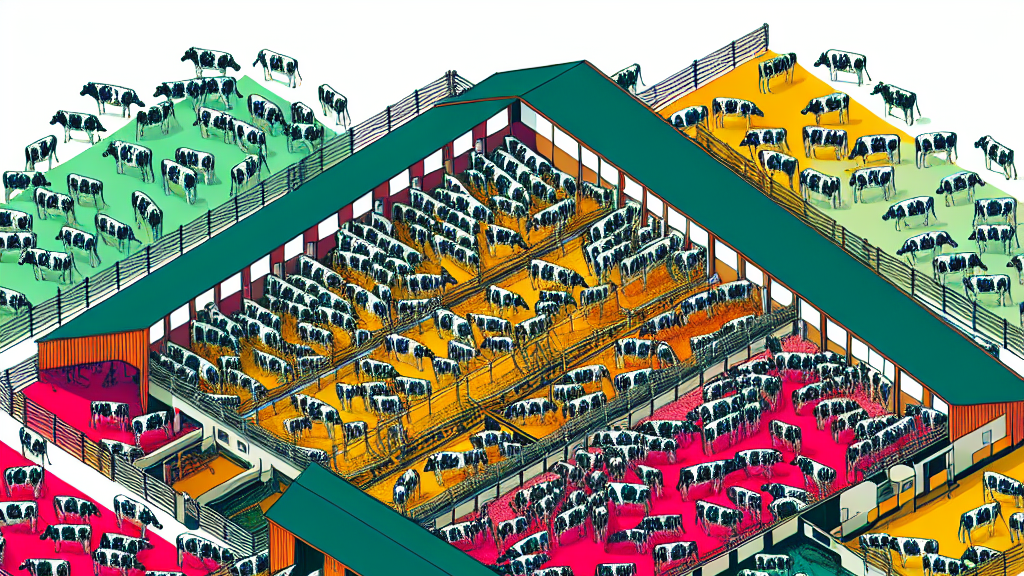
Did you know cows might have hidden social communities right on the farm? Researchers have discovered fascinating insights into how dairy cows interact with each other and their environment. By using a system to track their movements and proximity, scientists have found evidence of social clustering in certain barn areas, despite the overall barn lacking tightly-knit communities.
This study used data from around 210 dairy cows over two weeks, employing a system called Cowview to track their positions. This proximity was used to infer social interactions, with networks visualized through adjacency matrices. The study applied community detection techniques to understand the centralization and hierarchy within these networks. Surprisingly, while cows don’t form stable social groups in the entire barn, distinct communities emerge in zones dedicated to particular activities.
Imagine how understanding cow friendships can help make farms more efficient! By recognizing these social patterns, farmers could optimize barn designs and management practices, improving cow welfare and productivity. Better social environments may lead to happier, healthier cows, ultimately resulting in better milk production and more sustainable farming practices.
Cows have best friends and can become stressed when separated from them!
FAQs
How do cows form social networks on a farm?
Researchers track cow movements using a positioning system like Cowview to see how close they are to each other, which acts as a clue to their social interactions. This reveals how cows form networks based on their proximity.
Why aren’t cows forming stable social groups in the entire barn?
Cows tend to form communities based on activities within particular areas of the barn, indicating their social interactions are more stable in specific, purposeful spaces rather than across the entire barn.
How could understanding cow social networks improve farming?
By understanding cow social patterns, farmers can design barns and practices that promote better social environments, leading to improved cow welfare, milk production, and efficiency on the farm.
Background
Social networks are crucial for understanding how groups of animals interact. In this study, scientists tracked dairy cows using an advanced positioning system to analyze their social behavior based on proximity. By observing connections and interactions, researchers can gain insights into how community structures form and evolve over time. This kind of analysis is key to understanding how social environments impact animal welfare and productivity.
History
Studies on animal social behavior have always fascinated scientists, leading to breakthroughs in understanding group dynamics. Previous research has explored how farm animal social structures influence well-being and productivity. This new study builds on those foundations by using innovative technology to provide a clearer picture of cows’ social lives, adding depth to our understanding of animal interaction in a farm setting.
Based on “Dynamic Social Networks in Dairy Cows” by Emil Grosfilley, Yujie Mu, Dap De Bruijckere, available on arXiv (arxiv.org/abs/2506.06372), used under CC BY 4.0 (creativecommons.org/licenses/by/4.0/).