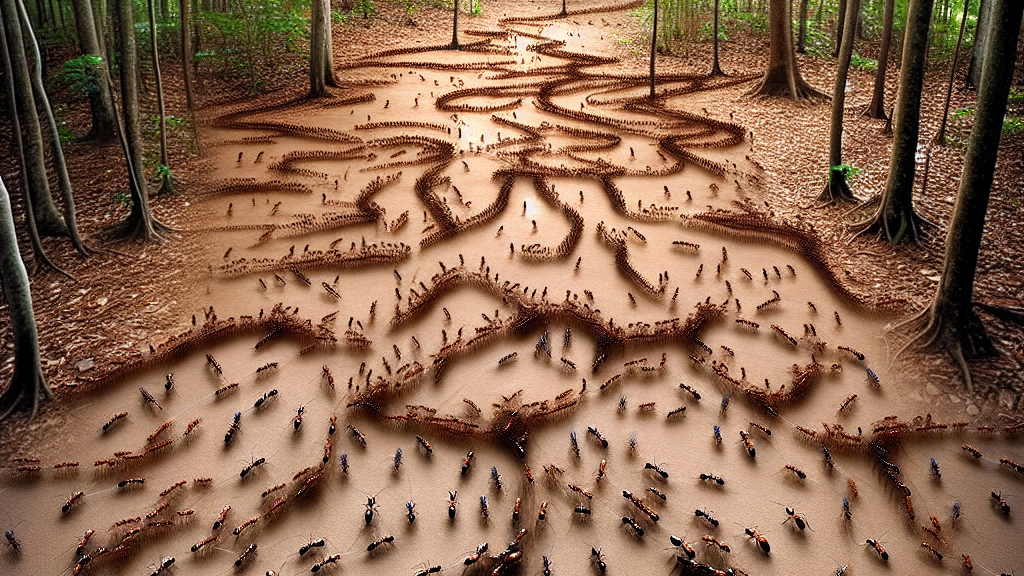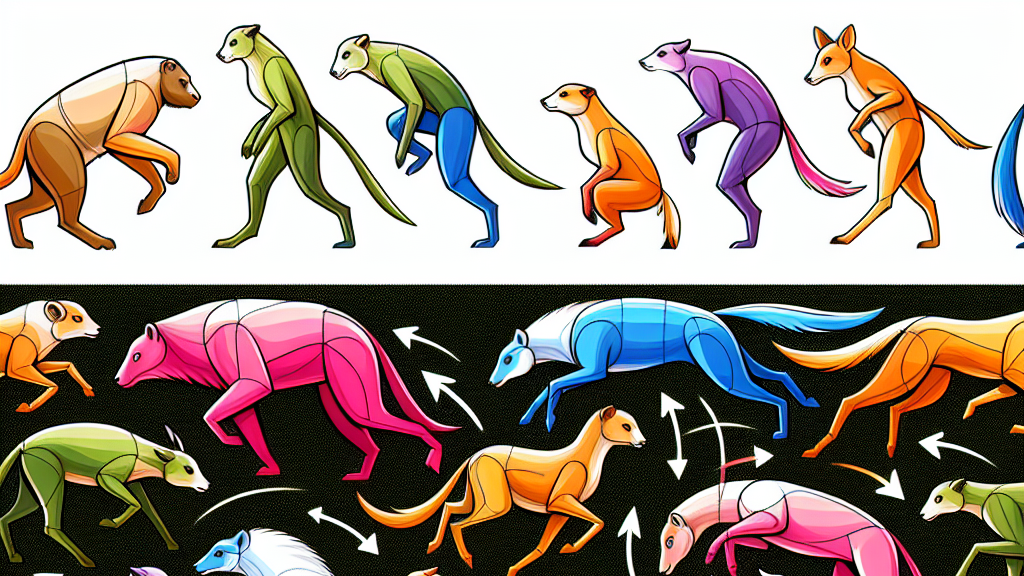
Have you ever wondered if the way animals move and work together could teach us something new? It turns out that the simple rules guiding animal interactions can result in complex and beautiful patterns, much like a choreographed dance. This fascinating discovery could help us understand team dynamics and organization in a whole new light.
Scientists have studied a model where two different types of animals, or particles, interact with each other in unique ways. Instead of simply following the leader or moving in harmony, these animals sometimes do the opposite and move away, known as anti-aligning interactions. What’s surprising is that instead of causing chaos, these interactions can actually lead to the entire group finding a new, more organized way to move together.
Imagine applying this concept to solve human challenges, such as traffic flow or crowd management. If animals can teach us how to self-organize effectively, we might be able to develop smarter systems for our cities, making them not only more efficient but also more harmonious places to live. The study of these animal interactions offers exciting potential to inspire innovation in our world.
Did you know that flocks of birds can change direction in a split second without crashing into each other? It’s all thanks to simple alignment rules!
FAQs
What is self-organization in animals?
Self-organization in animals is when simple interaction rules between individual animals lead to complex group patterns without a central leader, much like birds flying in flocks or fish swimming in schools.
How does anti-alignment promote organization?
Anti-alignment means moving away from others instead of towards them. Surprisingly, it can lead to an overall organized movement as individuals find a new way to align on a larger scale.
Can these animal insights be useful in the real world?
Absolutely! Understanding animal self-organization can inspire better crowd management, efficient traffic systems, and other organizational challenges in human society.
What’s unique about this research on self-organization?
The study reveals that not only do simple rules create complex outcomes, but opposing interactions (anti-alignment) can also lead to global order, offering new insights into team dynamics.
How does this research relate to multi-species systems?
It shows that even with cyclic alignment interactions between multiple species, patterns of coexistence and organization can emerge, highlighting the versatility of self-organization principles.
Background
The research investigates how self-organization emerges in nature through simple interaction rules. By studying how different species interact, researchers aim to understand emergent behaviors (like flocking in birds) that arise from individual actions. This helps to explore new mechanisms for organizing groups and systems effectively.
History
The exploration of self-organization in nature has been ongoing, with early studies focusing on single-species systems, like bird flocks or fish schools. This research builds on those foundations by examining two-species systems with both aligning and anti-aligning interactions, revealing complex behaviors and phase separations never fully understood before.
Based on “Flocking Beyond One Species: Novel Phase Coexistence in a Generalized Two-Species Vicsek Model” by Eloise Lardet, Letian Chen, Thibault Bertrand, available on arXiv (arxiv.org/abs/2503.17617), used under CC BY 4.0 (creativecommons.org/licenses/by/4.0/).