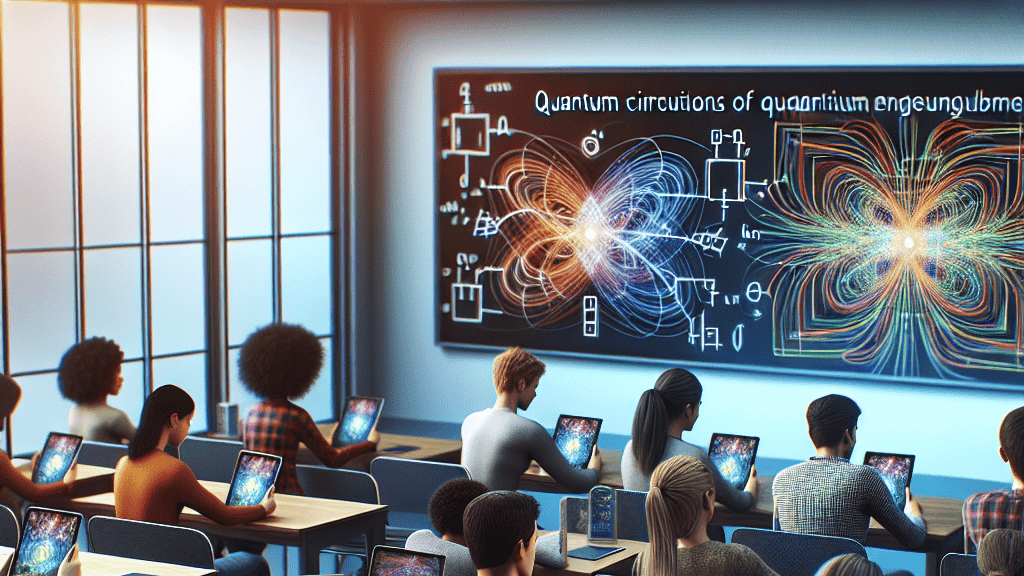
Imagine you’re back in school, where physics was often seen as one of the hardest subjects out there. What if I told you there’s a new way to make these lessons as engaging as your favorite video game? Thanks to quantum computing software, students are plugging into a digital world where they can actually visualize the mysteries of quantum physics, right from the classroom.
In this novel approach, educational materials based on Bell’s inequalities—a fundamental concept in quantum physics—are being reshaped using quantum computing. This is no longer about poring over dusty old textbooks. Instead, students get to use a software tool called Qibo to simulate real quantum circuit experiments. These tools not only teach important concepts like quantum entanglement and non-locality but also allow students to interact with virtual quantum hardware and see the impact of things like noise and statistical variables. It’s like moving from listening to music on an old radio to having a live concert in your room!
So, how can this research change the game for the next generation of students? Picture a world where anyone can dive into the frontiers of science without needing a Ph.D. These educational tools are making it possible for students to understand cutting-edge quantum ideas in a hands-on way. This means more people could join the field of quantum physics and potentially contribute to creating future technologies that we can only dream of today.
Did you know? Quantum computing can simulate real-world phenomena much faster than classical computers, even those as complex as the human brain.
FAQs
What unexpected discovery did scientists make?
They developed tools that make complex quantum mechanics concepts accessible and engaging for students using simulations.
Why are Bell inequalities important?
Bell inequalities help explain quantum entanglement and non-locality, two fundamental principles in quantum mechanics that challenge classical views of reality.
How does Qibo help in learning?
Qibo allows students to simulate quantum circuits, offering a hands-on way to see how quantum concepts work in real time, making learning interactive and fun.
Why should we care about quantum computing?
Quantum computing holds the promise to solve complex problems faster than traditional computers, potentially revolutionizing everything from medicine to finance.
Can anyone use these educational tools?
Yes, these tools are designed to be user-friendly and accessible even for those without a deep background in physics.
Background
Bell inequalities are a set of mathematical inequalities that test the principles of quantum mechanics against classical mechanics. They play a crucial role in understanding quantum entanglement—a phenomenon where particles become interconnected and the state of one can instantly affect the state of another, regardless of distance. The study and simulation of these inequalities not only teach fundamental concepts but also illustrate the limitations of classical interpretations in explaining the quantum world.
History
The concept of Bell inequalities originated from physicist John Bell in the 1960s, who aimed to explore the predictions of quantum mechanics versus classical theories. Over the years, this sparked numerous experiments to test the true nature of reality, leading to pivotal advancements in quantum theory. Today, the availability of quantum computing and software like Qibo builds on this foundation, offering innovative ways to simulate and understand these inequalities in an educational context.
Based on “Simulating Bell inequalities with Qibo” by Isabella Masina, Giuseppe Lo Presti, Matteo Robbiati, Michele Grossi, available on arXiv (arxiv.org/abs/2501.01434), used under CC BY 4.0 (creativecommons.org/licenses/by/4.0/).