Connect with us

Search by keyword

Physics

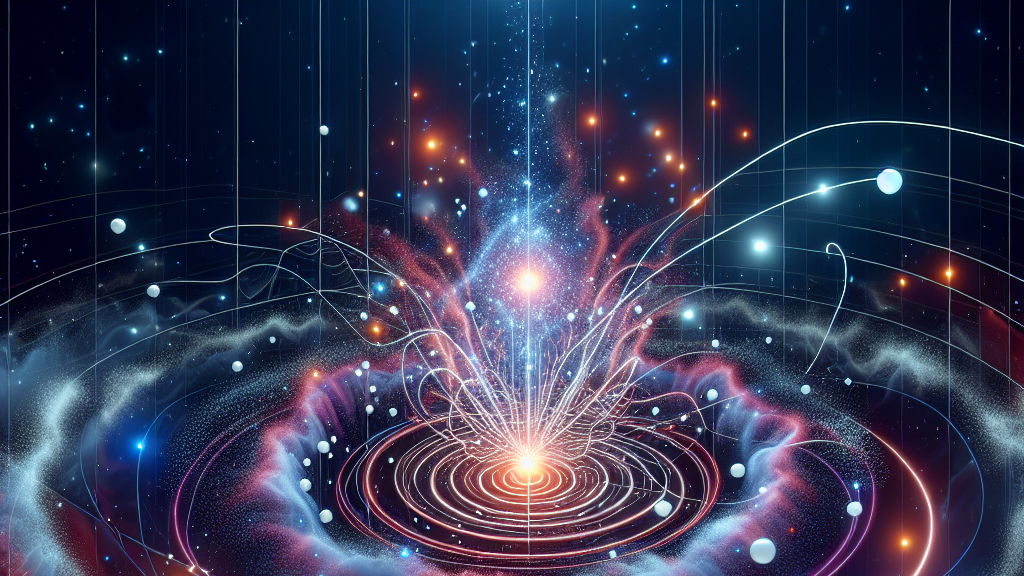
Unlocking Proton Immortality: A Cosmic Mystery

Scientists have discovered a groundbreaking model that ensures protons in atoms live forever using a unique mechanism that withstands even the mysteries of quantum gravity. This discovery could change our understanding of the universe, as it ties into phenomena like dark matter and the behavior of neutrinos.

Unlocking Proton Immortality A Cosmic Mystery
✨Researched by humans. Explained by robots. Learn more.

Did you know that the protons, those tiny particles inside every atom, might actually live forever? Imagine a universe where protons remain absolutely stable, unaffected by even the weirdest effects from unknown realms of quantum gravity. This new scientific model introduces a fascinating twist by using a clever combination of certain particle properties to achieve this stability.

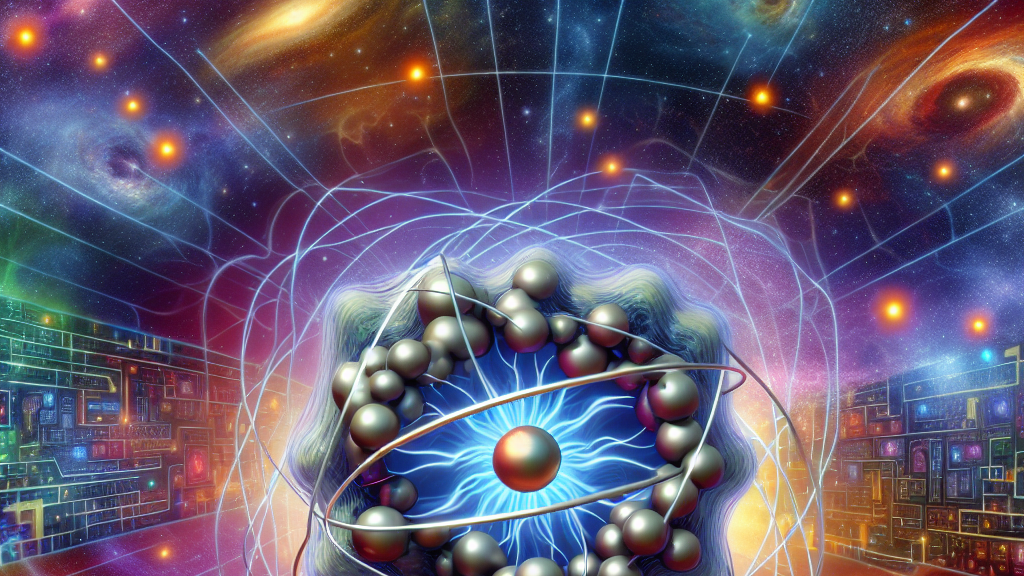
In simple terms, the research explains how a special balance between baryon numbers and lepton flavors is achieved and kept in check by a unique symmetry that acts like a cosmic rulebook. Despite having a minimal setup, this model effectively explains a variety of cosmic phenomena, from the smallness of neutrino masses to how certain particles could make up dark matter. It even predicts cosmic patterns that we might observe through advanced telescopes and space experiments.

Imagine a future where this research helps us detect new cosmic signals or confirms the existence of dark matter particles through various high-tech equipment. This could transform how we perceive the universe and aid in solving big mysteries related to particle physics and cosmology. For instance, by understanding the behavior of neutrinos and other particles better, we might answer questions about the origins of the universe and the forces that shaped it.

Protons are thought to be stable for at least 10^31 years, which is longer than the age of the universe!

FAQs

What makes proton stability so crucial in our universe?

Proton stability is critical because protons are fundamental building blocks of atoms. If they were unstable, the whole material world as we know it would eventually disintegrate, leading to an entirely different universe.

How does the combination of baryon number and lepton flavors affect proton stability?

This combination creates a balance enforced by a special symmetry, ensuring that protons remain stable by preventing certain processes that could otherwise lead to proton decay.

Why are neutrinos important in this research?

Neutrinos are tiny particles with very small masses, and their behavior can give us clues about the universe’s formation and the laws governing particle physics, potentially leading to breakthroughs in understanding dark matter.

How might this research impact future cosmic studies?

This model predicts specific patterns in cosmic radiation and neutrino behavior, paving the way for new discoveries through telescopes and space experiments, and possibly confirming the existence of dark matter particles.

Background

At the core of this research is understanding how protons, which make up the nuclei of atoms, can remain stable over incredibly long timescales. The study explores a new model that uses a gauge symmetry—a kind of cosmic ruleset—to safeguard protons from decay by linking together baryon numbers and lepton flavors. This approach ensures protons remain intact, even when considering unknown quantum effects that typically challenge such stability.

History

Traditionally, the proton has been puzzling scientists due to its immense stability. Previous models tried to explain this by either hypothesizing the existence of new particles or novel mechanisms. This current study builds upon these ideas by integrating a discrete gauge symmetry, which not only preserves proton stability but also aligns with current empirical evidence and provides potential explanations for phenomena like dark matter and neutrino massiveness.

Based on “Insights on the Cosmic Origin of Matter from Proton Stability” by Admir Greljo, Xavier Ponce Díaz, Anders Eller Thomsen, available on arXiv (arxiv.org/abs/2505.18259), used under CC BY 4.0 (creativecommons.org/licenses/by/4.0/).

Trending

Latest

Can AI Save Water Discover How

Computers

AI is transforming the tech world, but it uses lots of water! A new tool, SCARF, helps us measure and reduce AI's water footprint,...

Whats a Forbush Decrease and Why Should We Care Whats a Forbush Decrease and Why Should We Care

Space

Scientists just observed the biggest solar storm event in years, revealing unexpected cosmic ray patterns. Understanding these changes could help us protect our technology...

Can Cars Spot Danger Faster Than Humans Can Cars Spot Danger Faster Than Humans

Computers

Think about how quickly you react when something unexpected happens on the road. This research brings us closer to creating self-driving cars that can...

Can Fear of the Other Stop Social Harmony Can Fear of the Other Stop Social Harmony

Physics

Fear of the unknown might make it harder for people to agree and get along. This study shows that when people have strong xenophobic...

Can AI Revolutionize Breast Cancer Diagnosis Can AI Revolutionize Breast Cancer Diagnosis

Electricity

This research introduces a groundbreaking AI model that can accurately assess HER2-positive breast cancer using widely accessible staining methods, potentially revolutionizing how we diagnose...

Can AI Transform Your Singing into a Choir Can AI Transform Your Singing into a Choir

Computers

Imagine singing solo and having AI turn you into a choir. This research unveils a groundbreaking AI tool that transforms your voice into rich...

You May Also Like

Space

Scientists have discovered a new way that tiny early-universe structures might grow into massive black holes, potentially changing our understanding of cosmic evolution! This...

Space

This research uncovers how setting a visibility limit on starlight reveals more realistic details about galaxies, helping us understand their size and mass better—crucial...

Physics

Recent research suggests that supernova explosions in our galaxy might be key to discovering new, elusive forms of dark matter. These cosmic events could...

Space

Imagine invisible particles shaping galaxies from within! This study suggests that certain types of dark matter could help solve long-standing puzzles about galaxy formations...

Physics

Supernovae might be key to unlocking the secrets of dark matter, especially through its activity in our own galaxy, the Milky Way. This research...

Space

Scientists have discovered a possible explanation for how supermassive black holes could form in the early universe. This breakthrough could change our understanding of...

Space

Scientists have found a novel way to measure dark matter around black holes using light echoes from space. This could change how we understand...

Space

Scientists have uncovered why some small galaxies are born without stars. It turns out, they lack the dense gas needed for star formation, thanks...

Space

Scientists are on a quest to uncover the secret lives of dark matter haloes lurking in space. These invisible giants might be hiding in...

Copyright © 2024 8ig8rain.

Disclaimer: The content on 8ig8rain.com consists of AI-generated summaries of scientific abstracts from arXiv. Please note that most arXiv abstracts are preprints and may not have undergone formal peer review. While these summaries aim to convey key ideas and potential applications, they are provided for informational purposes only and should not be interpreted as validated scientific findings or professional advice. The summaries are intended to educate, spark curiosity, and inspire further exploration of science.