Connect with us

Search by keyword

Physics

Was Einstein a Mystical Genius?

Dive into whether Albert Einstein’s genius was more than scientific—was it also deeply spiritual, intertwined with mystical traditions? This exploration could change how you see one of history’s greatest minds.

Was Einstein a Mystical Genius
✨Researched by humans. Explained by robots. Learn more.

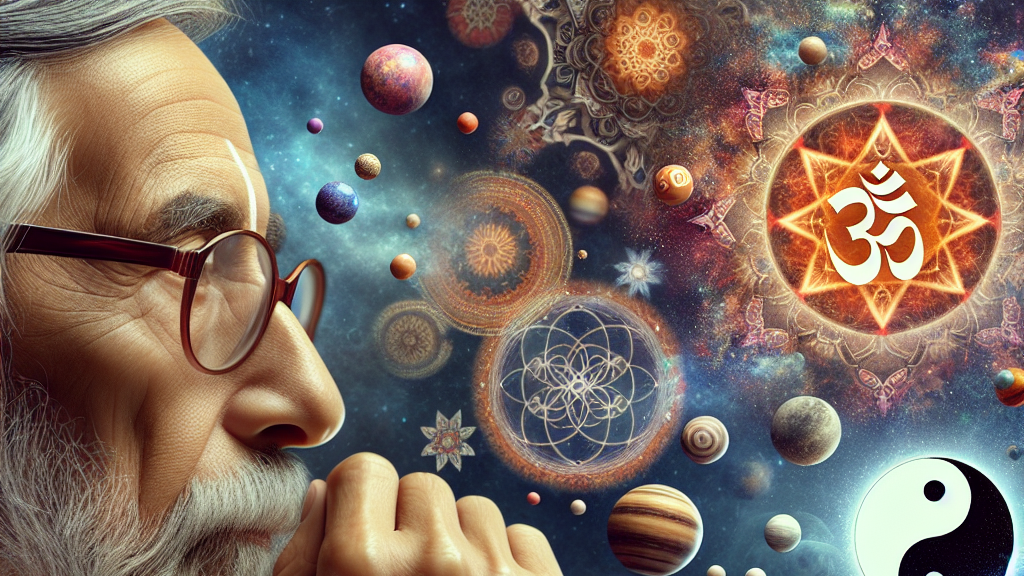
Albert Einstein is often celebrated as one of the greatest scientific minds of all time. But what if his brilliance wasn’t just limited to physics? Kieran Fox’s new paper takes a closer look at the spiritual side of Einstein’s journey, suggesting that his intellectual curiosity might have been a spiritual quest as well. This concept is not entirely new but is deeply fascinating as it challenges the common perception of Einstein as merely a scientist.

Fox proposes that Einstein could be the modern successor to a long-neglected tradition of rational spirituality, linking figures like Pythagoras and Spinoza to Eastern philosophies such as Vedanta and Buddhism. This blend of Western and Eastern influences might have led Einstein to develop a unique form of pantheistic mysticism—a belief in the divine all around us, woven through the very fabric of the universe. However, the paper highlights that this interpretation might oversimplify the complex layers of Einstein’s actual beliefs.

Understanding Einstein’s potential mystical inclination could shift how we view his contributions to science and society. Imagine if his visions of the universe went beyond equations and entered the realm of spiritual enlightenment! Such a perspective might inspire us to explore the ties between science and spirituality in our own lives, urging us to seek a balance between logic and wonder.

Albert Einstein reportedly once said, ‘I want to know God’s thoughts; the rest are details.’

FAQs

Was Albert Einstein really on a spiritual journey?

Kieran Fox’s paper suggests Einstein’s intellectual journey included a spiritual element, influenced by both Western and Eastern traditions. However, some critics argue this oversimplifies his complex thoughts and beliefs.

How did Albert Einstein’s ideas connect to both Western and Eastern philosophies?

Einstein’s ideas about cosmic unity and reverence for nature align with Western figures like Spinoza and Eastern philosophies like Vedanta and Buddhism, suggesting a unique form of pantheistic mysticism.

Could Albert Einstein’s mystical side change our view of him?

Yes, if Einstein’s genius included a spiritual element, it may inspire us to explore the connections between science and spirituality, broadening our understanding of his contributions beyond physics.

Background

If you’ve ever wondered how Einstein thought, you’ll notice he was always curious about the universe’s mysteries. His famous equation, E=mc², revolutionized physics by showing that energy and mass are interchangeable. But he wasn’t just about numbers and formulas; he pondered big questions about life, existence, and the universe’s interconnectedness—topics that also resonate with spiritual traditions.

History

The idea of rational spirituality has deep roots, with thinkers like Pythagoras and Spinoza exploring the connection between logic and the divine. Einstein’s work in the early 20th century, showcasing a universe full of wonder and mystery, has led some to view him as the heir to this tradition, blending science with a deeper sense of cosmic unity.

Based on “How One Quiet Man Became Everyone’s Sage: The Spiritual Recasting of Einstein” by Galina Weinstein, available on arXiv (arxiv.org/abs/2505.19695), used under CC BY 4.0 (creativecommons.org/licenses/by/4.0/).

Trending

Latest

Can AI Save Water Discover How

Computers

AI is transforming the tech world, but it uses lots of water! A new tool, SCARF, helps us measure and reduce AI's water footprint,...

Whats a Forbush Decrease and Why Should We Care Whats a Forbush Decrease and Why Should We Care

Space

Scientists just observed the biggest solar storm event in years, revealing unexpected cosmic ray patterns. Understanding these changes could help us protect our technology...

Can Cars Spot Danger Faster Than Humans Can Cars Spot Danger Faster Than Humans

Computers

Think about how quickly you react when something unexpected happens on the road. This research brings us closer to creating self-driving cars that can...

Can Fear of the Other Stop Social Harmony Can Fear of the Other Stop Social Harmony

Physics

Fear of the unknown might make it harder for people to agree and get along. This study shows that when people have strong xenophobic...

Can AI Revolutionize Breast Cancer Diagnosis Can AI Revolutionize Breast Cancer Diagnosis

Electricity

This research introduces a groundbreaking AI model that can accurately assess HER2-positive breast cancer using widely accessible staining methods, potentially revolutionizing how we diagnose...

Can AI Transform Your Singing into a Choir Can AI Transform Your Singing into a Choir

Computers

Imagine singing solo and having AI turn you into a choir. This research unveils a groundbreaking AI tool that transforms your voice into rich...

You May Also Like

Physics

This new simulation shows how moving alters your view of electric and magnetic fields, making complex physics fun and understandable. Explore how Einstein's theories...

Physics

You know the mysterious world where two particles can be linked so perfectly that knowing everything about one tells you everything about the other?...

Physics

Inertia is that mystical force influencing everything from a rolling ball to Earth’s orbit. This research redefines how we understand motion, based on the...

Physics

Ever wondered what inertia really is? This research could reshape our understanding of motion, potentially impacting everything from space travel to everyday transport.

General Relativity and Quantum Cosmology

Discover how a new twist on black holes suggests that the information they absorb isn't lost forever, but can be recovered, transforming how we...

Physics

Imagine a new way of understanding gravity by tweaking Einstein’s original ideas, bringing us one step closer to a deeper understanding of the universe....

Copyright © 2024 8ig8rain.

Disclaimer: The content on 8ig8rain.com consists of AI-generated summaries of scientific abstracts from arXiv. Please note that most arXiv abstracts are preprints and may not have undergone formal peer review. While these summaries aim to convey key ideas and potential applications, they are provided for informational purposes only and should not be interpreted as validated scientific findings or professional advice. The summaries are intended to educate, spark curiosity, and inspire further exploration of science.