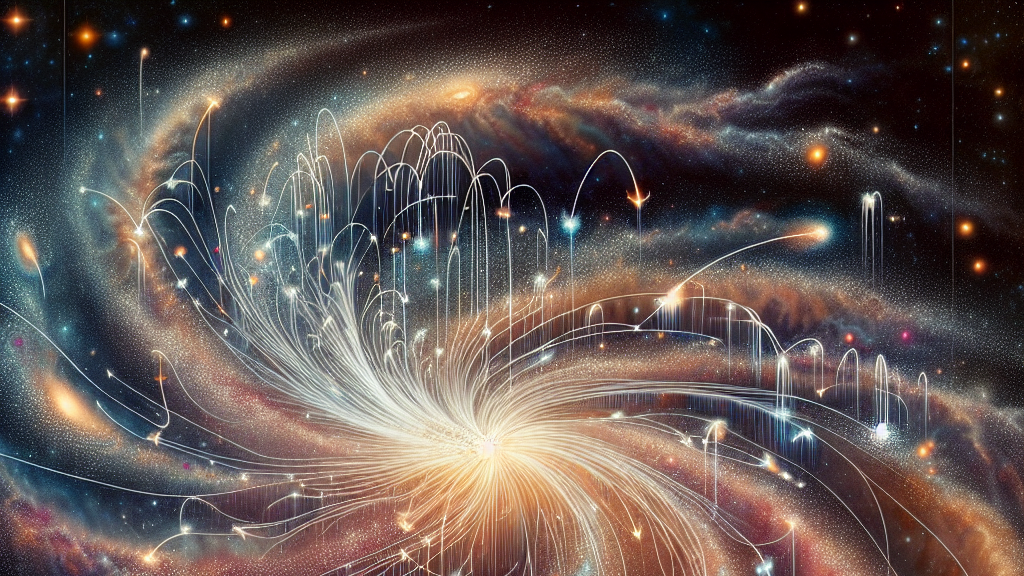
Imagine a stellar juggernaut, a massive star, reaching the end of its life. As it explodes in a jaw-dropping supernova, you might think it obliterates everything around it. Yet, this cosmic apocalypse might not entirely wipe out the surrounding dust, which can tell us incredible stories about the universe’s evolution.
Researchers have been investigating how dust from these massive stars interacts with shocking supernova blasts. Through high-tech simulations, they’ve tracked dust particles in the chaotic aftermath of these explosions. Amazingly, the dust’s fate depends on when the supernova strikes and the surrounding cosmic environment. In some cases, up to 75% of the dust can survive if the supernova follows just a few years after a giant stellar eruption.
This unexpected survival of cosmic dust has big implications. If dust can make it through these powerful cosmic events, it suggests that the universe has a crafty way of preserving elements that play essential roles in forming new stars and planets. Just think about it: the dust that survives a supernova could eventually become part of new celestial bodies, maybe even fuel life in the cosmos! This research could help us understand not just the life cycles of stars but also the ingredients for our own existence in this vast universe.
Did you know? Some cosmic dust particles have been around longer than our solar system!
FAQs
What happens to cosmic dust during a supernova explosion?
During a supernova explosion, shock waves generated can destroy cosmic dust, but surprisingly, some dust can survive depending on the timing and environment of the explosion.
How does the geometry of the circumstellar medium affect dust survival post-supernova?
The shape of the surrounding space environment plays a crucial role. In a spherical medium, more dust survives compared to a bipolar one due to how shock waves dissipate.
What percentage of dust survives if a supernova occurs shortly after a stellar eruption?
When a supernova follows a giant stellar eruption by just a few years, about 75% of the dust may survive, illustrating an unexpected resilience in cosmic dust.
Why is understanding dust survival important for astronomy?
Understanding dust survival helps scientists learn about the life cycles of stars and the formation of galaxies, as dust is a key component in building stars and potential life-supporting planets.
Can surviving dust from supernovae contribute to new celestial bodies?
Yes, the surviving dust can become part of the material that forms new stars, planets, and even contributes to the conditions necessary for life over cosmic timescales.
Background
Massive stars, those with more than eight times the mass of our Sun, go through dramatic end-of-life stages. When they run out of nuclear fuel, they can’t support their own weight and collapse under gravity, leading to a supernova explosion. This event releases immense energy, obliterating the star’s outer layers, which interact with nearby dust and matter known as the circumstellar medium (CSM). Dust in the CSM, formed from previous stellar eruptions, faces destruction from these shock waves but also has a chance to survive, thus playing a crucial role in astronomical processes.
History
The study of supernovae and dust interaction is rooted in understanding stellar life cycles. With the development of advanced telescopic and computational technologies, scientists have been able to simulate and study these cosmic events more accurately. This research builds on previous studies by modeling how shock waves from different supernova scenarios impact dust survival, considering various CSM geometries and timings.
Based on “The bright, dusty aftermath of giant eruptions & H-rich supernovae. Late interaction of supernova shocks & dusty circumstellar shells” by Diana B. Serrano-Hernández (Instituto Nacional de Astrofísica, Óptica y Electrónica), Sergio Martínez-González (Instituto Nacional de Astrofísica, Óptica y Electrónica), Santiago Jiménez (Astronomical Institute of the Czech Academy of Sciences), Sergiy Silich (Instituto Nacional de Astrofísica, Óptica y Electrónica), Richard Wunsch (Astronomical Institute of the Czech Academy of Sciences), available on arXiv (arxiv.org/abs/2502.09700), used under CC BY 4.0 (creativecommons.org/licenses/by/4.0/).