Have you ever wondered what’s really happening at the center of our galaxy? Scientists have just taken a major leap in understanding the forces at play around the supermassive black hole lurking there. By studying star S2, which orbits this dense area, a team has revealed new insights into gravity that could shake up everything we know about the universe.
They used data collected by powerful instruments at the Very Large Telescope to watch how star S2 moves. By applying a special kind of analysis called Markov Chain Monte Carlo, the researchers looked for signs of a strange gravitational effect, known as Yukawa-like correction. This effect could change how gravity behaves on a gigantic scale. And guess what? They’ve narrowed down how intense this effect can be with incredible precision.
Imagine this: If we can better understand how gravity works even under the most extreme conditions, it could lead to breakthroughs in technology and our understanding of space travel and the universe. For example, new insights about gravity at such scales might help us craft better navigation systems for spacecraft or even foresee ways to harness energy in ways we can’t yet dream of. It’s like seeing the blueprints of the universe unfolding right in front of our eyes!
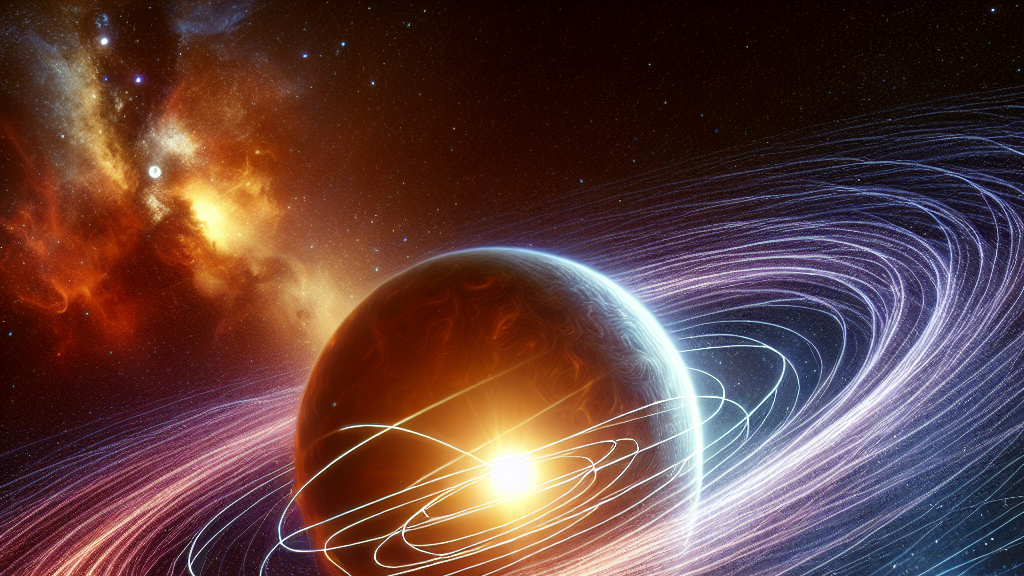
Star S2 travels at over 11,000 miles per second around the galactic center!
FAQs
What is the Yukawa-like correction to Newtonian gravity?
The Yukawa-like correction is a theoretical modification of Newtonian gravity that adds an additional factor, potentially altering gravitational forces over large distances. It’s expressed as a term that decreases with distance, which could mean gravity behaves differently than previously thought.
How does this research use star S2 at the Galactic Center?
Researchers tracked the movements of star S2, which orbits close to the galaxy’s center, using data from cutting-edge telescopes. By studying its path, they gained insights into gravitational forces at extreme distances.
Why is the discovery important for understanding the universe?
Understanding how gravity works around massive objects like the one at our galactic center can refine our general knowledge of physics, possibly leading to groundbreaking applications in space travel and technology.
How was the precision of this study achieved?
The incredibly detailed data from the GRAVITY instrument and a sophisticated analytical method called Markov Chain Monte Carlo allowed scientists to make precise measurements of gravitational effects.
What are the practical implications of understanding these gravitational forces?
Better understanding these forces can improve space navigation, contribute to energy research, and enhance our overall understanding of the universe’s mechanics.
Background
The Yukawa correction to gravity suggests deviations from classical Newtonian physics at large scales, introducing a term that decays exponentially with distance. This adds complexity to large-scale gravitational interactions, particularly in dense environments like around black holes. By analyzing the orbit of star S2, researchers use this concept to test gravity’s behavior in such extreme conditions.
History
The study of gravity has evolved with many contributions from Albert Einstein’s theory of general relativity, which revised Newton’s laws by considering the curvature of spacetime. More recently, physicists have proposed modifications, such as the Yukawa correction, to explore gravity under different cosmic conditions. This study builds on previous research by applying precise observational data and advanced analytical techniques to refine our understanding.
Based on “On the presence of a fifth force at the Galactic Center” by The GRAVITY Collaboration, K. Abd El Dayem, R. Abuter, N. Aimar, P. Amaro Seoane, A. Amorim, J. P. Berger, H. Bonnet, G. Bourdarot, W. Brandner, V. Cardoso, Y. Clénet, R. Davies, P. T. de Zeeuw, A. Drescher, A. Eckart, F. Eisenhauer, H. Feuchtgruber, G. Finger, N. M. Förster Schreiber, A. Foschi, P. Garcia, E. Gendron, R. Genzel, S. Gillessen, M. Hartl, X. Haubois, F. Haussmann, T. Henning, S. Hippler, M. Horrobin, L. Jochum, L. Jocou, A. Kaufer, P. Kervella, S. Lacour, V. Lapeyrière, J. -B. Le Bouquin, P. Léna, D. Lutz, F. Mang, N. More, J. Osorno, T. Ott, T. Paumard, K. Perraut, G. Perrin, S. Rabien, D. C. Ribeiro, M. Sadun Bordoni, S. Scheithauer, J. Shangguan, T. Shimizu, J. Stadler, O. Straub, C. Straubmeier, E. Sturm, L. J. Tacconi, I. Urso, F. Vincent, S. D. von Fellenberg, E. Wieprecht, J. Woillez, available on arXiv (arxiv.org/abs/2504.02908), used under CC BY 4.0 (creativecommons.org/licenses/by/4.0/).