Imagine two tiny particles behaving like friends moving closer together and, even without touching, forming a mysterious connection due to gravity. Scientists have discovered that this connection, known as entanglement, can happen quickly and doesn’t require the particles to be very heavy. This means it’s possible to observe this fascinating quantum phenomenon with simpler and more affordable experiments.
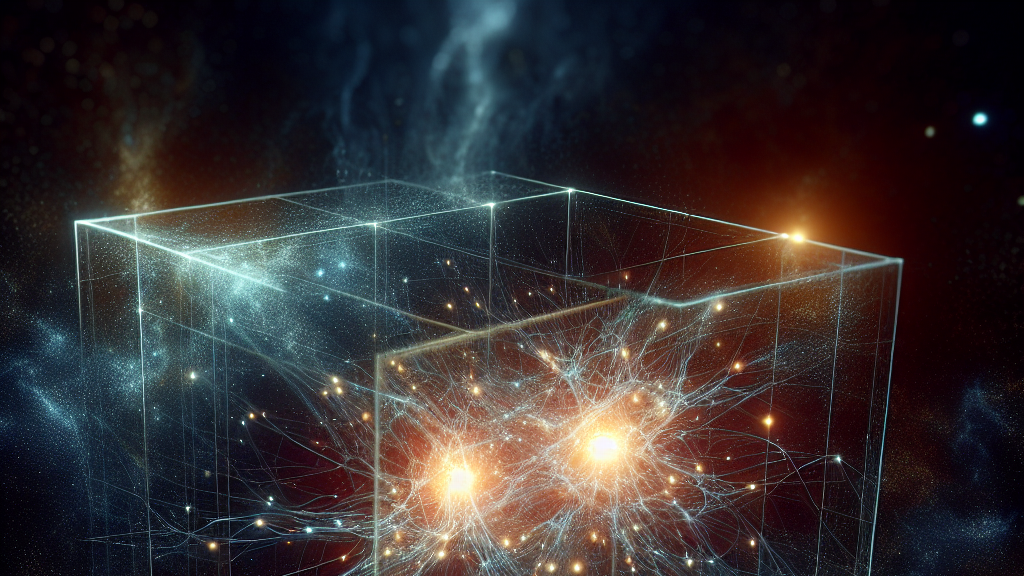
In their study, researchers started with two particles locked in boxes, or ‘potential wells,’ which are isolated spaces that keep them confined. Each particle was in its calmest state at first. As they slowly drew the particles toward each other, they noticed that gravity helped these particles become entangled, almost as if they were whispering secrets from a distance. This approach is unique because it allows this magical connection with smaller particles than ever before, reducing the cost and complexity of experiments.
This breakthrough means we could witness these mysterious quantum events not just in high-tech labs but potentially in classrooms or smaller research settings in the future. Imagine being able to show students or curious minds firsthand how the universe’s tiniest elements can interact in ways we can’t even fully comprehend yet. It’s not just a step forward for scientists but also for making science more fun and accessible for everyone.
Did you know that quantum entanglement was once described by Einstein as ‘spooky action at a distance’?
FAQs
What is quantum entanglement, and how does gravity play a role in it?
Quantum entanglement is a phenomenon where particles become interconnected in such a way that the state of one instantly influences the state of another, no matter how far apart they are. In this research, gravity plays a role by facilitating this connection between particles even when they are initially confined in separate spaces.
Why is reducing particle mass important for studying quantum entanglement?
Reducing particle mass makes it simpler and cheaper to study quantum entanglement. It lowers the experimental threshold, allowing researchers to conduct these experiments with more accessible resources, opening the door for more scientists and educators to explore this quantum phenomenon.
How could this research impact future scientific experiments or education?
This research can make studying quantum mechanics more affordable and widespread. Smaller and less expensive setups mean that universities, schools, and smaller research facilities could conduct experiments showcasing quantum entanglement, greatly enhancing science education and understanding.
Background
In quantum physics, entanglement refers to a unique connection between particles where the properties of one particle are directly linked with another, regardless of the distance between them. This is considered one of the strangest and most fascinating phenomena in quantum mechanics, often challenging our classical understanding of the world. By using potential wells, researchers can contain particles within set boundaries to study their interactions under controlled conditions. These wells help simplify complex quantum behaviors for better observation and measurement.
History
Quantum entanglement was first famously noted by Albert Einstein, Boris Podolsky, and Nathan Rosen in the 1930s. It was dubbed ‘spooky action at a distance’ by Einstein, who was skeptical of its implications. Over the decades, experiments have confirmed entanglement’s realness, but challenges remained, especially concerning the heavy particles needed for clear observation. This study innovates by using smaller particles, building on the foundational work while simplifying the experimental requirements.
Based on “Entanglement induced by quantum gravity in an infinite square well” by Chi Zhang, Fu-Wen Shu, available on arXiv (arxiv.org/abs/2504.10543), used under CC BY 4.0 (creativecommons.org/licenses/by/4.0/).