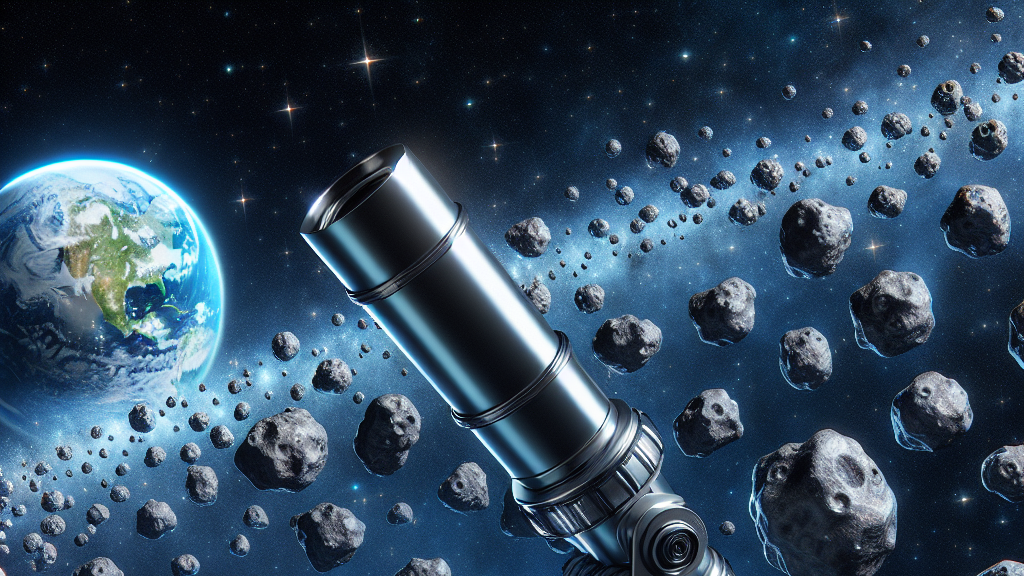
Imagine countless tiny asteroids, like hidden dangers lurking in space, all potentially on a path towards Earth. These small cosmic travelers, while they may seem insignificant, can cause massive destruction if they collide with our planet. That’s why scientists are dedicated to spotting them, and the James Webb Space Telescope (JWST) is now making this daunting task a bit easier.
The new research has leveraged JWST’s advanced infrared capabilities to detect some of the smallest asteroids ever seen in the main asteroid belt. By capturing the heat they emit, JWST helps us understand their size, shape, and path. This is crucial because it helps us paint a more accurate picture of how many of these celestial objects might become near-Earth objects (NEOs), potentially delivering meteorites to our planet. The findings reveal surprising variations in size, which helps scientists understand the processes that transport these asteroids closer to Earth.
In the near future, this research could lead to a revolutionary leap in our ability to predict and prevent potential asteroid impacts. By identifying and mapping thousands of these tiny space rocks, scientists can keep better track of them and develop strategies to divert them if necessary. It’s like having a new, highly efficient guardian in space, watching out for any threats headed our way.
The James Webb Space Telescope can spot asteroids as small as 10 meters—about the size of a bus!
FAQs
How does the James Webb Space Telescope help in detecting small asteroids?
The James Webb Space Telescope uses its advanced infrared capabilities to detect the heat emitted by small asteroids, allowing scientists to determine their size and trajectory even when they are too small to be seen directly.
Why is it important to find small asteroids near Earth?
Small asteroids can cause significant damage if they impact Earth. By detecting them, scientists can better predict potential collisions and work on preventive measures to safeguard our planet.
What makes the new discoveries about asteroid size distribution important?
The new discoveries provide insights into how asteroids are transported towards Earth and influence our understanding of their origins, especially regarding the potential delivery of meteorites to our planet.
What are the implications of these findings for planetary defense?
These findings enable better tracking of thousands of small asteroids, improving our ability to predict and prevent possible impacts, thus enhancing planetary defense strategies.
Which asteroid families have been primarily studied in this research?
The research indicates that the asteroids detected likely originate from the Nysa, Polana, and Massalia families, helping to map out their potential pathways towards Earth.
Background
Asteroids orbit the Sun much like planets but are significantly smaller. While most reside in the asteroid belt, their paths can change due to collisions or gravitational influences, sending some of them towards Earth, becoming near-Earth objects (NEOs). Understanding their size distribution helps in predicting their potential impact on Earth. Infrared telescopes like the James Webb Space Telescope can detect the heat emitted by these objects, providing valuable size and trajectory data.
History
Asteroid detection has evolved from simple telescopic observations to using sophisticated space-based telescopes. The study of near-Earth objects became a priority after significant impacts like the Tunguska event in 1908. Recent advancements in infrared technology and tracking techniques have significantly improved our ability to spot and analyze smaller asteroids.
Based on “JWST sighting of decameter main-belt asteroids and view on meteorite sources” by Artem Y. Burdanov, Julien de Wit, Miroslav Brož, Thomas G. Müller, Tobias Hoffmann, Marin Ferrais, Marco Micheli, Emmanuel Jehin, Daniel Parrott, Samantha N. Hasler, Richard P. Binzel, Elsa Ducrot, Laura Kreidberg, Michaël Gillon, Thomas P. Greene, Will M. Grundy, Theodore Kareta, Pierre-Olivier Lagage, Nicholas Moskovitz, Audrey Thirouin, Cristina A. Thomas, Sebastian Zieba, available on arXiv (arxiv.org/abs/2502.01744), used under CC BY 4.0 (creativecommons.org/licenses/by/4.0/).