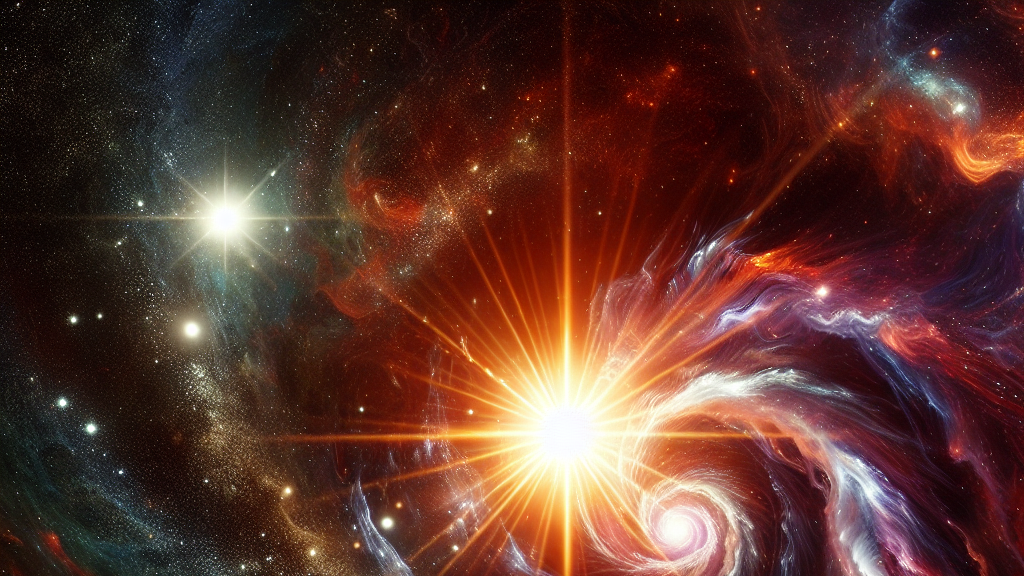
Did you know that space isn’t just an empty void? It’s full of secret patterns and structures that are invisible to the naked eye. Scientists have discovered that these hidden formations can be understood using something called the ‘wavelet power spectrum,’ which helps to decode their mysterious messages. Imagine being able to look at a supernova, a gigantic explosion in space, and understand its hidden patterns like reading a cosmic book.
The recent research focuses on a technique that projects these cosmic structures into simpler forms without losing their complex details. Think of it like taking a messy, crumpled map and stretching it out into a clearer, flat version you can actually read. By doing this, scientists found out that even the wisps of gas left behind by a supernova explosion hold clues about the universe’s secrets, measured in something called ‘fractal dimensions.’ It’s almost like a treasure hunt, where the ‘X’ marks are hidden in complex cosmic codes.
So why should you care? Well, this approach isn’t just about space. It could change how we process complex data in any field. Imagine cybersecurity systems that use the same principles to find hidden data patterns in massive datasets, or environmental studies that decode complex ecosystem dynamics. This scientific breakthrough might just be the key to seeing the unseen in all kinds of big data problems, giving us new eyes with which to see the world!
Fractal dimensions, often above whole numbers, describe how complex patterns extend into space, revealing the intricate nature of structures like supernovas.
FAQs
What is the significance of fractal dimensions in space research?
Fractal dimensions help scientists understand the complex and detailed patterns within cosmic structures, like supernovas, by providing a mathematical way to describe how these patterns repeat at different scales.
How does the wavelet power spectrum technique work with cosmic data?
The wavelet power spectrum reveals the hidden patterns within projected cosmic structures by analyzing their power at different scales. This helps scientists decode data that may seem random or chaotic at first glance.
Can the principle of fractal dimensions be applied outside space research?
Yes, this principle could be revolutionary in other areas, such as data science and cybersecurity, where understanding complex patterns in large datasets can lead to improved analysis and solutions.
Why is finding hidden patterns in supernovae important?
Uncovering hidden patterns in supernovae can give insights into the origins and behaviors of these cosmic events, potentially helping predict similar occurrences and understand the universe’s evolution.
How might this research impact everyday technology?
This approach to decoding structures could enhance our ability to analyze complex systems, leading to advancements in fields like data management, security systems, and environmental studies, benefiting technology and industry.
Background
In the realm of science, mesoscale structures are complex formations that occupy a middle ground between microscopic and macroscopic scales. They can often be explained using something called ‘fractal dimensions,’ which allow scientists to view them as repeating patterns at various scales. A key challenge has been to understand how these structures look when reduced from a high-dimensional space to a lower one, similar to flattening a curved surface into a two-dimensional map. Traditional methods like box-counting or Fourier analyses often fail due to complex aliasing issues. The wavelet power spectrum technique offers a new lens for revealing these structures by focusing on how different parts of the data ‘vibrate’ at various frequencies.
History
Mesoscale structures have long intrigued scientists, especially in fields like physics and astronomy. The study of these structures has evolved from basic theories of chaos and fractals developed in the late 20th century, which first highlighted the complex patterns found in nature. Both box-counting and Fourier methods have historically been used to tackle these problems, although with limited success given their restrictions. The latest research builds on these early advancements by applying a new wavelet-based approach that allows a clearer perspective on data that once appeared too chaotic to decode.
Based on “Using Wavelet Decomposition to Determine the Dimension of Structures from Projected Images” by Svitlana Mayboroda, David N Spergel, available on arXiv (arxiv.org/abs/2503.23202), used under CC BY 4.0 (creativecommons.org/licenses/by/4.0/).