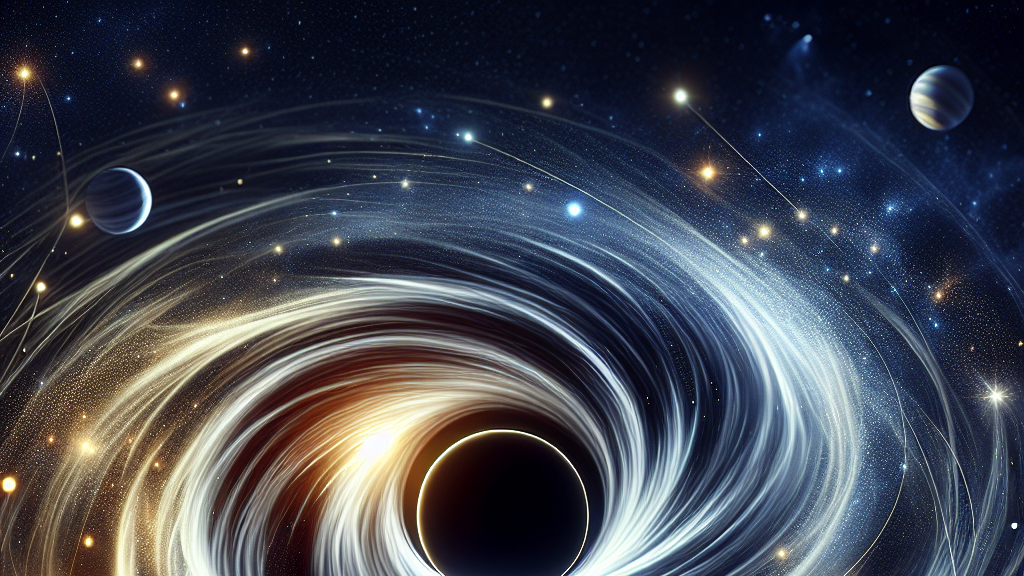
**What if the mysterious dark matter filling our universe is actually made up of black holes?** This striking question challenges our understanding of space and could change everything we know about the cosmos. Recent discoveries have detected tiny black holes, known as primordial black holes, which might make up dark matter—a substance we can’t see but know exists because of its gravitational effects on galaxies and stars. It’s like finding the missing piece of a puzzle that helps us understand the history of our universe better than ever before. The idea that these black holes formed during the universe’s infancy during periods of intense energy is both captivating and revolutionary, giving us a peek into the universe’s grand theater of life and death on a cosmic scale. When scientists discovered that some of our exoplanet sightings might actually be black holes, it painted a picture of a universe filled with invisible, yet massively powerful, objects. As the universe cooled billions of years ago, larger black holes might have formed, some evolving into the supermassive black holes we find today in the centers of galaxies. This topic isn’t just about gazing at stars; it’s about understanding what holds our universe together. Imagine if in the future, we discover that all dark matter isn’t invisible particles, like axions or WIMPs, but rather these primordial black holes. Such a discovery would revolutionize astrophysics and make us rethink the universe’s birth and fate, potentially impacting technologies beyond our wildest imagination. Perhaps one day, we’ll even harness this knowledge in ways unimaginable today, changing society forever.
Did you know that the first black hole was discovered when scientists were looking at a star that seemed to be orbiting… nothing?
FAQs
How could black holes be related to dark matter?
Primordial black holes, formed during the universe’s infancy, could make up dark matter due to their gravitational effects and recent discovery through microlensing techniques.
What makes primordial black holes different from regular black holes?
Primordial black holes are thought to have formed in the early universe, unlike regular black holes, which typically form from the collapse of massive stars.
Could some exoplanets actually be primordial black holes?
Yes, some recent exoplanet detections might actually be primordial black holes, opening a new understanding of unseen cosmic objects.
What is the significance of supermassive black holes found with JWST?
The discovery of supermassive black holes at high redshifts with the James Webb Space Telescope confirms theories about how the universe evolved from high-energy beginnings.
Background
Understanding primordial black holes and dark matter is crucial because dark matter makes up a significant part of our universe, although we can’t see or touch it directly. It was formed early in the universe when conditions allowed high-energy processes to create these tiny black holes, possibly filling the ‘dark’ gap in our cosmic understanding.
History
The journey to understanding dark matter has been filled with theories and discoveries. Initially, scientists believed dark matter was composed of exotic particles. Recently, the discovery of primordial black holes has shifted this paradigm, suggesting these remnants from the universe’s birth could fill the dark matter role.
Based on “Dark Matter Genesis” by Jeremy Mould, available on arXiv (arxiv.org/abs/2504.11595), used under CC BY 4.0 (creativecommons.org/licenses/by/4.0/).