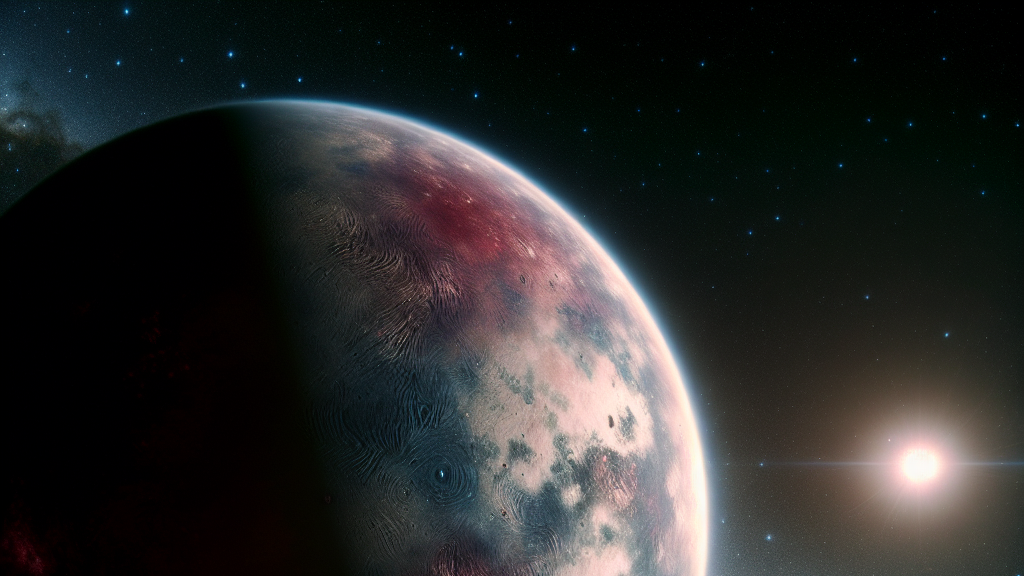
Imagine a planet far, far away, teetering on the edge between being an Earth-like paradise or an inhospitable Venus-like furnace. That’s the mystery of TRAPPIST-1 d, a planet that’s been lurking in the shadows while its sibling, TRAPPIST-1 e, stole the spotlight as a potential home for life. But now, researchers are turning their telescopes and computer models towards TRAPPIST-1 d, trying to decipher what type of world it really is.
The latest study dives into the atmospheric puzzle of TRAPPIST-1 d, using 3D models and oceanic dynamics to simulate how the planet might support life. Could it have a stable atmosphere like Earth, or is it transitioning into a lifeless counterpart like Venus? By testing various scenarios, scientists have found that TRAPPIST-1 d might just squeak into the habitable zone if specific conditions align. It’s like finding that perfect balance between a sunny day and a stormy afternoon, crucial for life as we know it.
This research not only piques our cosmic curiosity but also sharpens the tools we need to distinguish between different types of exoplanets. Imagine in the future, identifying a new Earth based on lessons learned from TRAPPIST-1 d. Finding out whether it’s capable of supporting life could pave the way for humanity’s interstellar adventures, sparking a new era of discovery in the search for life beyond our solar realm.
Did you know that if TRAPPIST-1 d is found to be habitable, it might redefine our understanding of planets outside our solar system?
FAQs
What is the significance of studying TRAPPIST-1 d’s atmosphere?
Studying TRAPPIST-1 d’s atmosphere helps scientists determine whether it is more Earth-like or Venus-like, affecting its potential to support life and guiding future exploration.
How does TRAPPIST-1 d compare to its sibling TRAPPIST-1 e?
TRAPPIST-1 e is more commonly studied and considered to be in the habitable zone, whereas TRAPPIST-1 d is less understood and could resemble either Earth or Venus.
Could TRAPPIST-1 d really be habitable?
If TRAPPIST-1 d retains a stable atmosphere, it may reside within a narrow range called the habitable zone, where conditions could support life.
Why is the potential habitability of TRAPPIST-1 d important?
The potential habitability of TRAPPIST-1 d provides insights into the diversity of planets in other solar systems and the possibility of life beyond Earth.
What methods are researchers using to study TRAPPIST-1 d?
Researchers use 3D atmospheric models and dynamic ocean simulations to explore different conditions and assess whether TRAPPIST-1 d could support life.
Background
TRAPPIST-1 d is a planet orbiting a star around 40 light-years away from Earth, part of a system that has intrigued scientists since its discovery. The key focus is understanding its atmosphere using general circulation models, which simulate the planet’s climate and atmospheric dynamics. These models help predict how the planet might sustain liquid water—a critical ingredient for life.
History
The TRAPPIST-1 system gained fame when a team of scientists discovered multiple Earth-sized planets around a cool dwarf star, each orbiting in a zone where liquid water might exist. TRAPPIST-1 e emerged as a star candidate for habitability, but TRAPPIST-1 d escaped detailed scrutiny until now. This study builds on earlier atmospheric modeling efforts, expanding our understanding of how diverse these distant worlds can be.
Based on “TRAPPIST-1 d: Exo-Venus, Exo-Earth or Exo-Dead?” by M. J. Way, available on arXiv (arxiv.org/abs/2502.00132), used under CC BY 4.0 (creativecommons.org/licenses/by/4.0/).