Connect with us

Search by keyword

Space

Could TRAPPIST-1e Shelter Life?

TRAPPIST-1e, an Earth-like planet in the nearby TRAPPIST-1 system, may support life thanks to its magnetic field. Scientists are exploring how this magnetic shield reacts to space weather, potentially revealing if this distant world could be habitable.

Could TRAPPIST 1e Shelter Life
✨Researched by humans. Explained by robots. Learn more.

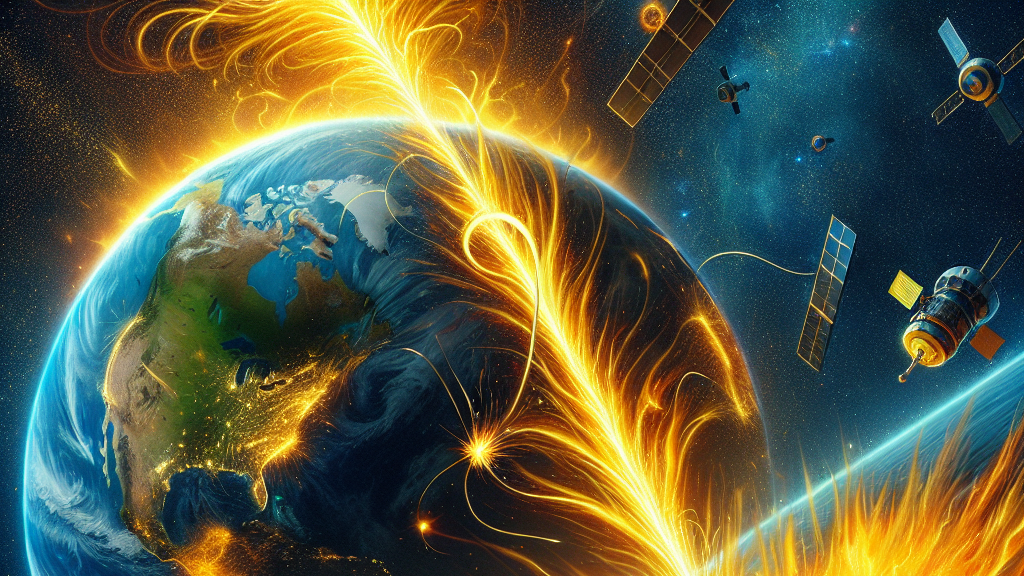
Imagine a distant planet orbiting a tiny star, shielded by an invisible but mighty force—its magnetic field. TRAPPIST-1e, nestled in the habitable zone of its star, might just be the place where life is waiting for us to find it. This planet’s magnetic field is like an umbrella, protecting it from harmful cosmic events that bombard it like showers of sparks.

Scientists have dived deep into understanding how TRAPPIST-1e’s magnetic field behaves under the wild and unpredictable weather of space. They’ve discovered that when this exoplanet is hit by space storms, much like the sun’s powerful ejections, it could glow with mysterious radio emissions. This glow might just be the signature of a safe haven for life, safeguarded by its magnetic defenses.

In the future, researchers might use radio telescopes to listen for TRAPPIST-1e’s whispers across the galaxy, trying to unveil its secrets. If this planet’s magnetic umbrella is strong enough, it could mean that Earth-like worlds are more common—and potentially habitable—than we ever dreamed. Who knows, TRAPPIST-1e might not just be an ordinary exoplanet, but a new frontier for explorers seeking life beyond our blue planet.

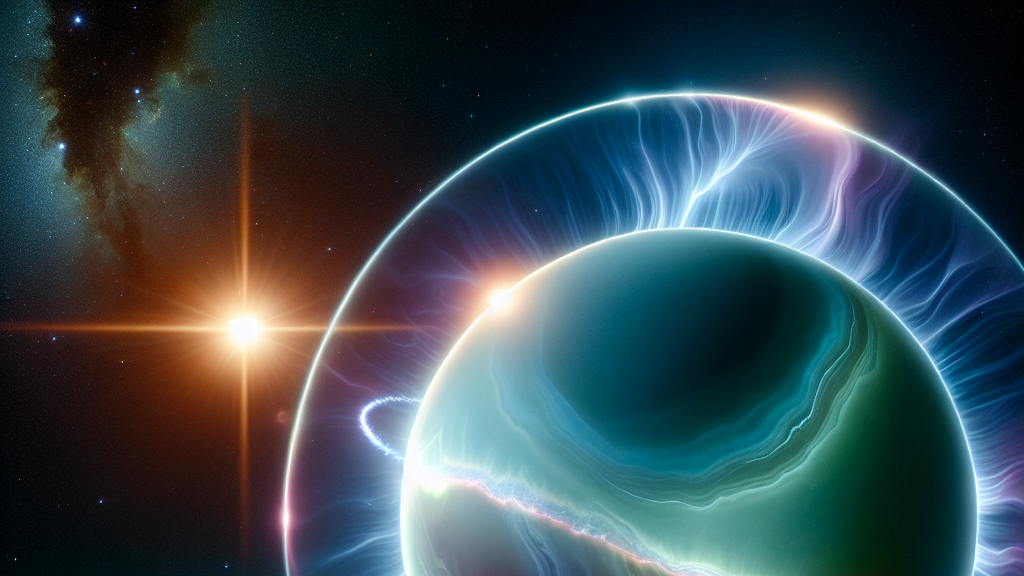
TRAPPIST-1e’s magnetic field behaves like a planet-wide force field, protecting it from dangerous space weather.

FAQs

What makes TRAPPIST-1e’s magnetic field important for its habitability?

TRAPPIST-1e’s magnetic field acts as a protective shield against space weather, similar to Earth’s, potentially making it a safe environment for life.

How does space weather affect TRAPPIST-1e’s potential to support life?

Space weather, like cosmic storms, can influence TRAPPIST-1e’s habitability by affecting its magnetic field’s ability to protect the planet from harmful cosmic rays.

Why are scientists interested in the radio emissions from TRAPPIST-1e?

Radio emissions from TRAPPIST-1e could indicate how its magnetic field responds to space weather, helping scientists assess its potential for life.

How does TRAPPIST-1e’s magnetic field compare to Earth’s?

TRAPPIST-1e’s magnetic field is similar to Earth’s but its response to space weather events can vary due to differences in field strength and axis orientation.

Could TRAPPIST-1e’s magnetic field make it a candidate for human exploration?

If TRAPPIST-1e’s magnetic shield offers significant protection, it might be considered for future explorations—but many unknowns remain about its environment.

Background

Exoplanets like TRAPPIST-1e orbit stars outside our Solar System. Scientists study their potential for life by examining their magnetic fields, which can protect the planet from harmful cosmic events, much like Earth’s magnetic field does. Space weather, including cosmic rays and solar winds, influences these magnetic fields and, as a result, the planet’s potential habitability.

History

Research on exoplanet habitability has evolved from initially discovering planets outside our Solar System to analyzing their environments. The focus has shifted towards understanding how magnetic fields interact with space weather, a concept derived from studying Earth’s own protective magnetic shield. Studies on other stars’ cosmic events have also contributed to understanding how exoplanets like TRAPPIST-1e may respond to similar conditions.

Based on “MHD Simulations Preliminarily Predict The Habitability and Radio Emission of TRAPPIST-1e” by BoRui Wang, ShengYi Ye, J. Varela, XinYi Luo, available on arXiv (arxiv.org/abs/2504.16662), used under CC BY 4.0 (creativecommons.org/licenses/by/4.0/).

Trending

Latest

Can AI Save Water Discover How

Computers

AI is transforming the tech world, but it uses lots of water! A new tool, SCARF, helps us measure and reduce AI's water footprint,...

Whats a Forbush Decrease and Why Should We Care Whats a Forbush Decrease and Why Should We Care

Space

Scientists just observed the biggest solar storm event in years, revealing unexpected cosmic ray patterns. Understanding these changes could help us protect our technology...

Can Cars Spot Danger Faster Than Humans Can Cars Spot Danger Faster Than Humans

Computers

Think about how quickly you react when something unexpected happens on the road. This research brings us closer to creating self-driving cars that can...

Can Fear of the Other Stop Social Harmony Can Fear of the Other Stop Social Harmony

Physics

Fear of the unknown might make it harder for people to agree and get along. This study shows that when people have strong xenophobic...

Can AI Revolutionize Breast Cancer Diagnosis Can AI Revolutionize Breast Cancer Diagnosis

Electricity

This research introduces a groundbreaking AI model that can accurately assess HER2-positive breast cancer using widely accessible staining methods, potentially revolutionizing how we diagnose...

Can AI Transform Your Singing into a Choir Can AI Transform Your Singing into a Choir

Computers

Imagine singing solo and having AI turn you into a choir. This research unveils a groundbreaking AI tool that transforms your voice into rich...

You May Also Like

Space

Discovering planets orbiting two stars is like finding a new chapter in a cosmic fairytale. These findings can change what we think about planet...

Space

Scientists searched for alien radio signals from distant planets, but found none, giving us a peek into the universe's mysteries and possibly sparking more...

Physics

This research reveals how wild changes in space weather can make satellites fall faster to Earth, impacting how our tech works up in space.

Space

Scientists have discovered a new way to check for volcanic activity on planets outside our solar system, opening the door to understanding how these...

Materials

This study reveals that superconductors with holes behave differently in magnetic fields than expected, challenging existing theories and hinting at new ways to harness...

Space

This research unveils how solar storms and space weather can influence satellite orbits, leading to a shorter life for these crucial technologies. It highlights...

Space

This research helps us understand how planets and stars line up in space, which can reveal secrets about the universe's past and future. Knowing...

Space

Imagine worlds so different from Earth yet potentially habitable! This study explores how different alien environments could support life better than Earth, challenging our...

Space

Researchers explore the possibility of habitable moons around distant gas giants, suggesting that these moons could extend the habitable zones beyond what they've traditionally...

Copyright © 2024 8ig8rain.

Disclaimer: The content on 8ig8rain.com consists of AI-generated summaries of scientific abstracts from arXiv. Please note that most arXiv abstracts are preprints and may not have undergone formal peer review. While these summaries aim to convey key ideas and potential applications, they are provided for informational purposes only and should not be interpreted as validated scientific findings or professional advice. The summaries are intended to educate, spark curiosity, and inspire further exploration of science.