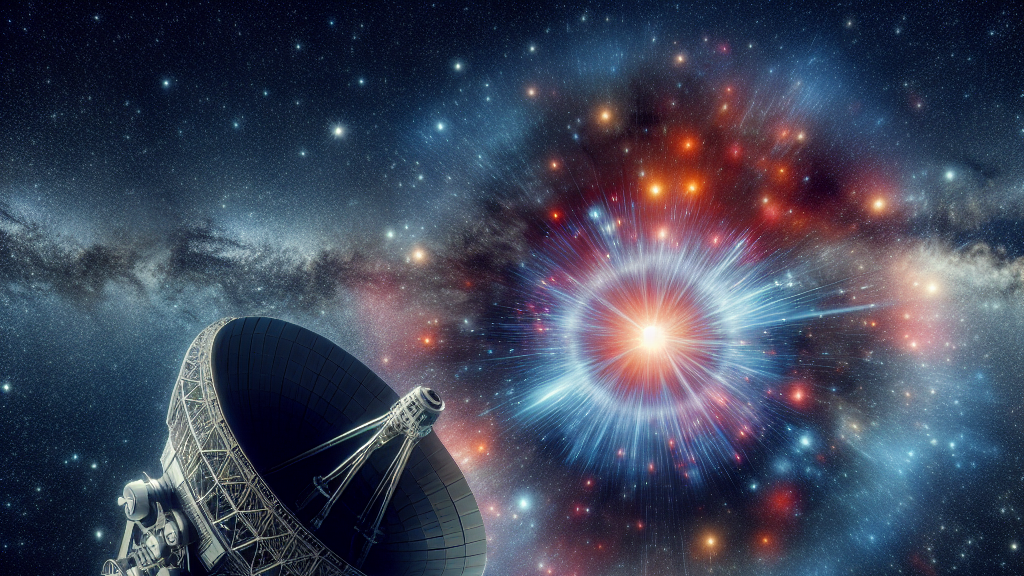
Imagine discovering something in space that no one else has ever seen—it’s like finding a hidden treasure in the vast universe! That’s exactly what just happened with a recent observation of an incredibly high-energy particle by a telescope called KM3NeT. What’s truly mind-blowing is that another well-known telescope, IceCube, which normally picks up these space particles, hasn’t reported anything like this.
The energy level of this particle is astonishing, possibly coming from a neutrino with energy between 23 and 2400 PeV! To put it in perspective, if this neutrino were a wave in the ocean, it would be the biggest wave recorded. Scientists are puzzled because they can’t pinpoint where it came from. It could be from a brand-new source in space or a cosmic origin that we haven’t discovered yet.
So, why should you care? Well, cracking this mystery might change how we understand the universe. It could lead to discovering new cosmic phenomena or even improve how we detect and study these elusive particles. Who knows, one day it might even help us explore the universe in ways we’ve never imagined!
Did you know? Neutrinos are sometimes called ‘ghost particles’ because they hardly interact with anything, making them extremely hard to detect!
FAQs
What is KM3NeT and what did it discover?
KM3NeT is a next-generation underwater telescope used to observe neutrinos, tiny particles that travel through space. It recently detected a very high-energy neutrino, one of the most powerful ever recorded, sparking interest in its mysterious origin.
Why is KM3NeT’s discovery significant compared to IceCube’s findings?
While IceCube has been finding neutrinos for a longer time, it hasn’t detected any with energy levels reaching those recorded by KM3NeT. This raises questions about the source and why it hasn’t been observed by both detectors.
How do scientists determine the energy levels of neutrinos?
Scientists measure the energy levels of neutrinos based on how they interact with particles in detectors like KM3NeT. High-energy interactions light up parts of the detector, allowing scientists to estimate their energy range.
What are the potential sources of such high-energy neutrinos?
Potential sources include cosmic events or unidentified astrophysical objects. They could originate from massive galaxies, black holes, or other exotic cosmic phenomena.
Could this discovery lead to new scientific advancements?
Yes! Exploring the origins of these high-energy neutrinos could deepen our understanding of the universe, lead to new astronomical discoveries, and possibly enhance future technologies related to space exploration.
Background
Neutrinos are incredibly small and elusive particles that travel through space at nearly the speed of light. They are difficult to detect because they rarely interact with other matter. Scientists use large detectors like KM3NeT and IceCube to try and spot the rare interactions between neutrinos and particles on Earth. These interactions can reveal information about cosmic events and the origins of the universe.
History
Neutrino research began in the mid-20th century when scientists first theorized their existence. IceCube, located in Antarctica, has been one of the most prominent detectors for high-energy neutrinos, providing critical data for astrophysics. KM3NeT, a newer facility deep in the Mediterranean Sea, expands our detection capabilities. Both detectors build on past discoveries, aiming to uncover cosmic phenomena by observing neutrinos that pass through them.
Based on “Clash of the Titans: ultra-high energy KM3NeT event versus IceCube data” by Shirley Weishi Li, Pedro Machado, Daniel Naredo-Tuero, Thomas Schwemberger, available on arXiv (arxiv.org/abs/2502.04508), used under CC BY 4.0 (creativecommons.org/licenses/by/4.0/).