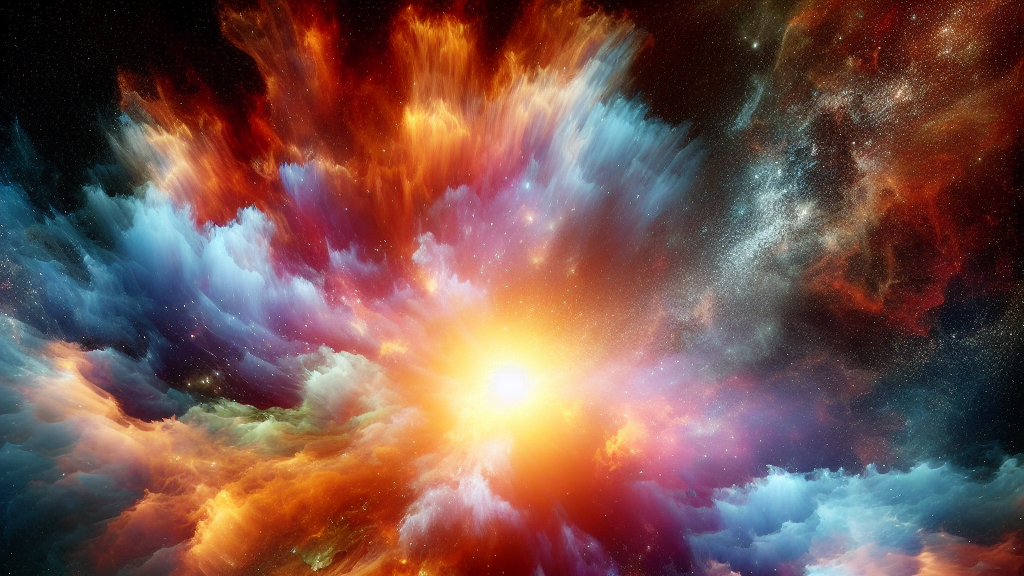
Imagine a cosmic fireworks show where massive stars end their lives in a grand explosion known as a supernova. This event is not just a dramatic spectacle but also a key to understanding how dust grains, which are the building blocks of planets and even life, manage to survive such powerful blasts. Surprisingly, the timing and intensity of the explosion play a huge role in whether these dust particles can endure the chaos and continue their cosmic journey.
In this latest research, scientists used sophisticated 3D models to simulate how dust behaves when these massive stars explode. They found that dust formed from earlier stellar eruptions often faces a tough survival process when bombarded by shock waves from the supernova. Depending on the circumstances, anywhere from 2% to 75% of the dust can endure the explosion. The structure of the surrounding space, like whether it’s shaped like a sphere or more like an hourglass, greatly influences the dust’s survival chances. Plus, if the supernova follows closely after an eruption, the odds of dust survival can surprisingly increase.
Why should we care about cosmic dust survival? Well, these grains eventually come together to form planets, asteroids, and comets—basically the raw ingredients for our solar system. By understanding how much dust survives and how it evolves, scientists gain insights into the early stages of planet formation and the overall cycle of matter in the universe. So next time you see a shooting star, remember it might be part of the dust that survived a supernova millions of years ago.
A single supernova can outshine an entire galaxy for a short period, releasing as much energy as the sun would over its entire lifetime.
FAQs
How do supernova explosions affect dust clouds?
Supernova explosions create powerful shock waves that can destroy dust grains formed around the stars. However, some dust can survive depending on the timing of the explosion and the shape of the surrounding space.
Why is the survival of cosmic dust important?
Surviving dust grains eventually contribute to the formation of planets and other celestial bodies, playing a critical role in the cosmic cycle of matter and the evolution of galaxies.
What role does the shape of the circumstellar medium play in dust survival?
The shape of the surrounding space, such as a spherical or hourglass-like structure, can significantly influence how much of the dust survives the shock waves from a supernova explosion.
How does the timing of a supernova impact dust survival?
If a supernova occurs shortly after a stellar eruption, more dust might survive because the shock waves have less time to completely disperse the dust clouds.
Can cosmic dust grains be part of our solar system?
Yes, cosmic dust that survives supernova explosions can eventually become part of our solar system by forming or contributing to planets, asteroids, and comets.
Background
Massive stars undergo a dramatic end-of-life phase that results in intense eruptions, shedding vast amounts of material including dust. These stars eventually explode as supernovae, generating shock waves that threaten the existence of this dust. Understanding how much dust can survive these events helps us learn about cosmic dust’s role in planet and galaxy formation.
History
For decades, researchers have studied the late stages of massive star evolution, observing their violent eruptions and subsequent supernova explosions. Past studies have established that dust forms during these eruptions, but recent advancements in computer simulations have allowed scientists to model these processes in greater detail, leading to new insights on dust survival through supernova events.
Based on “The bright, dusty aftermath of giant eruptions & H-rich supernovae. Late interaction of supernova shocks & dusty circumstellar shells” by Diana B. Serrano-Hernández (Instituto Nacional de Astrofísica, Óptica y Electrónica), Sergio Martínez-González (Instituto Nacional de Astrofísica, Óptica y Electrónica), Santiago Jiménez (Astronomical Institute of the Czech Academy of Sciences), Sergiy Silich (Instituto Nacional de Astrofísica, Óptica y Electrónica), Richard Wunsch (Astronomical Institute of the Czech Academy of Sciences), available on arXiv (arxiv.org/abs/2502.09700), used under CC BY 4.0 (creativecommons.org/licenses/by/4.0/).