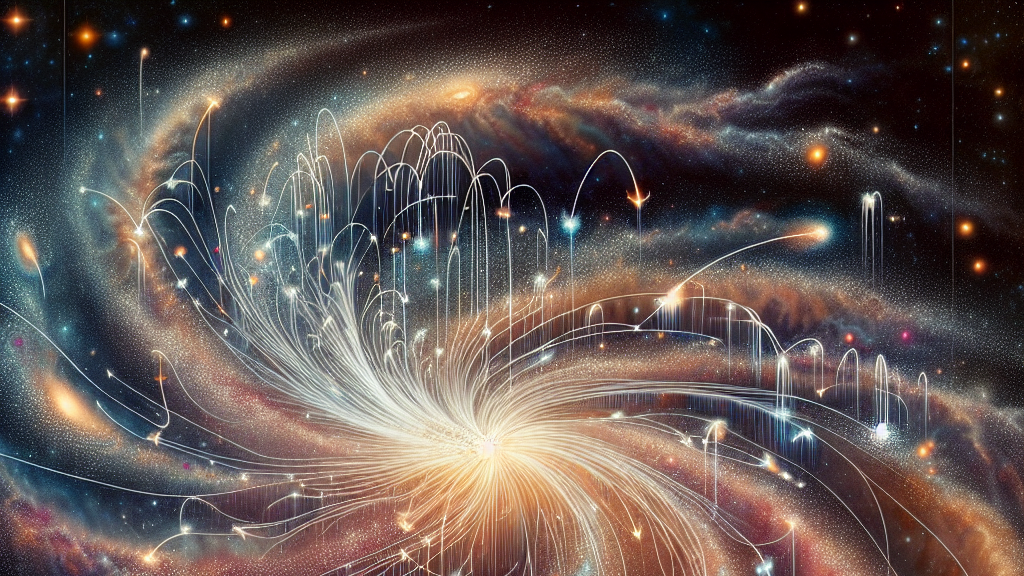
Have you ever looked up at the night sky and wondered how our galaxy stays together? Scientists recently uncovered that smaller galaxies, or satellite systems, often organize themselves into flat, organized planes around larger galaxies like our own Milky Way. These arrangements aren’t just random—they’re influenced by cosmic filaments, which are like the universe’s invisible threads that hold everything together.
In their study, researchers used simulations to recreate these cosmic settings. They found that about 30% to 70% of these satellite systems arrange in flat shapes, much like what astronomers observe in real life. By analyzing their connections with cosmic filaments and gas streams, the researchers discovered that these thin, plane-shaped systems align with these cosmic structures. Some planes lie perpendicular to their closest cosmic filament, aligning with swirling cosmic flows, while others run parallel to these filaments.
Imagine a future where we use this knowledge to predict where new galaxies might form or even how to better locate planets outside our solar system! Perhaps the next big asteroid mining operation will use these cosmic maps to navigate space more efficiently. Understanding the hidden order of the universe could make space exploration more precise and fascinating than ever before.
Did you know the universe’s largest structures, like cosmic filaments, stretch across hundreds of millions of light-years and connect galaxies like a cosmic web?
FAQs
How do dwarf satellite systems organize around galaxies?
Dwarf satellite systems often form organized, flat plane structures around larger galaxies, guided by cosmic filaments, much like how our solar system’s planets revolve around the sun.
What are cosmic filaments and why do they matter?
Cosmic filaments are massive threads of dark matter connecting galaxies across the universe, and they influence the formation of galaxy structures by organizing matter.
How do cosmic structures influence galaxy behaviors?
Cosmic structures like filaments guide the movement and arrangement of galaxy systems, creating organized planes of galaxies and affecting how they evolve over time.
Why are some galaxy systems isotropic rather than planar?
Some galaxy systems become isotropic due to multiple misaligned mergers of cosmic filaments, preventing a single coherent structure from forming.
What implications does this have for future space exploration?
Understanding these cosmic structures can enhance our ability to map the universe and aid in more efficient space exploration and resource utilization.
Background
The universe is filled with structures called cosmic filaments—vast webs of invisible matter connecting galaxies. These filaments influence everything from the formation of galaxies to their movement through space. Understanding them allows scientists to map and predict the universe’s grand design.
History
The idea of cosmic filaments dates back to the 1980s when astronomers first theorized about large-scale structures connecting galaxies. With advanced simulations, researchers now investigate how these filaments influence galaxy formations and satellite arrangements, revealing more about our universe’s hidden order.
Based on “Zippers and Twisters: Planes of Satellite Galaxies Emerge from Whirling and Shocking Gas Streams in the Cosmic Web” by Janvi P. Madhani, Charlotte Welker, Sneha Nair, Daniel Gallego, Lianys Feliciano, Christophe Pichon, Charlotte Olsen, Yohan Dubois, Sugata Kaviraj, Katarina Kraljic, available on arXiv (arxiv.org/abs/2504.18515), used under CC BY 4.0 (creativecommons.org/licenses/by/4.0/).