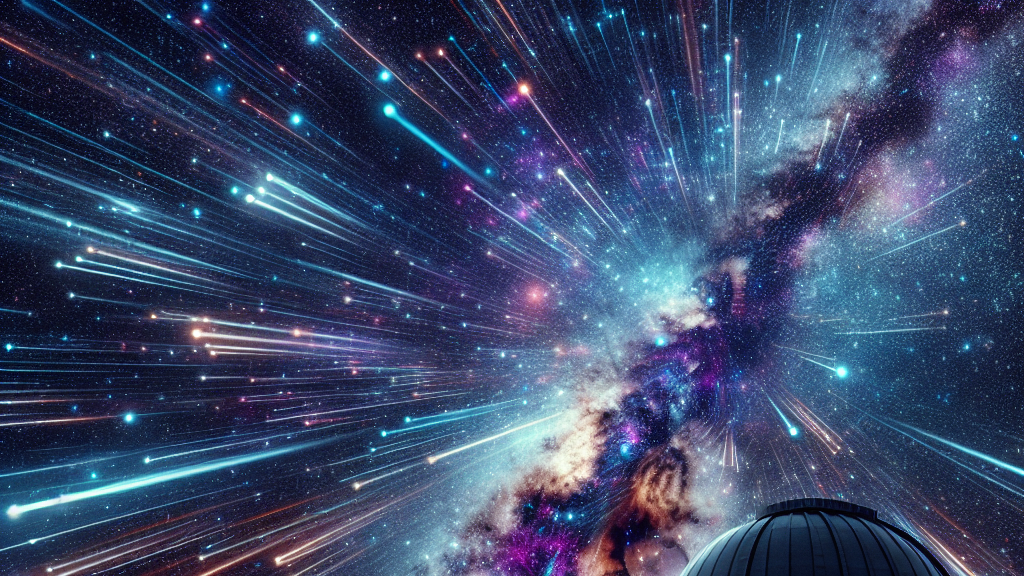
Imagine powerful waves in space that can give particles a ‘supercharge,’ like a turbo boost, launching them at incredible speeds. These cosmic shock waves are found in places like supernova remnants and are nature’s way of accelerating particles without actually colliding with them, which is pretty wild if you think about it. Scientists have been piecing together how these waves work, and it turns out they play a huge role in powering up cosmic rays that zoom across the universe.
By studying satellite data and using the latest theories, scientists have built a more accurate model to explain how these shock waves can consistently speed up electrons to super-fast, or relativistic, speeds. Much like a snowball gathering speed down a hill, electrons get their boost through interactions with different kinds of waves and ever-changing stellar winds found in outer space. This helps us understand not only how these particles gain such high energy but also gives us clues about where these cosmic rays are possibly coming from.
So why does this matter to you? Well, it connects directly to understanding phenomena like solar flares or space weather that can affect Earth’s technology, like satellites and power grids. Imagine having more advanced technologies that can predict these kinds of cosmic energies or new ways to protect our systems from potential damage. Who knew that a better understanding of space shock waves could have such a practical impact here on Earth?
Did you know that the shock waves from a supernova can accelerate particles to nearly the speed of light, making them nature’s fastest movers?
FAQs
What exactly are collisionless shock waves found in space?
Collisionless shock waves are powerful waves in space that can accelerate particles to high speeds without physical collisions, often found in places like supernova remnants.
How do these shock waves accelerate electrons?
Through a combination of transient structures and interactions with waves and varying stellar wind conditions, allowing electrons to gain energy rapidly.
Why is understanding shock waves important for us on Earth?
Studying shock waves can help improve our ability to predict space weather events that may impact Earth’s technology, like satellites and power grids.
What role do shock waves play in the formation of cosmic rays?
Shock waves are believed to be one of the main accelerators that give cosmic rays their high energy, helping us understand their origins and behavior.
Can we replicate such shock wave conditions on Earth?
Yes, scientists can create similar shock wave conditions in laboratories for better study, mimicking those found in space environments.
Background
Shock waves in space, known as collisionless shock waves, are unique because they increase particle energy without physical collisions. They create conditions where electrons can gain enough speed to reach what we call relativistic speeds, close to the speed of light. This is significant in space environments, where such waves are naturally occurring in supernovae, planetary, and stellar settings.
History
Collisionless shock waves have intrigued scientists since discovering cosmic rays over a century ago. Early theories focused on the basic mechanics of shock waves, but it wasn’t until satellite technologies and lab simulations improved that we could understand the full scope. Recent studies have highlighted the multiscale nature of these waves, with advances in plasma physics playing a crucial role.
Based on “Revealing an unexpectedly low electron injection threshold via reinforced shock acceleration” by Savvas Raptis, Ahmad Lalti, Martin Lindberg, Drew L. Turner, Damiano Caprioli, James L. Burch, available on arXiv (arxiv.org/abs/2502.10643), used under CC BY 4.0 (creativecommons.org/licenses/by/4.0/).