Connect with us

Search by keyword

Space

Is Space Really Smooth or Full of Cosmic Foam?

Discover if the universe’s fabric is smooth or a foamy mess, impacting how we spot distant stars and galaxies. This could change our perception of space and time.

Is Space Really Smooth or Full of Cosmic Foam
✨Researched by humans. Explained by robots. Learn more.

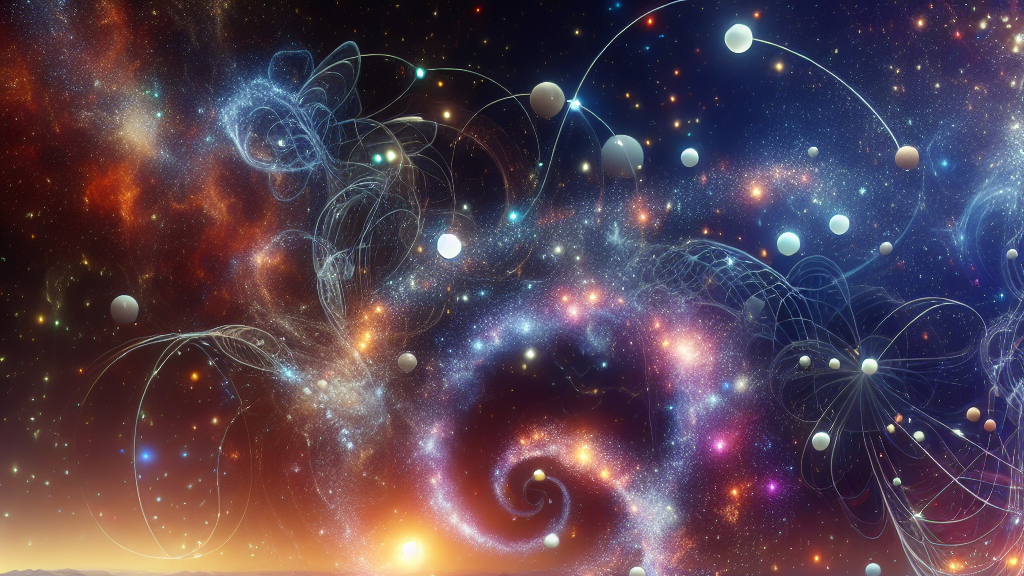
Imagine looking at the stars and galaxies in the sky and wondering if what you’re seeing is blurred not just by your telescope, but by the universe itself. The idea of cosmic ‘foam’ was proposed by a scientist named John Wheeler in the 1950s. It’s like imagining the universe as a bubbly bath, with spacetime being frothy and full of tiny, unpredictable blurs at incredibly small scales, called the Planck scale.

Recently, an extraordinary event, a Gamma-Ray Burst (GRB), was observed, which was super bright and allowed scientists to study it in detail. This particular GRB, named GRB221009A, was so luminous that it could be seen across various spectrums, from infrared to high-energy gamma-rays. Observations of this GRB challenge the idea that spacetime foam can cause images of faraway cosmic objects to be smeared out, like a photograph slightly out of focus.

The study reveals that instead of losing clarity, these cosmic signals maintain their sharpness, suggesting that the universe might not be as ‘foamy’ as previously thought. This discovery is crucial because it means that spacetime might not blur images from distant galaxies and quasars as much as feared, keeping our cosmic observations clearer and more accurate. If this idea holds, it could change how astronomers observe the universe, providing a more precise view of the cosmos, which could one day affect everything from navigation systems to understanding speed limits of the cosmic kind!

Did you know? Gamma-Ray Bursts can release more energy in a few seconds than our sun will in its entire lifetime!

FAQs

What is the concept of spacetime foam?

Spacetime foam suggests that at very small scales, the universe is not smooth but rather bubbly and frothy, leading to potential blurring of light from distant objects.

How do Gamma-Ray Bursts help in studying spacetime foam?

Gamma-Ray Bursts (GRBs) are extremely bright cosmic events that help scientists study spacetime foam by observing if light is blurred as it travels through space.

What was unique about the Gamma-Ray Burst GRB221009A?

GRB221009A was exceptionally bright, allowing for observation across multiple spectrums and testing the effects of spacetime foam on cosmic light.

Why is it important to understand if spacetime is foamy or smooth?

Understanding the nature of spacetime helps refine our cosmic observations and improve accuracy in astronomy, affecting everything from star maps to GPS technology.

How does the concept of spacetime foam affect telescope observations?

If spacetime were foamy, it would cause images from telescopes to blur more than expected, complicating the study of distant galaxies and stars.

Background

Spacetime foam refers to the idea that at very small scales (the Planck scale), the fabric of the universe is not smooth, but is instead full of bubbly, foam-like distortions. This concept suggests that light traveling through space could be blurred by this ‘foamy’ nature, affecting how we observe distant stars and galaxies.

History

The concept of spacetime foam was first introduced by John Wheeler in the 1950s. It has been a topic of debate for decades, especially concerning its effects on electromagnetic waves, which could lead to blurring of cosmic images. Recent observations of Gamma-Ray Bursts have provided new insights into this theory, contributing to our understanding of quantum gravity.

Based on “Observations of Holographic Quantum-Foam Blurring” by Eric Steinbring, available on arXiv (arxiv.org/abs/2502.04474), used under CC BY 4.0 (creativecommons.org/licenses/by/4.0/).

Trending

Latest

Can AI Save Water Discover How

Computers

AI is transforming the tech world, but it uses lots of water! A new tool, SCARF, helps us measure and reduce AI's water footprint,...

Whats a Forbush Decrease and Why Should We Care Whats a Forbush Decrease and Why Should We Care

Space

Scientists just observed the biggest solar storm event in years, revealing unexpected cosmic ray patterns. Understanding these changes could help us protect our technology...

Can Cars Spot Danger Faster Than Humans Can Cars Spot Danger Faster Than Humans

Computers

Think about how quickly you react when something unexpected happens on the road. This research brings us closer to creating self-driving cars that can...

Can Fear of the Other Stop Social Harmony Can Fear of the Other Stop Social Harmony

Physics

Fear of the unknown might make it harder for people to agree and get along. This study shows that when people have strong xenophobic...

Can AI Revolutionize Breast Cancer Diagnosis Can AI Revolutionize Breast Cancer Diagnosis

Electricity

This research introduces a groundbreaking AI model that can accurately assess HER2-positive breast cancer using widely accessible staining methods, potentially revolutionizing how we diagnose...

Can AI Transform Your Singing into a Choir Can AI Transform Your Singing into a Choir

Computers

Imagine singing solo and having AI turn you into a choir. This research unveils a groundbreaking AI tool that transforms your voice into rich...

You May Also Like

General Relativity and Quantum Cosmology

Researchers have uncovered a potential connection between the behavior of black holes and elusive dark matter particles. This exciting discovery may change how we...

Physics

Could tweaking quantum theory solve an age-old mystery? This research explores how adding a nonlinear twist to quantum mechanics might provide clues to the...

General Relativity and Quantum Cosmology

Ever wondered what happens when a star collapses? Some scientists think these tiny, super-dense 'Planck Star Remnants' could hold the key to understanding dark...

General Relativity and Quantum Cosmology

Imagine if gravity could move faster than light and change our understanding of the universe. This research introduces new ideas that could solve cosmic...

General Relativity and Quantum Cosmology

This study introduces a new way to understand gravity, potentially solving mysteries like the Universe's expansion. If true, it could change everything we thought...

Physics

Scientists have used cosmic neutrinos, which travel across the universe, to investigate if mysterious quantum gravity effects can alter the very nature of space-time....

General Relativity and Quantum Cosmology

Scientists are exploring if black holes might transform into something completely different rather than just fading away. This research taps into the mysterious world...

General Relativity and Quantum Cosmology

This research uncovers a surprising quantum boundary on how fast objects can orbit massive celestial bodies, hinting at secrets of the universe's deepest laws!

Computers

Imagine if our best digital locks and keys could be cracked wide open by the wonders of quantum physics! This research dives into the...

Copyright © 2024 8ig8rain.

Disclaimer: The content on 8ig8rain.com consists of AI-generated summaries of scientific abstracts from arXiv. Please note that most arXiv abstracts are preprints and may not have undergone formal peer review. While these summaries aim to convey key ideas and potential applications, they are provided for informational purposes only and should not be interpreted as validated scientific findings or professional advice. The summaries are intended to educate, spark curiosity, and inspire further exploration of science.