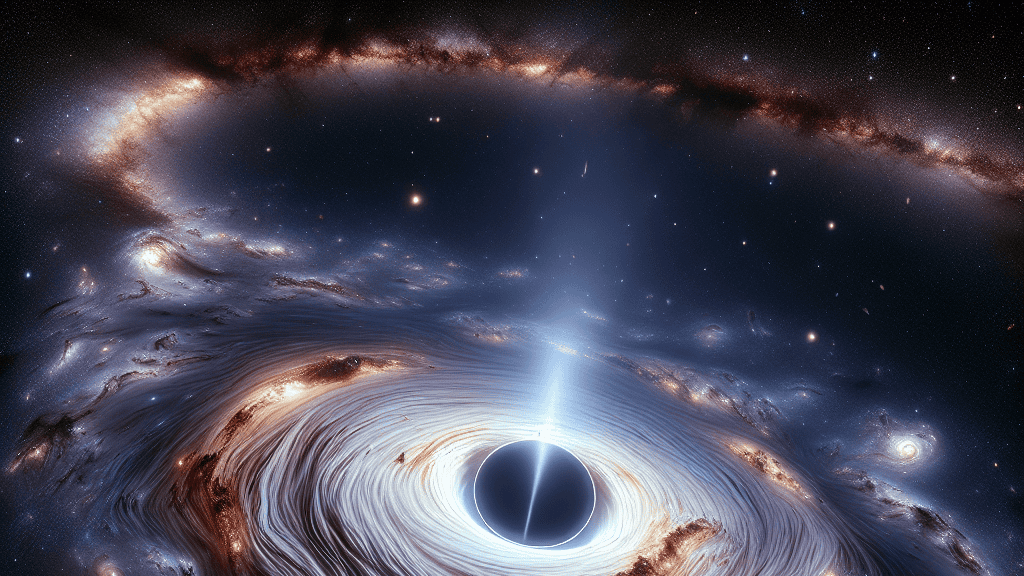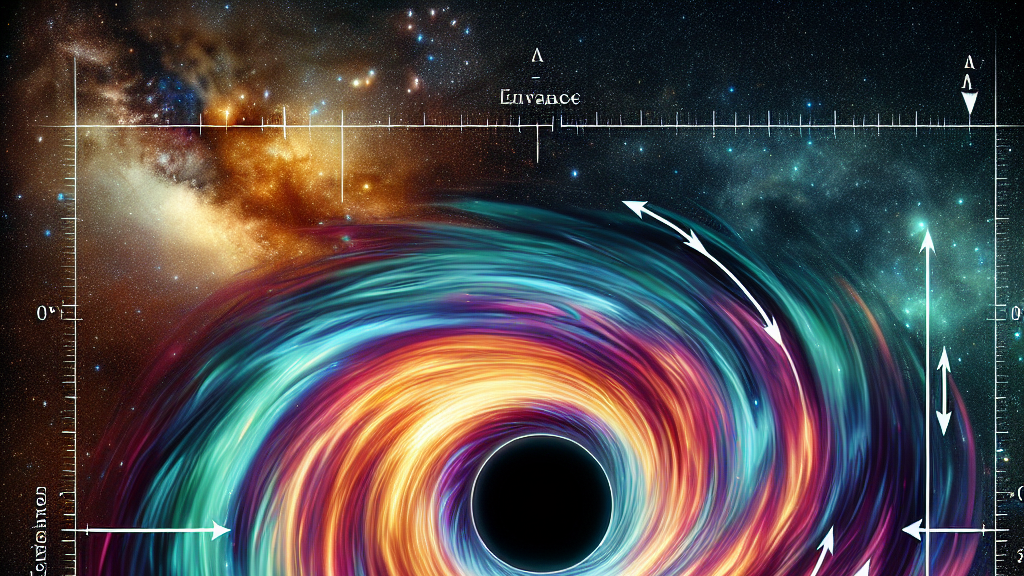
Have you ever wondered just how fast things move around a black hole? Scientists have now calculated the incredible speed of the inner edge of the accretion disk around M87*, one of the most famous black holes, using cutting-edge imaging techniques. It turns out that the spinning material moves at about 0.14 times the speed of light! That’s not all—they also worked out the ‘spin’ of the black hole itself and found it to be quite fast, around 80% of its maximum possible value.
The Event Horizon Telescope, a global network of radio observatories, provided us with the first image of a black hole back in 2019. Now, using this groundbreaking data, researchers have analyzed how material spirals into M87* and the magnetic fields that guide this cosmic whirlpool. These amazing findings suggest that the accreting matter and magnetic fields are tightly linked, and this understanding may help explain how black holes release powerful jets of energy that can travel far into space.
So, why does this matter to you? Well, if black holes can be this powerful and efficient in spinning and ejecting energy, it could change our entire understanding of how galaxies form and evolve. Plus, it feeds our eternal curiosity about what lies beyond the known universe and how these cosmic giants operate. Imagine a future where we harness such energy processes, potentially leading to new technology inspired by the universe’s own forces!
Did you know that the accretion disk around M87* spins at about 14% the speed of light?
FAQs
What is M87* and why is it important?
M87* is a supermassive black hole located in the center of the galaxy M87, about 55 million light-years from Earth. It’s important because it’s the first black hole ever imaged by the Event Horizon Telescope, giving us direct insights into black hole behavior.
How fast does the material around a black hole spin?
In the case of M87*, the material in the accretion disk is calculated to spin at about 14% the speed of light, which is incredibly fast and helps scientists understand the dynamics of black holes.
What is the significance of a black hole’s spin?
The spin of a black hole affects how it interacts with its surroundings, including how it gathers material and emits energy. Understanding a black hole’s spin provides insights into its formation and the forces it can exert on nearby cosmic structures.
How does this research affect our understanding of the universe?
This research helps scientists better understand the physics governing black holes and their influence on surrounding galaxies, which in turn shapes our broader understanding of cosmic evolution.
What are accretion-driven jets?
Accretion-driven jets are streams of particles that are ejected at high speeds from regions around a black hole, powered by the energy from material spiraling inward on the accretion disk. They play a crucial role in transferring energy and matter into space.
Background
Black holes are regions in space where gravity is so strong that nothing, not even light, can escape. Material spiraling into a black hole forms an accretion disk, which glows brightly due to intense gravitational forces. Observing and understanding these disks can reveal much about black hole spin and behavior. A ‘spin parameter’ is used to measure how fast a black hole rotates compared to its maximum possible speed.
History
The study of black holes has evolved significantly over the years, from theoretical predictions to actual imaging. The landmark achievement of capturing the first-ever image of a black hole by the Event Horizon Telescope in 2019 revolutionized our understanding, providing real observational evidence. This study builds upon these observations, helping to unravel the complexities of black hole dynamics, especially the spin and its effects on surrounding matter.
Based on “New estimates of the spin and accretion rate of the black hole M87*” by Michael Drew, Joshua S. Stanway, Brett A. Patterson, Timothy J. Walton, Derek Ward-Thompson, available on arXiv (arxiv.org/abs/2505.17035), used under CC BY 4.0 (creativecommons.org/licenses/by/4.0/).