Connect with us

Search by keyword

Space

What’s Causing Bumps in Supernova Light Shows?

This research sheds light on mysterious bumps in supernova light, offering insights into cosmic events that shape our universe and hinting at a shared origin with other space phenomena.

Whats Causing Bumps in Supernova Light Shows
✨Researched by humans. Explained by robots. Learn more.

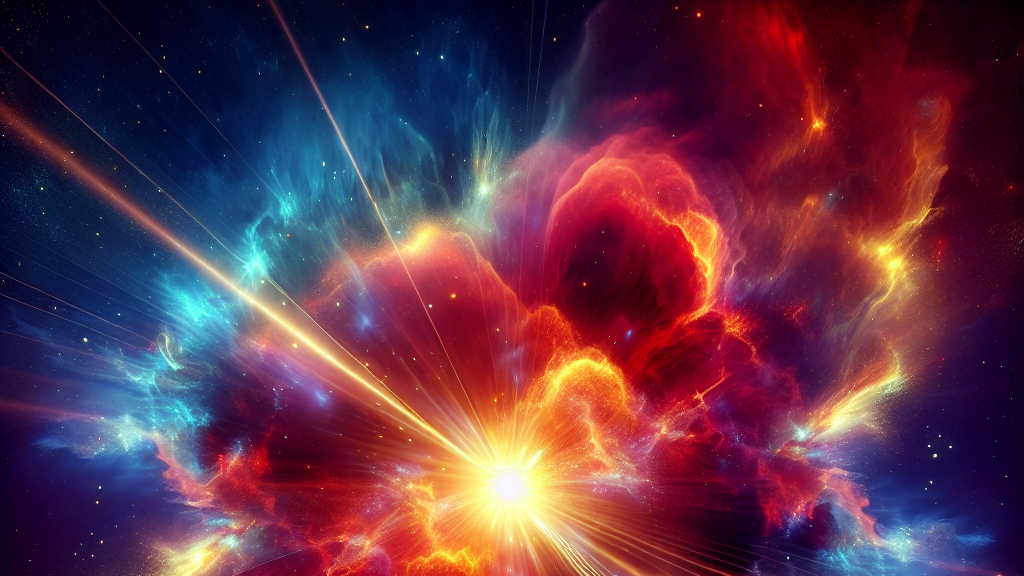
Imagine this: the light from a supernova, an exploding star, isn’t just a bright flash that fades away smoothly. Instead, it has mysterious bumps, like hiccups, after its brightest point. Astrophysicists are intrigued by these surprises in what should have been a predictable cosmic event, raising questions about what’s really happening out there in the universe.

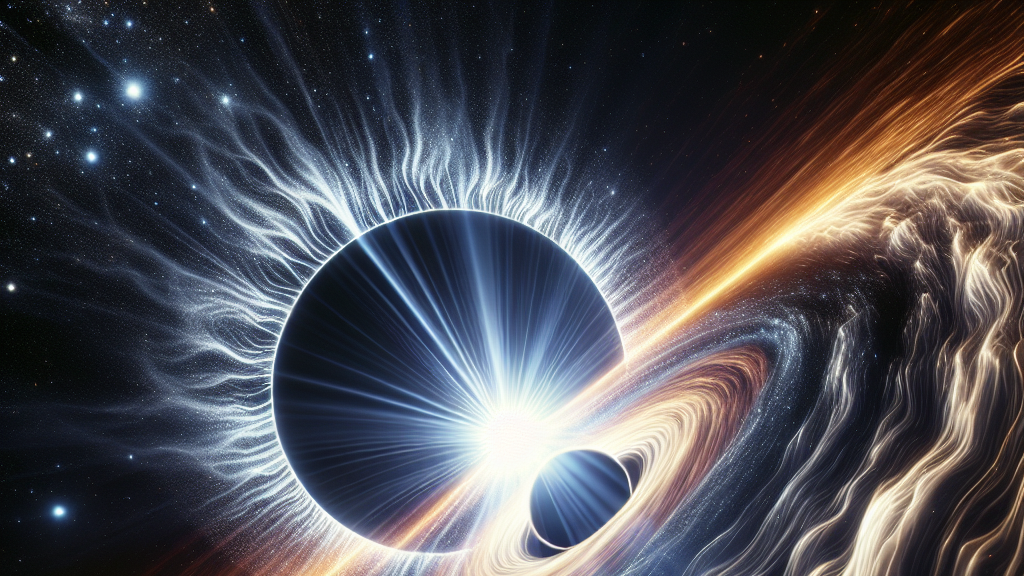
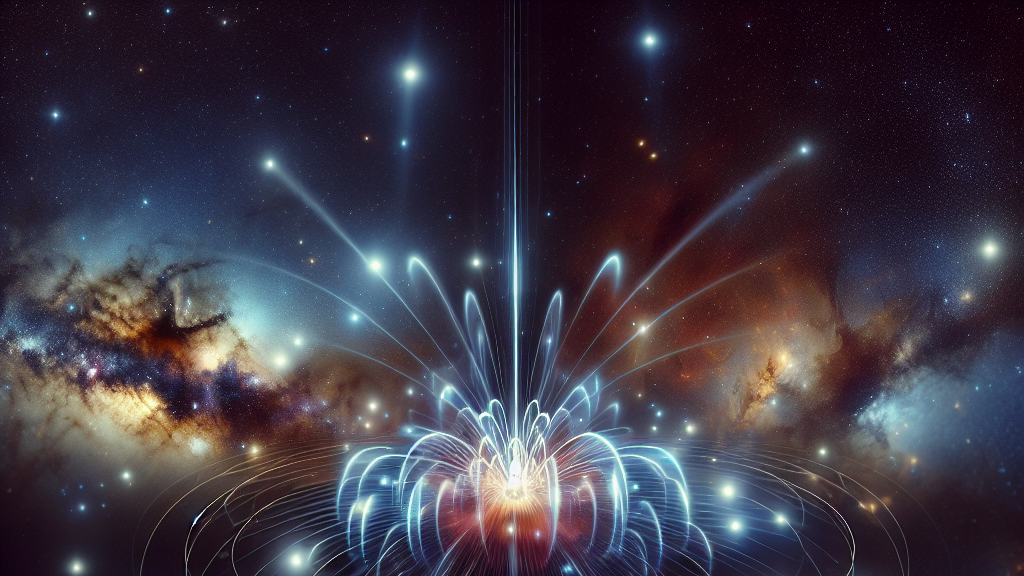
Recent studies have taken a fresh look at these bumps by considering the wobble or precession of magnetars, which are super-dense, magnetic remnants of exploded stars. The research shows that as these magnetars spin and their magnetic fields wobble, they could be causing those odd light bumps in some supernovae. By adjusting models to include this precession, scientists matched their predictions to real-life observations of these curious light patterns.

Imagine a spinning top that’s slightly off-balance, making it wobble as it spins. This research suggests that similar behavior in magnetars might link surprising supernova light curves with other explosive space events. This could help us understand not just these peculiar light patterns, but also offer a glimpse into the life cycles of stars and the cosmic fireworks they leave behind.

Did you know? Some supernovae light curves have ‘bumps’ after their peak brightness, a mystery that might be explained by wobbling magnetars!

FAQs

What are hydrogen-poor superluminous supernovae?

Hydrogen-poor superluminous supernovae are extremely bright star explosions that lack significant hydrogen in their spectra, making them intriguing to astronomers studying extreme celestial events.

How do magnetars affect supernova light curves?

Magnetars, the highly magnetic cores left behind after a star explodes, can affect the light curves of supernovae by causing them to exhibit unexpected bumps due to their magnetic field’s precession.

Why is the precession of magnetars important?

The precession of magnetars is important because it influences their magnetic dipole radiation, which can create unexpected features in the light emitted by supernovae and help explain their complex behavior.

What did this new model reveal about supernova light curves?

This new model, which includes magnetar precession, successfully explains the post-peak bumps in the light curves of some superluminous supernovae, providing a deeper understanding of these cosmic events.

Could magnetars link superluminous supernovae and gamma-ray bursts?

Yes, the research suggests a potential common origin for these phenomena, as both involve magnetars and their dynamic magnetic fields could be influencing both types of cosmic events.

Background

Magnetars are incredibly dense neutron stars with immense magnetic fields, formed after massive stars explode as supernovae. The magnetic field of a magnetar is so strong that it can distort the star itself, causing it to precess or wobble over time. This precession can impact the light emitted by the supernova, leading to variations or ‘bumps’ in the light curve observed from Earth.

History

This research builds on decades of studying supernovae, which are critical in understanding the life cycle of stars. Earlier models primarily considered a stable magnetic field in magnetars, but new observations of unusual light variations in supernovae have prompted scientists to explore the effects of a wobbling magnetic field. By incorporating these dynamics, this study offers a new perspective on how supernovae can behave in previously unforeseen ways.

Based on “Hydrogen-poor Superluminous Supernovae with Bumpy Light Curves Powered by Precessing Magnetars” by Biao Zhang, Long Li, Zi-Gao Dai, Shu-Qing Zhong, available on arXiv (arxiv.org/abs/2504.15684), used under CC BY 4.0 (creativecommons.org/licenses/by/4.0/).

Trending

Latest

Can AI Save Water Discover How

Computers

AI is transforming the tech world, but it uses lots of water! A new tool, SCARF, helps us measure and reduce AI's water footprint,...

Whats a Forbush Decrease and Why Should We Care Whats a Forbush Decrease and Why Should We Care

Space

Scientists just observed the biggest solar storm event in years, revealing unexpected cosmic ray patterns. Understanding these changes could help us protect our technology...

Can Cars Spot Danger Faster Than Humans Can Cars Spot Danger Faster Than Humans

Computers

Think about how quickly you react when something unexpected happens on the road. This research brings us closer to creating self-driving cars that can...

Can Fear of the Other Stop Social Harmony Can Fear of the Other Stop Social Harmony

Physics

Fear of the unknown might make it harder for people to agree and get along. This study shows that when people have strong xenophobic...

Can AI Revolutionize Breast Cancer Diagnosis Can AI Revolutionize Breast Cancer Diagnosis

Electricity

This research introduces a groundbreaking AI model that can accurately assess HER2-positive breast cancer using widely accessible staining methods, potentially revolutionizing how we diagnose...

Can AI Transform Your Singing into a Choir Can AI Transform Your Singing into a Choir

Computers

Imagine singing solo and having AI turn you into a choir. This research unveils a groundbreaking AI tool that transforms your voice into rich...

You May Also Like

Space

Scientists are unraveling the mystery of Fast Radio Bursts, revealing that these mysterious space signals might all come from the same type of cosmic...

Space

Jellyfish galaxies are cosmic wonders where dramatic transformations happen because of their harsh surroundings. This study reveals how their unique 'tails' hint at active,...

Space

This research has unlocked a faster way to explore the universe using gravitational lensing, an astronomical phenomenon that could reveal hidden secrets of quasars...

Space

Our understanding of the universe's uniformity faces a serious challenge, as new findings suggest our cosmos might not be as smooth and even as...

Space

Tiny blue galaxies, like the one studied, may hold clues to the early universe, but there's a puzzling twist: their high-energy emissions hint at...

Space

Imagine if stars could live forever, thanks to dark matter! Upcoming telescopes may reveal a new 'dark main sequence' where stars burn longer with...

Space

Dark matter is not just an invisible force; it might be a cosmic alchemist transforming the chemical makeup of stars. This discovery could change...

Space

Stars near black holes might change dramatically due to cosmic forces, leading to fascinating cosmic events and possibly even new discoveries of faint celestial...

Space

Astronomers discovered a star showing strange behavior before exploding as a supernova, potentially helping us predict these cosmic events better.

Copyright © 2024 8ig8rain.

Disclaimer: The content on 8ig8rain.com consists of AI-generated summaries of scientific abstracts from arXiv. Please note that most arXiv abstracts are preprints and may not have undergone formal peer review. While these summaries aim to convey key ideas and potential applications, they are provided for informational purposes only and should not be interpreted as validated scientific findings or professional advice. The summaries are intended to educate, spark curiosity, and inspire further exploration of science.