Did you know that stars can pair up in an elegant cosmic waltz across the galaxy, and they’re doing it in ways scientists never fully expected? Thanks to the Gaia space telescope, we’ve found over a million star pairs or binaries, mainly located quite far apart from each other and orbiting in elongated paths. These wide, eccentric pairings have been a puzzle for astronomers, who have struggled to explain how so many of them could form through traditional means.
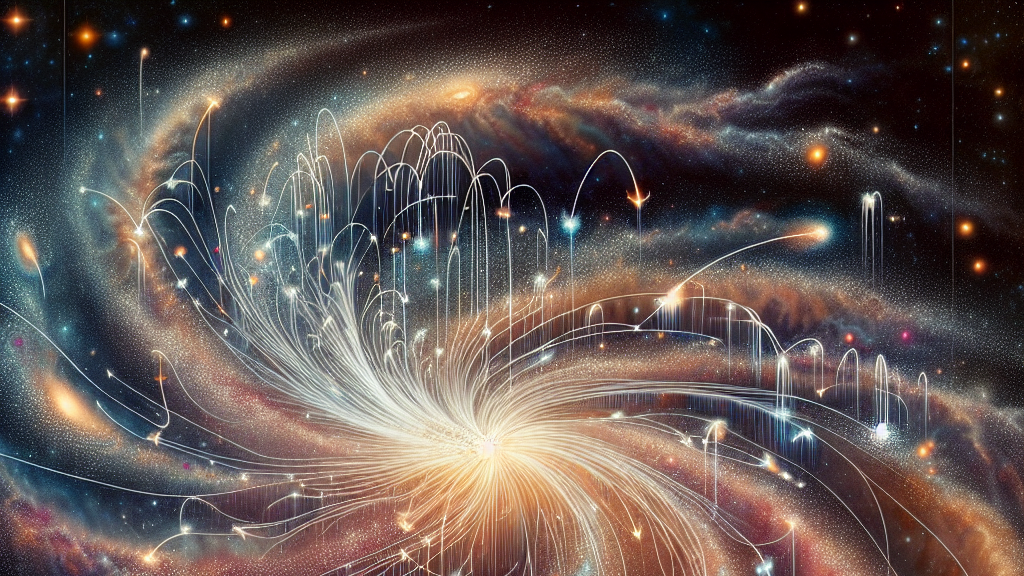
Recent research has shown that these star pairs might not be forming in the way we imagined. Instead, they might form when three stars pass by each other, and through gravitational interactions, two stars end up dancing together while the third moves on solo. This idea is based on a model predicting how such interactions could efficiently produce the wide and eccentric binaries found by Gaia, especially in the crowded environments of star clusters.
So, what does this mean for us? Understanding how these star pairs form can give us insights into the history and evolution of our own galaxy. It might even help us predict how often stars can end up in such cosmic dances. If we can forecast where and when these stellar duos are likely to form, we could one day use this knowledge to understand more about the life cycles of stars, possibly even affecting studies related to planets orbiting these stars.
Star clusters can act like cosmic dance floors where stars meet, pair up, and perform a celestial waltz!
FAQs
How do wide, eccentric binary stars form according to this study?
Wide, eccentric binary stars are proposed to form through the gravitational interactions of three stars. When three stars meet in a cluster, gravitational forces can cause two of them to bind together, forming a new binary pair.
What role does the Gaia mission play in understanding these binary stars?
The Gaia mission has provided extensive data on star positions and motions, revealing over a million binary star candidates. This data has been crucial in identifying these wide and eccentric binaries, which sparked the investigation into their formation.
Why is the discovery of this binary formation method significant?
This discovery challenges traditional views on star pair formation and provides a new perspective on how stars interact in clusters. It enhances our understanding of the dynamics within star clusters and the evolutionary history of our galaxy.
What are star clusters, and why are they important for this study?
Star clusters are groups of stars formed from the same molecular cloud and are tightly bound by gravity. They serve as environments where stars can interact, making them key sites for studying phenomena like three-body binary formation.
How does understanding binary star formation affect our knowledge of the galaxy?
It helps refine models of galactic evolution and the life cycles of stars, offering insights into the formation of other celestial bodies, like planets, and informing overall cosmic history.
Background
Stars often form in clusters, where many stars are born from the same cloud of gas and dust. In such environments, stars can interact closely, which can lead to fascinating gravitational phenomena. Binary stars are pairs that are bound by gravity and orbit around each other. Traditionally, binary formation was thought to be a result of star formation processes occurring in two-star systems. However, this study highlights that when three stars come into proximity, two can become gravitationally bound, creating a binary pair through a mechanism called three-body binary formation.
History
The study of binary stars dates back centuries, but the understanding of their formation has evolved significantly. Initially, it was thought that all binary stars formed from the same material simultaneously. Over time, models suggested different mechanisms, including capture scenarios. The Gaia mission has revolutionized this field by providing precise data on stellar positions and motions, leading to new insights and challenging previous assumptions. The concept of three-body binary formation builds on past ideas but offers a compelling explanation for the many wide, eccentric binaries spotted by Gaia.
Based on “A Million Three-Body Binaries Caught by Gaia” by Dany Atallah, Yonadav Barry Ginat, Newlin C. Weatherford, available on arXiv (arxiv.org/abs/2503.14605), used under CC BY 4.0 (creativecommons.org/licenses/by/4.0/).