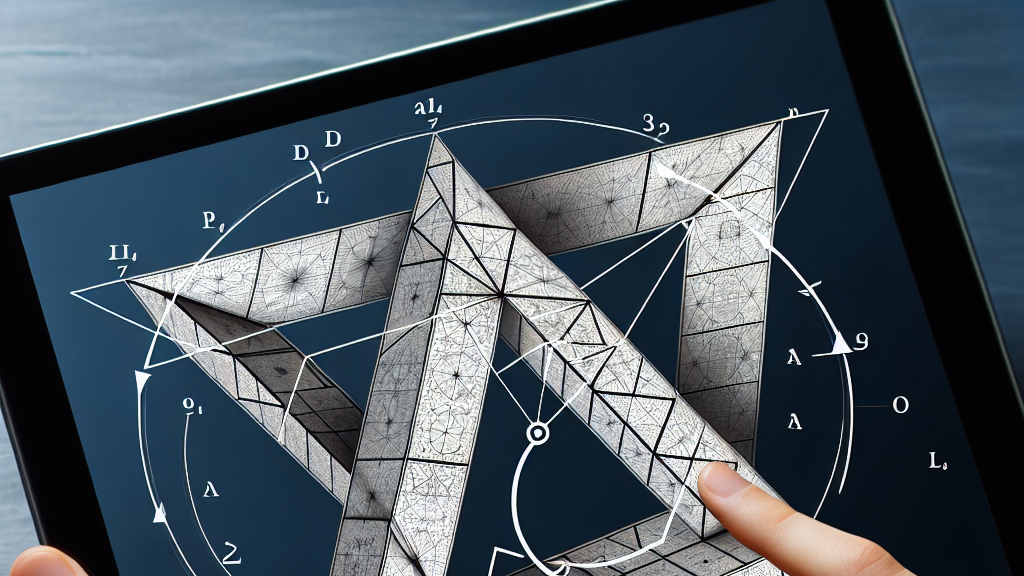
Have you ever looked at a knot and wondered about its hidden secrets? Researchers are doing just that, using intricate 3D shapes called complexified tetrahedrons to explore the mysterious world of double twist knots. This isn’t just about tying a rope, but about unlocking deep geometric principles that have puzzled mathematicians for years.
At the heart of this research is the volume conjecture, a bold idea that connects the geometry of knots to the mathematics of shapes in space. By using complex shapes with edges and angles that extend into the realms of complex numbers, scientists are piecing together how these elements interact in fascinating ways. The complexified tetrahedron acts as a supercharged version of a 3D shape, offering a new lens through which to view and understand knot theory.
So, why should you care? Well, this research could pave the way for breakthroughs in areas like 3D modeling, where understanding the geometry of space is crucial. Imagine architects using these principles to design more efficient structures or creating more realistic virtual environments. The possibilities are as limitless as the knots themselves.
The colored Jones polynomial is a mathematical tool that helps unravel the complex properties of knots, using principles from quantum mechanics!
FAQs
What unexpected discovery did scientists make?
Scientists discovered that complexified tetrahedrons can help prove concepts in knot theory, providing new insights into geometric shapes.
How does this research affect our daily lives?
This research enhances our understanding of geometry, which could lead to innovations in fields like architecture and 3D computer graphics.
What is a complexified tetrahedron?
It’s a 3D shape where edge lengths and angles are extended into complex numbers, offering a new perspective on spatial relationships.
How is knot theory connected to geometry?
Knot theory explores the properties of tangled shapes, and geometry helps explain how these shapes exist and interact in space.
What is the volume conjecture?
It’s a theory suggesting a deep connection between the geometry of knots and mathematical expressions about their structure.
Background
Knot theory is a branch of mathematics that studies the ways in which loops can be tied in space, and the volume conjecture is a hypothesis that suggests a specific relationship between knot theory and 3D geometry. The complexified tetrahedron is a mathematical model that represents a tetrahedron (a pyramid with a triangular base) with complex numbers used for its measurements, allowing for a more profound exploration of geometric properties.
History
Knot theory has been a subject of fascination since the 19th century when mathematicians first began to formally classify different types of knots. The volume conjecture emerged in the latter half of the 20th century as mathematicians looked to connect knot theory with three-dimensional shapes. This new research builds on these earlier advancements by using complex numbers to deepen our understanding of the geometric properties of knots.
Based on “Complexified tetrahedrons, fundamental groups, and volume conjecture for double twist knots” by Jun Murakami, available on arXiv (arxiv.org/abs/2501.00225), used under CC BY 4.0 (creativecommons.org/licenses/by/4.0/).