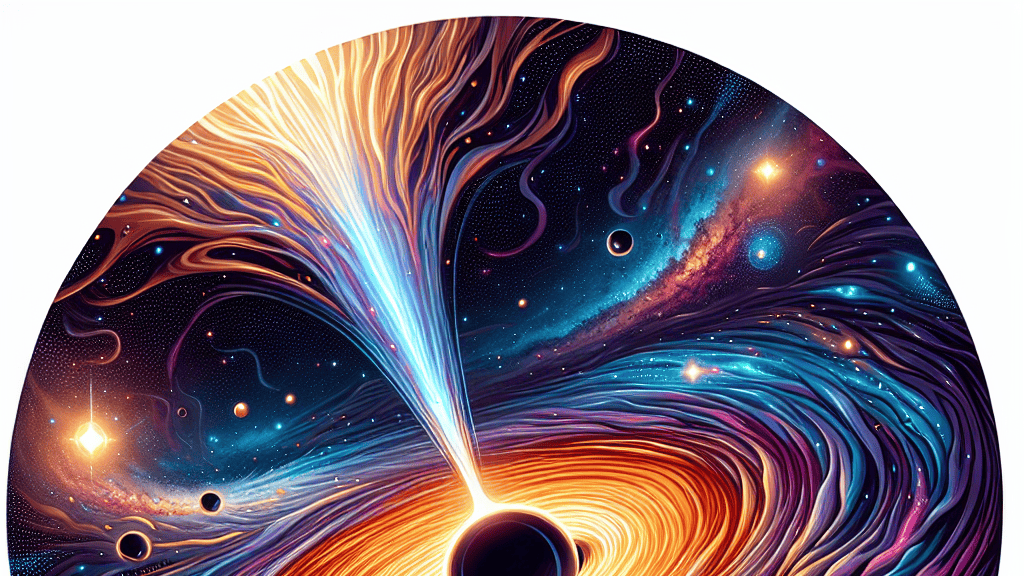
Imagine a cosmic dance so powerful it sends ripples through space, detectable from millions of miles away. This mind-boggling scenario involves tiny black holes spiraling into enormous ones at the heart of galaxies, creating what scientists call ‘wet extreme mass-ratio inspirals.’ As they do this, they generate gravitational waves, which are like invisible water ripples in the fabric of space itself! These waves are so unique that they can tell us a lot about the black holes, like their size and the speed at which they spin. It’s like having a cosmic telescope peering into the most secretive corners of the universe.
What’s even more fascinating is that these interactions happen in super active areas known as Active Galactic Nuclei, which are basically galactic centers filled with intense activity and gas. Unlike their ‘dry’ counterparts that just quietly spiral in through gravitational attractions, these ‘wet’ inspirals get all wet and wild, interacting with accretion disks of matter, like a star’s leftovers being sucked in. As they dance and spiral, they create electromagnetic signals, flashes of light that scientists can spot through telescopes. This dual dance of lights and waves gives scientists deeper insights into how black holes form, evolve, and sometimes even launch cosmic jets.
Think about this: the very nature of these black hole pairs could provide clues to the speed at which our universe is expanding. By measuring these gravitational waves, scientists can predict the Hubble parameter—the cosmic speed limit, so to speak—more accurately. This means we get a better idea of how fast galaxies are moving away from each other. So, the next time you gaze up at a starry sky, just imagine the hidden dances of invisible forces shaping wondrous discoveries of the cosmos, with potential implications reaching back to Earth in ways we can’t yet imagine!
Did you know that gravitational waves, those ripples in space-time, travel at the speed of light and were first predicted by Einstein back in 1916?
FAQs
What unexpected discovery did scientists make about black holes?
Scientists discovered that black holes can create detectable ripples in space-time, known as gravitational waves, as they spiral into supermassive black holes.
How do these cosmic dances affect us on Earth?
These events help scientists measure the universe’s expansion rate more accurately, which could refine our understanding of cosmology and affect future technologies and theories.
Why are these interactions called ‘wet’ inspirals?
They are called ‘wet’ because they occur in active, gas-rich environments where additional interactions with matter (like accretion disks) create electromagnetic signals alongside the gravitational waves.
How do these waves help us understand the cosmos better?
Gravitational waves provide precise data on black hole mass and spin, aiding in the calibration of traditional electromagnetic techniques and offering new insight into black hole environments and dynamics.
What role do these black hole pairs play in cosmology?
They act as cosmic markers to measure the Hubble parameter, key to understanding how fast the universe is expanding.
Background
The universe is full of black holes, some that are small like our Sun, and others that dwarf whole galaxies. When a tiny black hole, like a stellar-mass one, starts spiraling into a gigantic supermassive black hole, the dance is called an ‘extreme mass-ratio inspiral.’ These inspirals are like space’s version of a record player needle dragging across a vinyl groove, creating waves known as gravitational waves. These waves are important because they carry information about the black holes and the fabric of space-time, helping scientists understand the universe in new and exciting ways.
History
For over a century, since the days of Einstein, scientists have predicted the existence of gravitational waves. However, it wasn’t until advanced observatories like LIGO detected them that we could hear the ‘sounds’ of space. As technology improved, researchers began exploring different types of inspirals, including ‘dry’ ones that happen due to gravitational forces alone, and now ‘wet’ ones that occur in gas-rich environments. This study builds on this foundational work, using new space-borne detectors to track these cosmic events more precisely than ever before.
Based on “Science Opportunities of Wet Extreme Mass-Ratio Inspirals” by Zhenwei Lyu, Zhen Pan, Junjie Mao, Ning Jiang, Huan Yang, available on arXiv (arxiv.org/abs/2501.03252), used under CC BY 4.0 (creativecommons.org/licenses/by/4.0/).