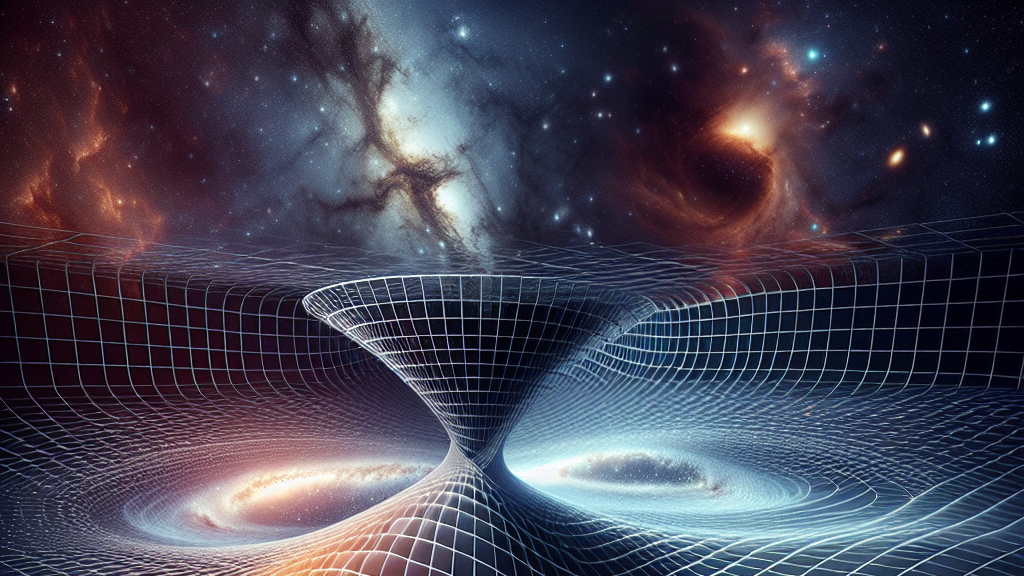
Imagine you’re in a world where two different observers look at the same shape and argue whether it’s smooth or not. That’s not just a whimsical idea—it’s a deep mathematical reality! This research reveals that different ways of understanding shapes—something called differential structures—might actually alter the laws of physics themselves.
At the heart of this study is the puzzling 7-sphere, a kind of shape that exists in seven dimensions. Discovered by a mathematician named Milnor, this shape can be viewed in 28 different smooth ways. Although the underlying surface remains the same, the rules of physics, like those governing fields described by the Dirac equation, could vary depending on which version of the smooth surface you’re using.
Why does this matter to us? Well, it hints at a whole new way of thinking about the universe. Imagine if where you live, rules of nature could depend on how we decide to label the smoothness of space. In the future, this could change how we understand everything from particle physics to big cosmological events, potentially leading to new technologies or insights into the universe’s mysteries!
Did you know? The 7-sphere is one of the first known examples of a shape that can be understood in 28 different ways!
FAQs
What is the 7-sphere in the study of differential structures?
The 7-sphere is a complex mathematical shape that exists in seven dimensions, first identified by mathematician John Milnor. It can have 28 different differential structures, meaning there are 28 ways to label what’s considered smooth on it, influencing physical laws.
How do differential structures affect physical laws on the 7-sphere?
Different differential structures can change how fields, such as those governed by the Dirac equation, behave on the 7-sphere. So, even though the shape remains the same, the physical laws might differ depending on how we perceive its smoothness.
Why does this research about differential structures matter in physics?
This research opens up new possibilities for understanding space and how physical laws operate. It suggests that our perception of space’s smoothness could impact our understanding of physics, potentially leading to groundbreaking theories or technologies.
Can the idea of differential structures be applied to other shapes or spaces?
While this study focuses on the 7-sphere, the concept of differential structures can apply to other mathematical manifolds. It challenges us to consider how different perceptions could transform our understanding of the universe.
Who is John Milnor and what did he discover about the 7-sphere?
John Milnor is a renowned mathematician who discovered that the 7-sphere can possess 28 different differential structures. This was the first discovery of its kind, revealing the possibility of multiple smooth perspectives on a single shape.
Background
In mathematics and physics, a manifold is a space that locally resembles Euclidean space. It can have different kinds of structures, like being ‘smooth,’ which means functions on it can be differentiated. However, some manifolds can have multiple, inequivalent smooth structures, which means what one person might consider a smooth function, another might not. The 7-sphere is a classic example of such a manifold, known to have 28 different differential structures.
History
The concept of differential structures in topology has a long history, starting with the discovery of exotic spheres by John Milnor in the 1950s. Milnor’s work revolutionized how mathematicians and physicists understand manifolds, showing that a single topological entity can host multiple differential structures. This particular study builds on that foundation, exploring the consequences of these structures on physical laws governing fields like the Dirac equation.
Based on “Physics on manifolds with exotic differential structures” by Ulrich Chiapi-Ngamako, M. B. Paranjape, available on arXiv (arxiv.org/abs/2501.13328), used under CC BY 4.0 (creativecommons.org/licenses/by/4.0/).